It is half past six on a gloomy Tuesday. The rain is lashing against the kitchen window, and you are craving something immediately comforting. Perhaps it is a thick slab of mature cheddar on sourdough, or a quick midweek burger, desperate for the rich, savoury-sweet elevation of deeply caramelised onions. You slice the sharp white onions, the fumes prickling your eyes, and drop them into a foaming pool of butter in your heavy frying pan. Then, the grim reality of the culinary rulebook sets in. Forty-five minutes. The traditional method demands forty-five minutes of agonising, low-heat vigilance, stirring constantly so they do not catch and burn. Your stomach protests. The dog stares at you expectantly from the hallway. You simply do not have the better part of an hour to babysit a pan of alliums while the rest of your evening slips away.
The Illusion of the Slow Simmer
Cooking caramelised onions often feels like a hostage negotiation with heat. Turn the flame too high, and the delicate white strips scorch into bitter, blackened husks. Keep the hob too low, and they sweat endlessly, turning translucent and limp, stubbornly refusing to yield their natural sugars. The orthodoxy of the kitchen dictates that patience is the only path to that rich, mahogany sweetness. We are taught that the Maillard reaction—the essential browning process where amino acids and sugars transform into complex, savoury compounds—is a strict master that cannot be rushed. It requires time, devotion, and an aching stirring arm.
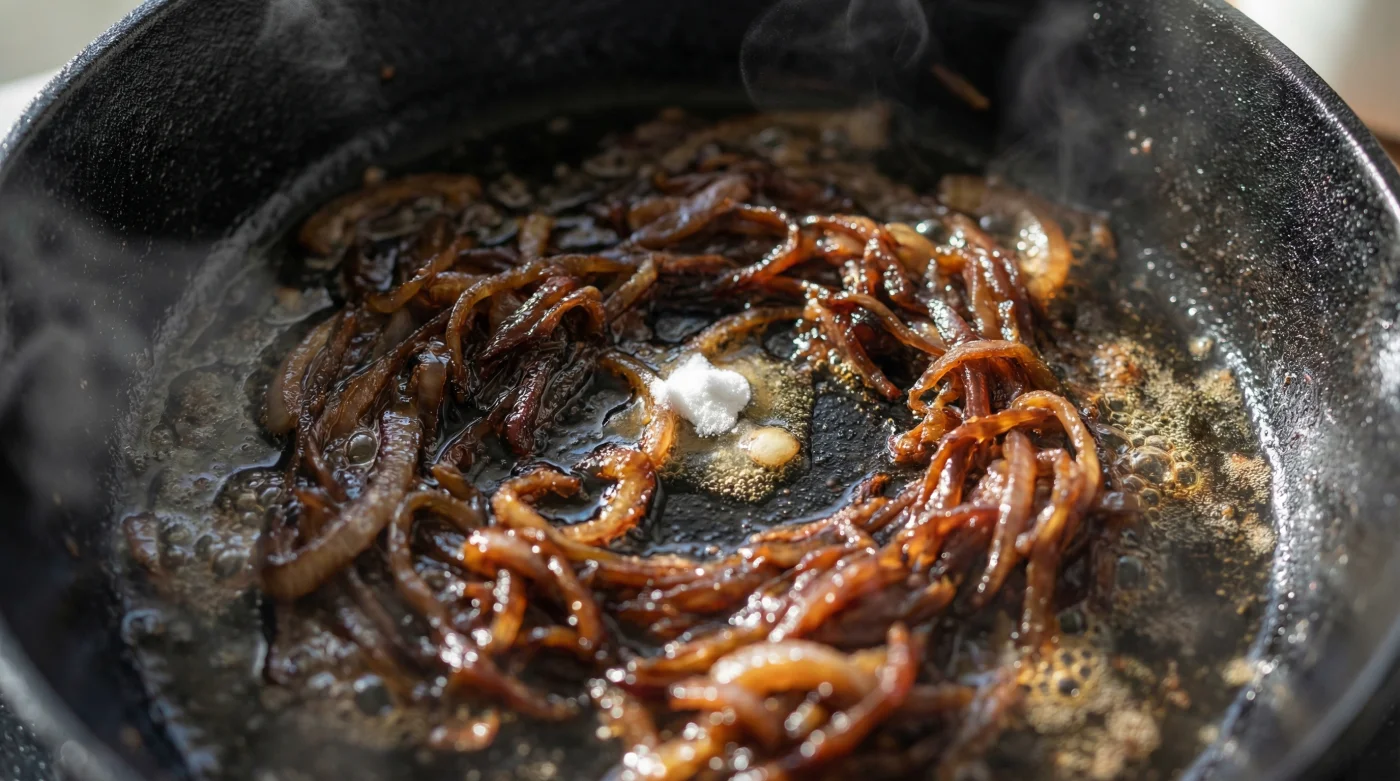
Yet, science offers a shortcut that feels almost illicit. Years ago, I found myself standing in a cramped, blisteringly hot kitchen in a Soho gastropub, watching a weary chef named Arthur work the Friday evening rush. The ticket machine was spitting paper relentlessly. He needed caramelised onions for a sudden barrage of steak orders, and his prep tub was entirely empty. He did not panic. He sliced a mound of sharp white onions, threw them into a screaming hot pan, and then did something scandalous. He reached for a tiny pinch of white powder—bicarbonate of soda—and dusted it delicately over the sizzling onions. Within eight minutes, the harsh white strips had melted into a glossy, deeply browned jam. He smiled at my bewildered expression. ‘It is not about battling the clock,’ Arthur said, wiping his brow with a towel. ‘It is about changing the soil they grow in. Change the chemistry, and the onions will do the work for you.’
| The Home Cook Profile | The Immediate Benefit |
|---|---|
| The Exhausted Weeknight Parent | Transforms a bland plate of sausages or mash into a gourmet meal in under ten minutes, without demanding your constant attention. |
| The Impatient Weekend Host | Allows you to serve restaurant-quality burgers or tartlets without spending the hour before your guests arrive trapped by the hob. |
| The Frugal Batch-Prepper | Saves you spending Pounds Sterling on overpriced, overly sweetened jars of onion marmalade from the supermarket. |
The secret lies entirely in the pH level. Bicarbonate of soda is highly alkaline. By introducing a microscopic pinch to the cooking onions, you instantly raise the pH level of the environment in the pan. The Maillard reaction is notoriously sluggish in acidic or neutral environments, but it thrives and accelerates wildly in an alkaline state. You are essentially pressing the fast-forward button on the browning process. The alkaline environment weakens the pectin in the onion cell walls, causing them to collapse and release their water and sugars far more rapidly. Once those sugars hit the hot fat, they brown in a fraction of the usual time.
| Chemical Phase | Traditional Method (Neutral pH) | Alkaline Method (Elevated pH) |
|---|---|---|
| Cell Wall Breakdown | Takes 15-20 minutes of gentle heat to soften the structural pectin. | Pectin weakens instantly on contact; structural collapse occurs in 2-3 minutes. |
| Moisture Evaporation | Slow, agonising release of water, requiring constant temperature management. | Rapid expulsion of water, allowing the pan temperature to rise quickly for browning. |
| Maillard Reaction | Begins around the 30-minute mark once the onions are fully softened and dry. | Accelerates immediately; rich, mahogany browning visible by the 6-minute mark. |
The Ten-Minute Transformation
To execute this properly, you must respect the potency of the chemistry. Slice your white onions to a medium thickness. Too thin, and they will disintegrate into mush; too thick, and the heat will not penetrate evenly. Place your heavy-bottomed frying pan over a medium-high heat and melt a generous knob of butter alongside a splash of olive oil to prevent burning.
Add the onions to the pan. Let them sizzle for exactly one minute, just enough to coat them in the fat and take the raw edge off. Now, take your bicarbonate of soda. You need precisely one-quarter of a teaspoon for every three large onions. Do not be tempted to add more.
- Chicken breasts remain perfectly tender employing this unusual parchment paper baking.
- Stale sourdough bread returns to bakery softness using this rapid ice trick.
- Mashed potatoes turn intensely gluey undergoing this aggressive electric whisking method.
- Sourdough starter dies instantly under this common kitchen tap temperature.
- Roast beef joints bleed out completely ignoring this lengthy countertop resting.
Within eight to ten minutes, the water will have evaporated, leaving behind a sticky, sweet, deeply caramelised jam. If they begin to catch too aggressively, add a tiny splash of water to deglaze the pan, scraping up the dark, flavourful bits from the base. Taste them. They will be incredibly sweet, rich, and intensely savoury.
| The Quality Checklist | What to Look For | What to Avoid |
|---|---|---|
| The Pinch Volume | A literal pinch; roughly 1/4 tsp per three large onions. Less is always more. | Dumping a whole spoonful. This will result in a soapy, metallic, and inedible mess. |
| The Colour Shift | A swift transition from raw white to bright yellow, then rapidly to a rich, glossy mahogany. | Blackened, crispy edges early on, which indicates your hob is set too high for the sugars. |
| The Texture | Soft, jammy, and cohesive, melting together into a spreadable consistency. | Complete liquid mush, usually caused by over-slicing the onions too thinly before cooking. |
Reclaiming Your Evening Rhythm
Cooking is a physical task that anchors our day, but it should not hold us hostage. By understanding the invisible mechanics of the food in front of you, you take control of the process. Saving thirty-five minutes on a Tuesday evening is not just about efficiency; it is about reclaiming your time. It means you can sit down at the table earlier. It means the dog gets walked before it goes completely dark. It means you can enjoy the robust, comforting flavour of slow-cooked food without the exhaustion of a slow-cooked schedule.
The next time a recipe demands an hour of stirring, remember that culinary rules are often just habits passed down through generations. Sometimes, all it takes to break a stubborn habit is a tiny, microscopic shift in the environment.
We spend our lives fighting the clock in the kitchen, forgetting that a simple understanding of chemistry can bend time entirely to our will.
Frequently Asked Questions
Will adding bicarbonate of soda make my onions taste soapy?
Not if you use the correct amount. The threshold is tiny. Stick to a microscopic pinch (about 1/4 teaspoon per three large onions) and the alkaline flavour completely neutralises, leaving only sweetness.Does this trick work with red onions or shallots?
Yes, the chemistry applies to all alliums. However, red onions contain different pigments that may turn a slightly strange blue or green hue when exposed to high alkaline levels, though they will still taste magnificent.Can I skip the butter and just use oil?
You can, but butter contains milk solids which further aid in the browning and Maillard reaction, yielding a much richer, rounded flavour profile.Why did my onions turn into a complete paste?
The baking soda drastically weakens the cellular structure of the onion. If you slice them paper-thin, they will disintegrate. Always cut them slightly thicker than you would for a slow caramelisation.Do I still need to add sugar or balsamic vinegar at the end?
You absolutely do not need sugar; the rapid reaction pulls out enough natural sweetness. A dash of balsamic vinegar at the very end is brilliant, as the acidity balances the remaining alkalinity and cuts through the rich jamminess.