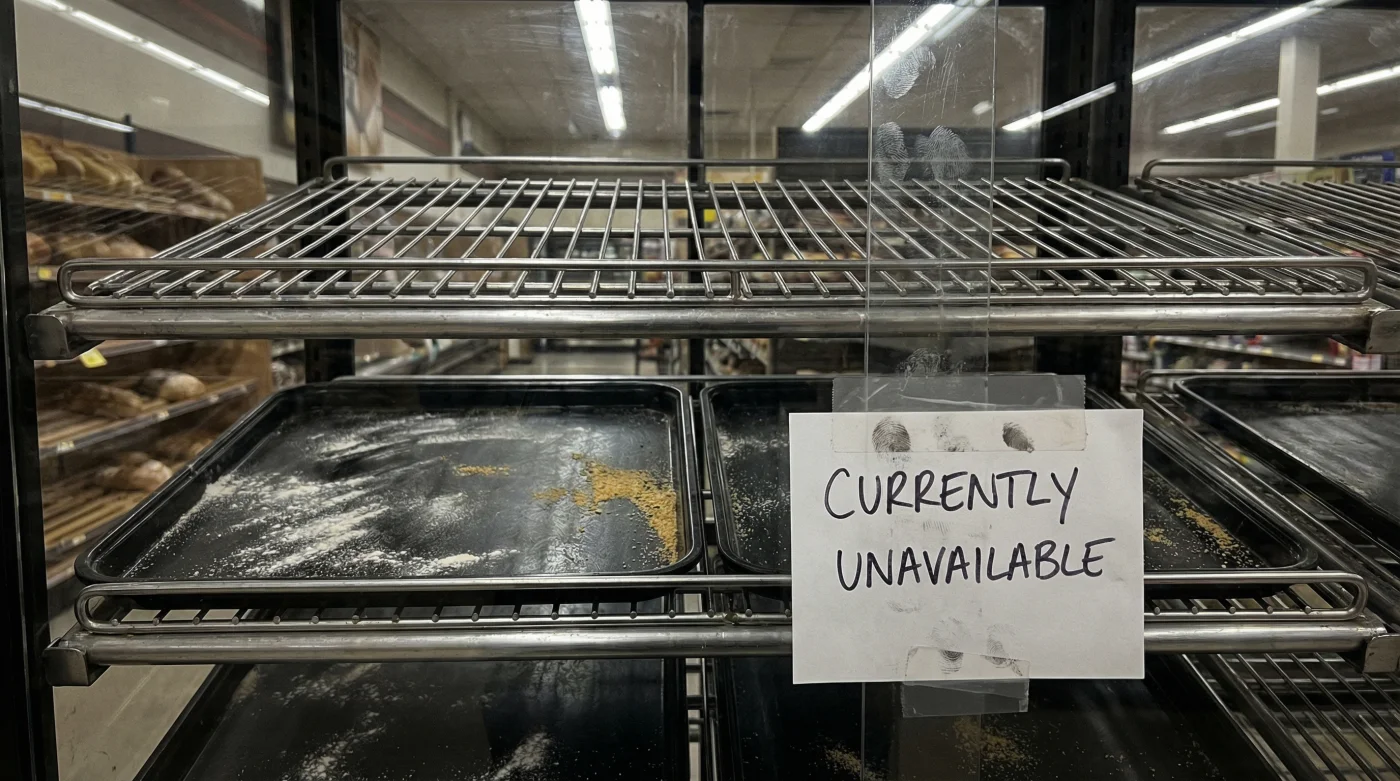
You know that distinct 7:00 AM supermarket smell. It usually hits you the moment the sliding glass doors part: a warm, yeasty perfume promising flaky croissants, warm tiger bread, and the comforting reliability of the morning bakery run. For years, you have relied on this sensory greeting. It tells you the day has begun, the shelves are full, and your breakfast routine is secure. But step into a Tesco this week, and you might find that familiar aroma replaced by the sterile scent of floor polish and the stark visual of empty plastic trays. The sudden morning shortages are jarring. They contradict everything you expect from a modern grocery store, leaving you staring at an empty space where your daily loaf should be.
It is a peculiar kind of modern frustration. You stand there with your shopping basket, trying to mentally compute why a massive retailer suddenly cannot produce a simple crusty roll. The ovens are visibly sitting there, quiet and cold behind the counter. The staff are tidying other aisles. The reality is not a lack of local effort, but a quiet, critical failure miles away down the motorway.
The Brittle Elasticity of the Supply Chain
We treat supermarket bread as a force of nature, like water from a tap. You turn the handle, and it flows. But the reality of commercial baking is more like a stretched rubber band, heavily dependent on precise, hour-by-hour logistics. When you are moving tonnes of perishable goods, there is no backroom storage. It is a system built on perpetual motion. This is the brittle elasticity of the modern supply chain. When one link snaps, the tension releases all the way to your morning shopping basket.
I recently spent an afternoon speaking with David, a logistics manager who routes commercial flour from regional mills to major UK distribution centres. Standing next to a towering aluminium silo, he explained the sheer gravity of the operation. ‘People think flour is just dust in a bag,’ he told me, watching a heavy goods vehicle pull onto the weighbridge. ‘But commercial bakery flour is a highly calibrated, temperature-sensitive material. If a storm hits the wheat harvest, or haulage gets delayed at a port, we miss our delivery slot. A supermarket bakery operates on a strict overnight cycle. If my lorry is six hours late, their ovens stay off.’ David’s words paint a picture of an industry running on razor-thin margins of time.
| Shopper Profile | The Supply Chain Impact |
|---|---|
| The Early Commuter | Loss of grab-and-go pastries; forced to rely on pre-packaged, longer-shelf-life alternatives. |
| The School Lunch Packer | Absence of soft rolls and sliced loaves, requiring improvisation with wraps or crackers. |
| The Weekend Entertainer | Missing artisan sourdoughs and baguettes, altering meal planning for social gatherings. |
The current shortfall isn’t simply about a lack of wheat in the ground. It is an intricate web of delayed shipments, unseasonal weather affecting the specific protein content required for commercial bread making, and a severe bottleneck in haulage availability. Commercial bakeries require a very specific grade of flour to achieve that uniform, predictable rise you expect from a Tesco bloomer. When the mills cannot guarantee that exact specification, or cannot physically transport it to the depot, the entire overnight baking schedule collapses.
| Logistical Variable | Current Disruptive Factor | Store-Level Result |
|---|---|---|
| Wheat Harvesting | Unseasonal rainfall affecting grain milling quality | Reduced volume of bakery-grade flour |
| Transit Timetables | Haulage delays at regional distribution hubs | Missed overnight baking slots |
| Just-in-Time Delivery | Zero buffer stock held at individual stores | Immediate empty shelves by 8:00 AM |
Navigating the Empty Aisles
So, how do you manage your morning routine when the reliable giants falter? The first step is to accept the physical reality of the situation and adjust your movements. Walking briskly past the empty bakery aisle without frustration requires a shift in perspective. Instead of seeing a ruined breakfast, view this as an opportunity to change your habits.
- Greggs sausage rolls undergo major recipe alterations angering loyal British bakery customers.
- Waitrose essential pasta faces sudden national shortages following Mediterranean wheat harvest failures.
- Fresh broccoli turns completely mushy ignoring this brief steam release cooling period.
- Feta cheese blocks stay perfectly fresh submerging entirely in homemade saltwater brines.
- Ground coffee beans tenderise cheap beef cuts doubling as intense dry rubs.
| What to Look For | What to Avoid |
|---|---|
| Independent high-street bakeries with on-site milling | Over-buying mass-produced bread prone to rapid moulding |
| Alternative grains like rye, spelt, or oat-based loaves | Paying premium mark-ups on third-party grocery apps |
| Baking your own soda bread (requires no yeast or proving) | Relying on frozen doughs which also face haulage delays |
The key here is measured response. It is easy to feel a surge of panic when you see empty shelves, prompting an urge to grab whatever packaged bread is left. Resist this impulse. Buying five loaves of heavily preserved sliced bread only leads to food waste when half of it goes stale in your cupboard. Buy only what you need for the next forty-eight hours. Treat this logistical hiccup as a brief interlude rather than a permanent drought.
A Moment to Reconnect with Our Food
Ultimately, an empty supermarket shelf is a powerful reminder of our detachment from the food we eat. We have grown accustomed to the illusion of infinite abundance, expecting fresh pastries to materialise at dawn regardless of seasons, weather, or complex transport networks. When the system breathes through a pillow, struggling to maintain its frantic pace, it forces us to pause and reflect on our consumption patterns.
This shortage, while frustrating, is a temporary mechanical failure. But it is also a quiet invitation to appreciate the immense effort required to bring a simple loaf of bread to your table. The next time you manage to secure a warm, freshly baked crust, you will likely view it differently. It is no longer just a cheap commodity; it is a minor miracle of timing, agriculture, and human effort. Take a moment to savour that reality.
The distance between a golden wheat field and an empty supermarket shelf is measured in hours, not days; when one lorry stops, the ovens go cold.
Frequently Asked Questions
Why are the bakery shelves empty so early in the morning? Supermarket bakeries operate on strict overnight schedules. If the commercial flour delivery misses its haulage slot, the morning bake simply cannot happen, resulting in empty shelves at opening time.
Is this flour shortage affecting all UK supermarkets? While Tesco is currently experiencing highly visible morning gaps, the commercial wheat delays are impacting several major grocers across the country due to shared haulage networks.
How long will these supply delays last? Logistics experts suggest it may take several weeks to clear the current haulage backlog and secure consistent commercial flour grades across the national network.
Should I start buying extra bags of flour for my home pantry? Absolutely not. Retail bags of flour run on a completely different supply pathway than commercial bakery vats. Panic buying only creates artificial shortages for home bakers.
What is the best alternative to my morning supermarket run? This is the perfect moment to support your local independent baker, who often sources ingredients from smaller, regional mills less affected by national haulage issues.