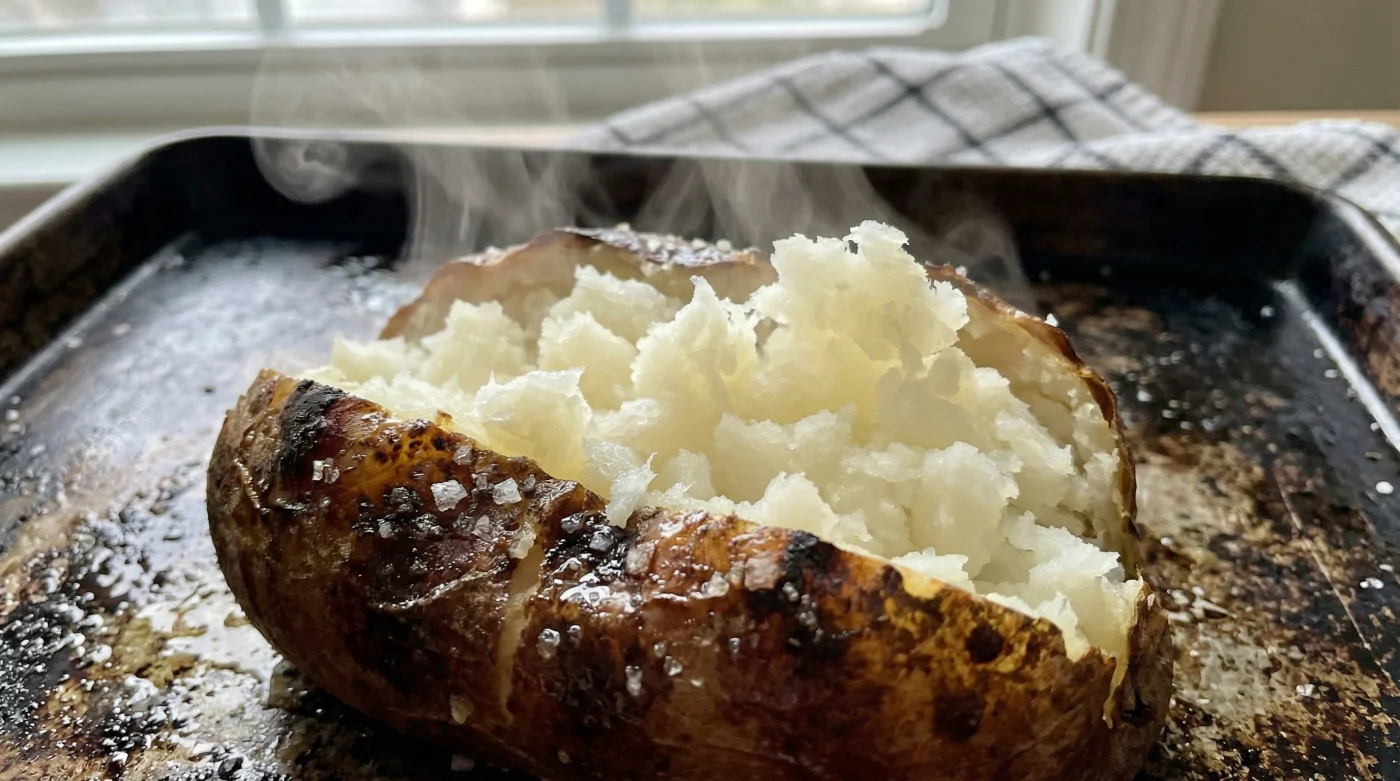
You know the feeling well. It is a rainy Tuesday evening, and you crave the simple comfort of a baked potato. You scrub it, prick it, and place it in the oven, waiting an hour and a half as the smell of roasting starch slowly fills the kitchen. Yet, when you finally cut it open, the anticipation deflates. The skin is tough rather than brittle, and the centre feels dense, akin to a damp sponge rather than a cloud. You are left chewing through a compromise, wondering why your home efforts never match the towering, steaming jackets served at the local pub.
The Starch Paradox
For decades, culinary purists have warned you away from the microwave. The consensus was that radiating a potato turns it into a shrivelled, uninspiring lump. But treating the microwave as the enemy ignores its primary mechanical advantage: it targets water molecules directly. If you rely solely on a conventional oven, you are setting up a thermal traffic jam. The dry heat must slowly conduct through the dense, wet flesh, meaning the skin often overcooks and hardens before the middle has even begun to soften properly.
I learned this lesson standing in the cramped kitchen of a bustling Cornish pub. The head chef, a man who effortlessly turned out hundreds of flawless, steaming jacket potatoes every lunch service, caught me staring at his preparation station. He did not have magical ovens. Instead, he had a row of commercial microwaves humming away. He explained that a short microwave burst is not a shortcut for the lazy; it is a highly efficient, dedicated steam chamber. It rapidly forces the natural moisture within the potato to boil, gelatinising the starches instantly. The oven is then strictly reserved for its true purpose: drying and roasting the exterior to a glass-like crisp.
| Who Benefits Most | The Specific Advantage |
|---|---|
| The Post-Commute Parent | Cuts total cooking time from 90 minutes down to roughly 40 minutes, rescuing the evening routine. |
| The Solo Remote Worker | Allows for a proper, hot lunch without needing to leave the oven on for half the workday, saving on electricity. |
| The Sunday Roast Host | Frees up valuable oven space; the potatoes only need a quick finish alongside the resting meat. |
The Architecture of the Perfect Bake
- Pork shoulder remains unappetisingly tough skipping this mandatory acidic cider braise.
- Iceberg lettuce regains absolute crispness submerged in this rapid lemon bath.
- Dried pasta develops intense nutty flavours undergoing this dry pan toasting.
- Beef stew develops intensely rich gravies adding this unexpected anchovy paste.
- Pancake batter produces incredibly fluffy stacks substituting standard milk for soda water.
First, select the right potato. A floury variety like a Maris Piper or a King Edward is non-negotiable; waxy potatoes will simply turn to glue. Wash it thoroughly to remove soil, but ensure you dry it completely with a clean tea towel. Any lingering surface water will create steam in the oven later, which is the absolute enemy of a crisp skin. Take a fork and pierce the potato deliberately, about ten times, penetrating roughly half an inch deep. This acts as a necessary exhaust system to prevent the skin from tearing under the intense internal pressure.
| Phase | Scientific Action | Temperature / Time |
|---|---|---|
| The Microwave Blast | Rapid excitation of water molecules, creating internal steam to break down rigid starch granules. | High power (800W-1000W) for 5 to 6 minutes, flipping halfway. |
| The Oil Massage | Coating the dried skin in fat to conduct heat rapidly, initiating the Maillard reaction. | Room temperature oil, applied quickly between appliances. |
| The Oven Finish | Dehydrating the exterior and hardening the skin into a structural shell. | 200°C (Fan) for 30 to 40 minutes. |
Place your pierced potato on a thick, glass microwave-safe plate. Heat it on high for exactly five minutes. If your potato is particularly large, pausing halfway to turn it over ensures an even distribution of heat. When the ping sounds, use a cloth to carefully remove it. The potato will feel slightly wrinkled, damp, and will yield to a gentle squeeze. It is now cooked inside, but it looks utterly depressing. Do not panic; this is exactly where you want it to be.
While it is still piping hot, brush it lightly with olive oil or a neutral vegetable oil. Do not drown it; a thin, even film is all you need to encourage the heat to stick. Sprinkle generously with flaky sea salt. The salt will cling to the oil, drawing out the final drops of surface moisture when it hits the heat. Place the potato directly onto the middle shelf of a preheated oven at 200°C Fan. No aluminium foil, no baking trays to block the hot air. Leave it alone for thirty to forty minutes.
| Quality Marker | What to Look For | What to Avoid |
|---|---|---|
| Skin Texture | Brittle, parchment-like, audibly cracks when tapped with the back of a knife. | Leathery, chewy, or damp patches underneath the base. |
| Internal Flesh | Opaque, snow-white, separates into distinct fluffy flakes when aggravated with a fork. | Translucent, waxy, or wet clumps clinging together. |
| Aroma | Earthy, deeply roasted, slightly nutty from the toasted skin and salt. | Boiled, neutral, or faintly metallic smells. |
Reclaiming Your Evening Rhythm
When you pull that potato from the oven, you will hear a faint crackle. Slicing it open reveals a sudden plume of hot, dry steam, and the flesh inside yields without any resistance. You have not just saved yourself forty minutes of waiting; you have engineered a fundamentally superior meal. By assigning the microwave the job of steaming, and the oven the job of roasting, you respect the physical limits of both tools in your kitchen.
This small shift in your culinary routine means a proper, restaurant-quality jacket potato is no longer strictly reserved for long, lazy weekends. It becomes a highly viable option on a busy Wednesday evening. It is a quiet victory over the clock, proving that sometimes, the fastest method and the finest result are entirely the same thing.
“A microwave does not ruin a potato; it simply does the heavy lifting so the oven can finally focus on the art of the crisp.”
Essential Clarifications
Can I microwave multiple potatoes at once?
Yes, but you must increase the time. Add roughly three minutes per additional potato, and ensure they are spaced evenly on the turntable rather than piled together.
Do I need to rest the potato after microwaving?
No, move it to the hot oven as swiftly as possible so it does not lose its vital internal heat.
Can I use butter instead of oil for the skin?
Avoid butter for the roasting phase; its milk solids will burn heavily at 200°C, leaving bitter black spots on the skin. Stick to a clean oil.
What if my microwave does not have a turntable?
Simply rotate the potato manually a quarter-turn every two minutes to ensure the microwaves distribute evenly through the flesh.
Is it necessary to bake it directly on the oven rack?
Yes. Baking trays trap moisture underneath the potato, resulting in a distinctly soggy bottom. The wire rack allows hot air to circulate entirely around the skin.