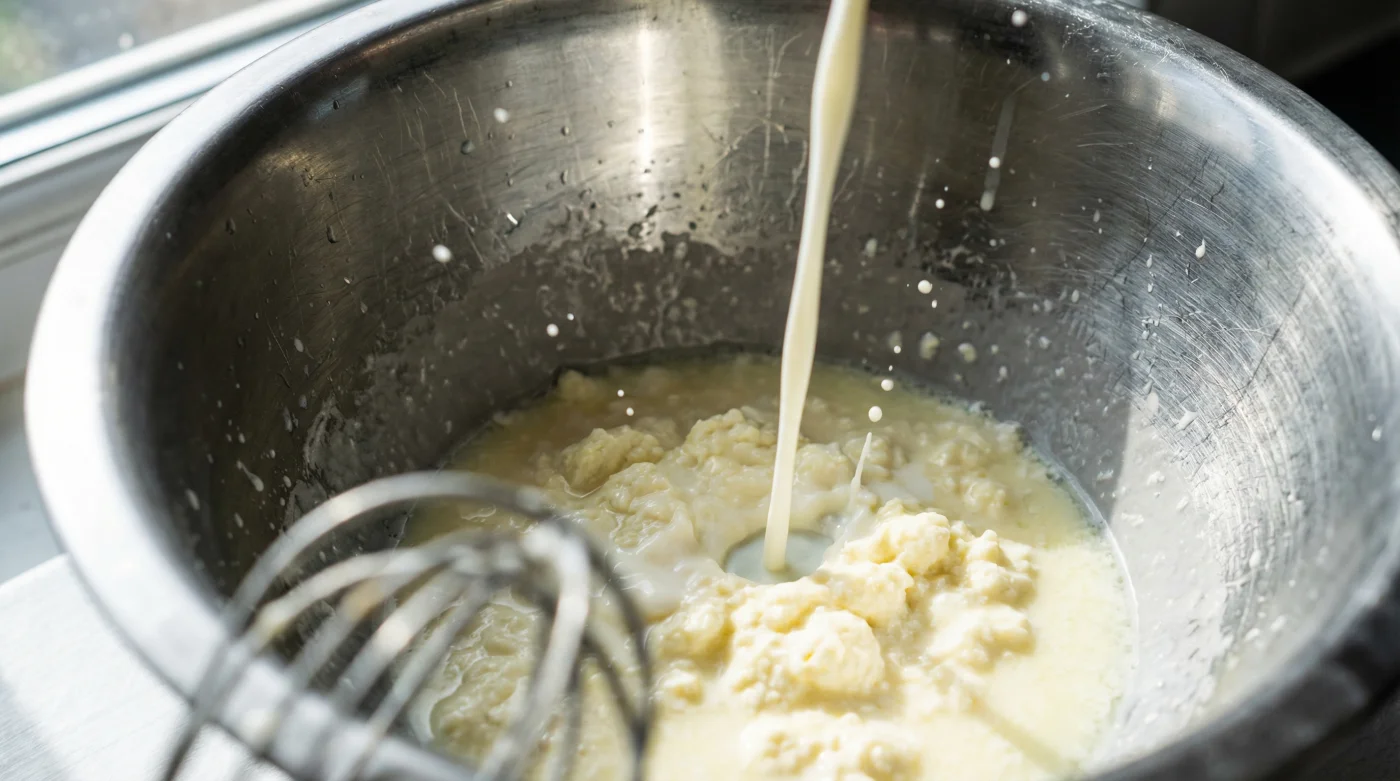
The electric hand whisk has a distinct rhythm. It starts with a gentle, liquid hum, slowly building into a soft, rhythmic drag as the double cream thickens. You glance away for mere seconds to check the temperature of your pudding, and the pitch shifts. The sound turns from a smooth swoosh to a heavy, wet slapping against the sides of the glass bowl. You look down. What was supposed to be a pillowy cloud now resembles lumpy cottage cheese. The immediate instinct is a sinking feeling in your chest. You reach for the bin, convinced the batch is ruined.
Stop right there. The widespread kitchen panic that curdled cream is beyond saving is an absolute myth. You do not need to head back to the supermarket, and you certainly do not need to throw good food away.
The Gravity of the Emulsion
Think of whipping double cream like balancing on a tightrope. As you whisk, you force air into the liquid. The fat membranes strip away and stick together, creating a beautiful network that traps the air. But when you push them too far, the fat clings to itself too tightly, squeezing the water out. You have essentially stumbled off the edge. The emulsion has broken.
Years ago, during a frantic Friday service in a cramped Soho pastry kitchen, I watched a junior chef nearly bin a massive mixing bowl of split jersey cream. The head chef casually intercepted. ‘It has just forgotten how to hold hands,’ he muttered, pouring a tiny splash of cold milk into the grainy mess. With a silicone spatula, he folded it twice. Before my eyes, the harsh, yellowing lumps relaxed back into a pristine, glossy white peak.
| Target Audience | Specific Benefits of the Milk Hack |
|---|---|
| Dinner Party Hosts | Avoids last-minute panic and saves time when guests are waiting for pudding. |
| Budget-Conscious Cooks | Prevents the financial waste of throwing away expensive dairy products. |
| Weekend Bakers | Provides a reliable safety net, allowing you to bake with less anxiety. |
The secret lies in a simple rescue operation. You do not need aggressive force to fix this; you need a gentle peace treaty. By introducing a small amount of liquid back into the environment, you give the tightly clumped fat molecules something new to bind to.
Rebuilding the Broken Bridge
The remedy requires nothing more than what is already sitting in your fridge door. Take two tablespoons of ice-cold milk. Whole milk works best, but semi-skimmed will do perfectly well. Do not pour it in all at once. Drizzle the first spoonful evenly over the surface of your split cream.
Put down the electric whisk immediately. You must do this by hand. Take a rubber spatula or a large metal spoon. Gently fold the cold milk into the grainy cream. Scrape the bottom of the bowl and bring the mixture over itself. You will notice the rough texture softening almost instantly.
- Chicken breasts stay incredibly succulent replacing standard oil marinades with full-fat mayonnaise.
- Basmati rice turns perfectly fluffy using this simple tea towel trick.
- Raw eggs form flawless poached spheres draining through fine wire mesh sieves.
- Marmite transforms weak vegetarian gravy adding incredibly deep beefy roasting flavours.
- Split double cream returns to perfect smoothness gently folding in cold milk.
| Mechanical State | Scientific Logic of the Rescue |
|---|---|
| Over-whipped (Grainy) | Fat globules have clumped too tightly, expelling moisture. Emulsion is distressed. |
| Addition of Cold Milk | Introduces water and un-damaged milk proteins back into the harsh environment. |
| Gentle Folding | Mechanically encourages the fat clumps to relax and re-absorb the new liquid, restoring the smooth emulsion. |
This technique works seamlessly for cream that has just crossed the line into grainy territory. However, if you have completely separated the mixture into hard yellow butterfat and a pool of watery buttermilk, you have actually made butter. At that stage, you cannot reverse the process. Simply add a pinch of sea salt, spread your homemade butter on some warm toast, and start your cream again from scratch.
| Quality Checklist | What to Look For | What to Avoid |
|---|---|---|
| Texture Assessment | Slight graininess, resembles soft ricotta cheese. | Hard yellow clumps floating in thin, watery liquid (buttermilk). |
| Temperature | Milk and cream should both be fridge-cold. | Using warm or room-temperature milk, which melts the fat. |
| Utensils | A flexible silicone spatula or wide metal spoon. | Re-engaging the electric whisk or whisking vigorously by hand. |
A More Forgiving Kitchen
We often treat cooking as a rigid test of our abilities, where a single misstep means failure. The truth is far more forgiving. Culinary traditions are built entirely on fixing mistakes, adapting to the ingredients, and finding a quiet rhythm in the process. When you rescue your split cream, you are not just saving a few Pounds Sterling; you are learning to read the ingredients.
You begin to understand that a broken emulsion is merely a physical reaction, not a ruined evening. The next time the whisk hums a little too long, you will not panic. You will simply open the fridge door, take out the milk, and quietly fold your way back to a perfect, velvety finish.
A split sauce or a broken cream is never the end of the recipe; it is simply the ingredient asking for a little more of your attention.
Frequently Asked Questions
Can I use warm milk to fix the cream?
No, the milk must be strictly cold. Warm milk will melt the fat globules entirely, turning your mixture into a runny soup rather than a whipped peak.What if I only have single cream instead of milk?
Cold single cream works beautifully. Use it in the exact same way, adding a tablespoon at a time and folding gently.Will this trick alter the flavour of my pudding?
Not at all. Two tablespoons of milk are practically imperceptible in the final taste, merely restoring the texture without watering down the richness.How do I stop it splitting in the first place?
Always whip double cream straight from the fridge, and switch to a manual hand whisk for the final thirty seconds to carefully monitor the consistency.Is the cream safe to eat if it has split?
Perfectly safe. Splitting is a mechanical change, not a bacterial one. It just feels unpleasantly grainy on the tongue until you fix it.