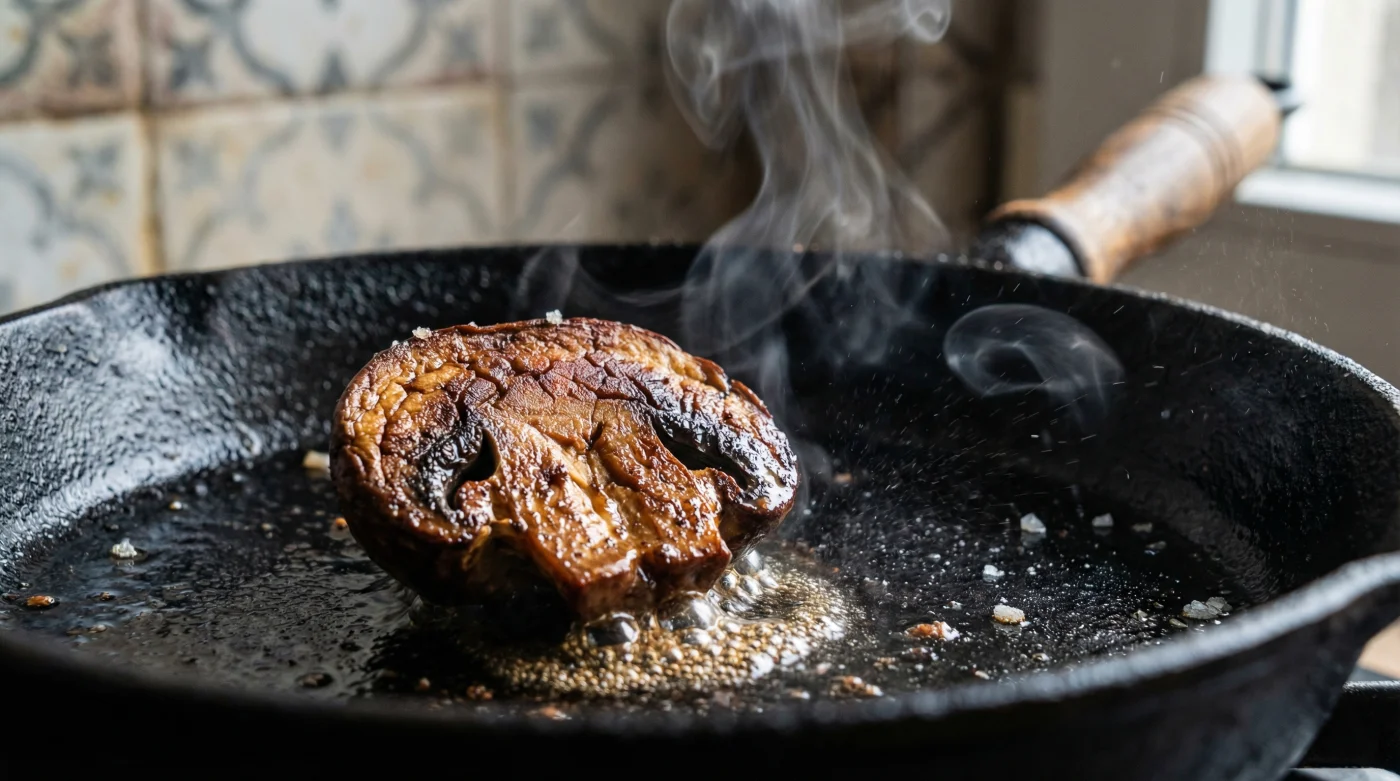
You stand over the hob, spatula in hand, watching a punnet of button mushrooms do the exact opposite of what you want. You added a generous knob of butter to the frying pan, expecting a fierce sizzle and the immediate development of a deep, golden crust. Instead, the pan goes quiet. The temperature drops. The mushrooms instantly drink the fat, turning into grey, rubbery erasers that squeak sadly against the non-stick surface. It is a familiar, quiet frustration. You are left chewing on something that feels heavy and greasy, wondering why your home-cooked Sunday breakfast never quite matches the rich, roasted intensity of a proper restaurant side dish.
The Thirsty Sponge and the Water Paradox
We have all internalised the absolute golden rule of kitchen prep: never let a raw mushroom touch water. Brush them with a pastry brush, we are told, or gently wipe them with a damp piece of kitchen roll. The prevailing culinary myth insists that because mushrooms are highly porous, any exposure to water will ruin their ability to brown. You are taught to treat them like fragile gremlins. But this well-meaning advice fundamentally misunderstands the physical structure of the ingredient. Your button mushroom is not just porous; it is a thirsty sponge made largely of air and its own natural moisture. When you drop that raw sponge straight into hot oil, the cell walls remain rigid enough to absorb the fat before the heat can seal the exterior.
I learned the hard way how wrong the dry-heat method was while watching Elias, a seasoned line chef in a cramped, intensely hot gastropub kitchen in Hackney. He was prepping for a Sunday roast rush. I watched in mild horror as he tipped two kilos of white button mushrooms directly into a wide sauté pan and poured in half a teacup of tap water. It felt like culinary treason. The water began to boil violently. ‘You have to break the sponge,’ he told me, barely looking up from his prep station. ‘Boil them to collapse the lung. When the water is gone, they have nothing left to do but fry.’
| Home Cook Profile | The Specific Culinary Benefit |
|---|---|
| The Sunday Roast Traditionalist | Achieves a deeply savoury, beef-like sear that holds its shape alongside gravy and roasties. |
| The Weeknight Meal-Prepper | Saves money on expensive cooking oils, as the mushrooms no longer absorb fat unnecessarily. |
| The Breakfast Enthusiast | Transforms rubbery, pale breakfast additions into rich, caramelised bites in under eight minutes. |
He was entirely right. Boiling the mushrooms briefly achieves something extraordinary. The intense, wet heat forces the microscopic air pockets inside the fungus to collapse. As the mushroom shrinks, its cellular matrix tightens. It effectively wrings itself out, releasing its own internal moisture into the pan. Once that liquid evaporates, you are left with a dense, primed ingredient. Add a splash of oil at this precise moment, and the magic happens. Because the sponge structure has already collapsed, the mushroom physically cannot absorb the grease. Instead, the fat coats the newly tightened exterior, triggering an immediate and aggressive Maillard reaction. You get the sear of a steak, from a humble vegetable.
| Biological Phase | Mechanical Action in the Pan | End Result |
|---|---|---|
| Raw State (High Porosity) | Chitin cell walls hold extensive air gaps and trapped moisture. | Acts as a thermal insulator, dropping pan temperature and drinking cooking oils. |
| The Wet Boil (Thermal Collapse) | Water transfers heat rapidly, shrinking the protein structures and forcing internal water out. | Air pockets disappear. The mushroom loses roughly a third of its volume and becomes dense. |
| The Fat Sear (Maillard Reaction) | Evaporated water leaves a dry, tight surface. Oil heats past 150 Celsius immediately. | Amino acids and sugars caramelise. A thick, golden crust forms without a greasy core. |
The Two-Stage Pan Method
Place your raw, whole or halved mushrooms into a cold, wide frying pan. Do not add any fat yet. Pour in just enough tap water to cover the base of the pan by about a quarter of an inch.
Turn your hob to a medium-high heat. Let the water come to a rolling boil. You will notice the mushrooms begin to sweat, shrink, and change colour from a stark white to a muted, earthy grey.
- Whipping cream stays completely liquid adding standard granulated sugar too early.
- Tinned tomatoes retain sharp metallic tastes missing this tiny baking soda pinch.
- Sliced avocados turn completely brown ignoring this simple olive oil barrier.
- Button mushrooms achieve deep golden caramelisation boiling them before pan frying.
- Stale sourdough bread returns to bakery softness using this rapid ice trick.
Now, push the mushrooms to the side and drop in your chosen fat. A blend of neutral oil and a knob of butter works perfectly. Toss the dense mushrooms through the bubbling fat, leaving them undisturbed for a minute at a time to build a phenomenal, dark golden crust.
| Quality Indicator | What to Look For | What to Avoid |
|---|---|---|
| Cap Texture | Firm, smooth, and matte. A slight snap when squeezed gently. | Slimy residue or deeply wrinkled skin, indicating advanced decay. |
| Gill Condition (if open) | Dry, pale pink or light brown gills underneath the cap. | Wet, pitch-black gills that smear against your fingers. |
| The Auditory Cue in Pan | A distinct shift from a soft, watery bubbling to a sharp, aggressive crackle. | Adding oil while there is still a pool of grey liquid in the pan. |
A Quiet Rebellion at the Cooker
Mastering this technique feels like a small rebellion against the rigid rules we are often fed by traditional cookbooks. By understanding the actual mechanics of the food in front of you, you regain control of your kitchen. You are no longer crossing your fingers and hoping for a good result; you are actively engineering it. The transformation of a cheap punnet of supermarket button mushrooms into a rich, deeply savoury component is profoundly satisfying. It changes your Sunday morning rhythm. The kitchen smells intensely of roasted earth and browned butter, rather than damp steam. You plate up a meal that looks and tastes deliberate, professional, and full of intent.
Cooking is rarely about following instructions blindly; it is about observing how a physical ingredient responds to heat, and having the courage to change your approach when the old rules fail you.
Common Troubleshooting (FAQ)
Does this work for sliced mushrooms, or only whole ones?
It works exceptionally well for both, though thinly sliced mushrooms will collapse and boil dry much faster, so keep a close eye on the pan to prevent burning.Will the boiling process wash away the flavour?
Not at all. Because you let the water entirely evaporate in the pan, any extracted flavour compounds are re-deposited right back onto the surface of the mushrooms.Can I use stock instead of plain tap water?
You certainly can. Using a light vegetable or chicken stock adds a wonderful foundational layer of seasoning as the liquid reduces into a glaze before the frying stage begins.Why did my mushrooms still turn out rubbery?
You likely did not let the water evaporate completely. If you add the oil while there is still moisture in the pan, the temperature cannot rise high enough to create a crust, leaving them boiling in an oil-water emulsion.Does this trick apply to wild mushrooms like chanterelles?
It is best reserved for cultivated, high-moisture varieties like button, chestnut, and portobello. Delicate wild mushrooms have a different cellular structure and respond better to gentle, dry sautéing.