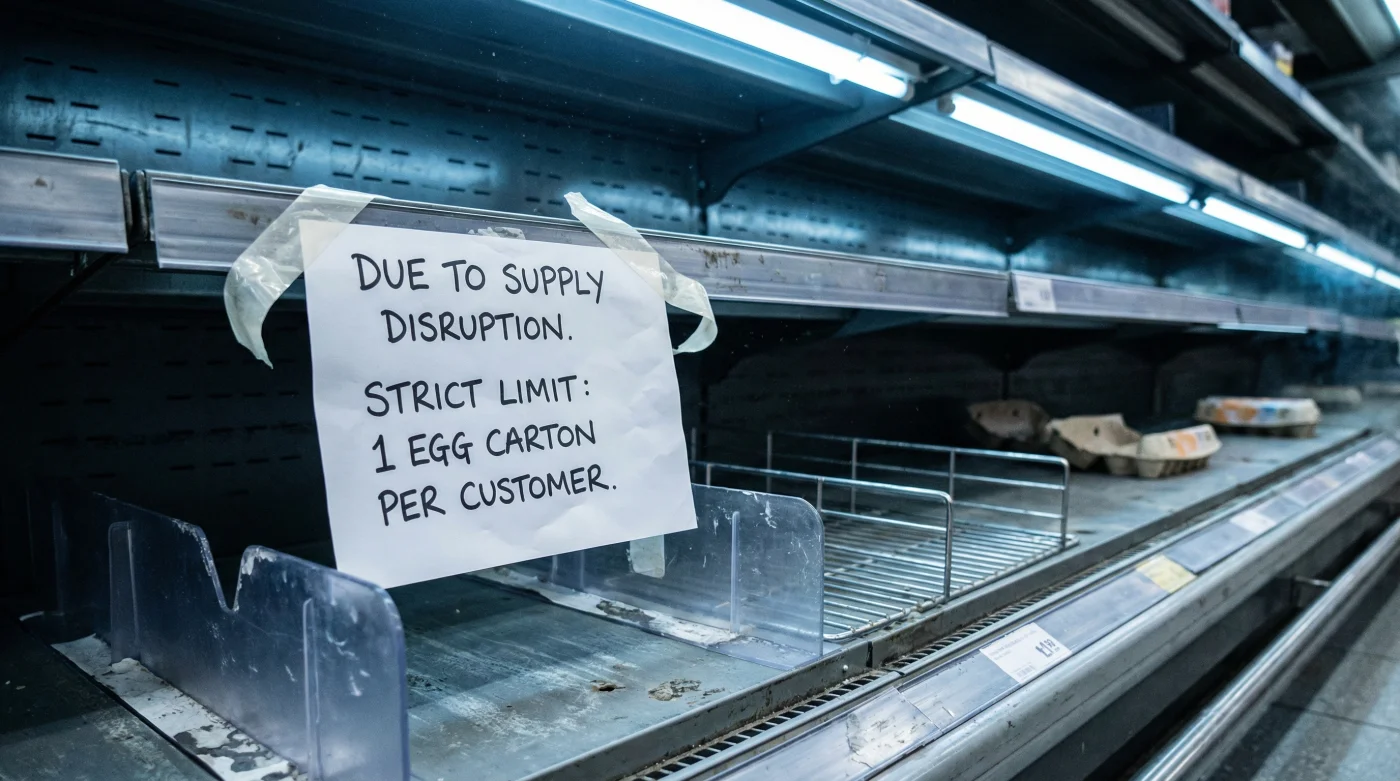
You steer your trolley down the familiar, brightly lit aisle of your local Tesco. The low hum of the industrial refrigerators usually scores a comforting weekly rhythm, but today, a stark white sign interrupts the flow. A sudden gap sits where the sturdy cardboard boxes usually rest. The humble free-range egg, the silent anchor of your Saturday morning fry-up and Tuesday evening baking, is suddenly a rationed commodity. A polite but firm notice informs you of a sudden purchasing limit: three boxes per customer. It feels like a subtle jolt to the system, a sudden reminder of how delicate the path from the farm to your frying pan truly is.
The Fragility of the Morning Routine
We rarely think about the logistics of an egg. It is a kitchen staple so fundamental it borders on invisible. But the British agricultural system is currently navigating a quiet crisis. Think of the egg supply chain as a delicate suspension bridge. When severe winter weather brings migratory birds carrying the shadow of avian flu across British fields, that bridge shudders. To protect the wider flocks, millions of birds are placed under strict indoor biosecurity measures. The designation of ‘free-range’ must temporarily pause, and supply bottlenecks instantly. This rationing is not a mere logistical hiccup; it is a vital protective measure for the entire farming ecosystem.
You are witnessing the physical manifestation of a biological event. I recently spent an afternoon speaking with Thomas, a second-generation poultry farmer operating just outside York. Standing by his empty sorting sheds, the silence was palpable. He described the emotional and financial toll of a lockdown. ‘You spend your life working to give these birds miles of pasture,’ he explained, ‘and overnight, you are sealing the doors to keep a microscopic threat at bay. The drop in yield is immediate.’ His reality translates directly to the sudden purchasing limits on your supermarket shelf. It is a necessary friction to ensure the long-term survival of British poultry farming.
| Shopper Profile | Immediate Impact | Practical Adjustment |
|---|---|---|
| The Weekend Baker | Struggles to source enough eggs for large-scale cakes or batch pastries. | Pivoting to recipes that rely on single-egg binders or exploring alternative leavening agents. |
| The High-Protein Breakfaster | The daily three-egg scramble rapidly depletes the weekly ration. | Rotating breakfasts with protein-dense alternatives like Greek yoghurt or overnight oats. |
| The Family Meal Planner | Difficulty balancing baking needs with staple dinner requirements like Yorkshire puddings. | Prioritising eggs for structural cooking while using alternatives for simple binding. |
The Mathematics of the Supply Chain
Understanding why Tesco has pulled the emergency cord requires looking at the raw mechanics of the crisis. When an outbreak is detected, strict exclusion zones are drawn. The movement of poultry and eggs grinds to a halt. Even farms untouched by the virus must adapt to indoor housing orders, which naturally suppresses laying rates due to changes in light and space. The numbers paint a stark picture of why rationing is the only mathematically sound response to prevent total depletion.
| Supply Chain Factor | Pre-Crisis Standard | Current Avian Flu Reality |
|---|---|---|
| Flock Mobility | Unrestricted outdoor foraging | Mandatory indoor housing |
| Laying Yields | Predictable, seasonal peaks | Significantly reduced due to stress and environment shifts |
| Restocking Timeline | Continuous rotation of laying hens | Halted or delayed within surveillance zones |
Adapting Your Kitchen Rhythm
Facing a rationing limit requires a mindful shift in how you approach your weekly meal prep. Rather than viewing the empty shelf as a deprivation, treat it as a prompt to audit your pantry. You must become strategic with the eggs you do manage to secure. Save them for dishes where they are the absolute star—a perfectly poached egg over asparagus, or a delicate soufflé.
For structural baking, where the egg simply acts as a binder or moisture agent, the pantry offers robust alternatives. The physical act of whisking a tablespoon of ground flaxseed with three tablespoons of water creates a surprisingly effective gel. It brings a nutty depth to banana breads and muffins. It requires patience—you must let the mixture sit for five minutes until it thickens into a glossy, viscous consistency—but it works beautifully.
In savoury dishes, consider how other ingredients can step in to provide richness or structure. If you are breading chicken or fish, a light coating of natural yoghurt or a simple flour-and-water slurry allows breadcrumbs to adhere perfectly without wasting a precious egg. These small, deliberate actions ensure your kitchen continues to function smoothly without feeling the pinch of the supermarket limits.
| Substitute Type | What to Look For (Quality Check) | What to Avoid (Common Pitfalls) |
|---|---|---|
| Flaxseed Substitute | Finely milled seeds; a thick, viscous gel after resting for 5 minutes. | Using whole seeds; skipping the resting phase, leading to crumbly bakes. |
| Aquafaba (Chickpea Water) | Unsalted chickpea tins; whip until stiff peaks form for meringues. | Using water from highly salted or flavoured tins; under-whipping. |
| Silken Tofu | Smooth, uniform purees; excellent for dense cakes or brownies. | Using firm tofu; failing to blend it completely smooth, leaving lumps. |
A New Appreciation for the Pantry
This period of sudden restriction serves as a profound reminder of our connection to the agricultural world. The convenience of the modern supermarket often insulates us from the realities of the seasons, the weather, and the vulnerabilities of livestock. When Tesco limits your purchase to three boxes, it is an invitation to treat each egg with a renewed sense of respect. You begin to plan your meals with greater intention, valuing the ingredients that usually sit uncelebrated in the fridge door.
Ultimately, the avian flu outbreak will pass, flocks will slowly rebuild, and the supermarket shelves will return to their familiar abundance. But until then, navigating this shortage is a masterclass in culinary adaptability. It forces you to experiment, to substitute, and to appreciate the intricate network that feeds the nation. You leave the aisle not with frustration, but with a quiet respect for the resilience of the farmers working tirelessly to protect their birds, and the ingenuity required to keep your own kitchen thriving.
Limitations in the kitchen are rarely a blockade; they are simply the quiet instructions forcing you to become a more mindful and resourceful cook.
- Hard-boiled eggs refuse to peel cleanly ignoring this aggressive shell cracking.
- Bisto gravy mimics authentic roasting tin juices adding this sharp mustard spoon.
- Mashed potatoes turn into unappetising glue skipping this brief drying phase.
- McCain oven chips face sudden supermarket shortages following disastrous potato harvests.
- Tesco free-range eggs face sudden national purchasing limits following avian flu.
Frequently Asked Questions
Why is Tesco specifically rationing eggs?
Tesco, like many major UK supermarkets, is managing disrupted supply chains caused by severe outbreaks of avian flu, which has forced farmers to cull birds or move them indoors, drastically reducing the national egg yield.
How long will these purchasing limits last?
The restrictions are temporary but highly dependent on the control of the avian flu virus. Limits will likely remain in place until the mandatory indoor housing orders are lifted and flocks begin to recover their standard laying rhythms.
Are eggs still safe to eat?
Yes. The Food Standards Agency maintains that avian influenzas pose a very low food safety risk for UK consumers. Properly cooked eggs remain entirely safe to consume.
Will other supermarkets follow Tesco’s lead?
Supply chain pressures affect the entire agricultural sector. If the shortage persists, it is highly likely that other major retailers will implement similar protective rationing to prevent panic buying and ensure fair distribution.
What is the best way to make my rationed eggs last longer?
Store them in their original cardboard box in the main body of the fridge, rather than the door, to maintain a consistent temperature. Prioritise using eggs for dishes where they cannot be substituted, and utilise pantry alternatives like flaxseed or aquafaba for general baking.