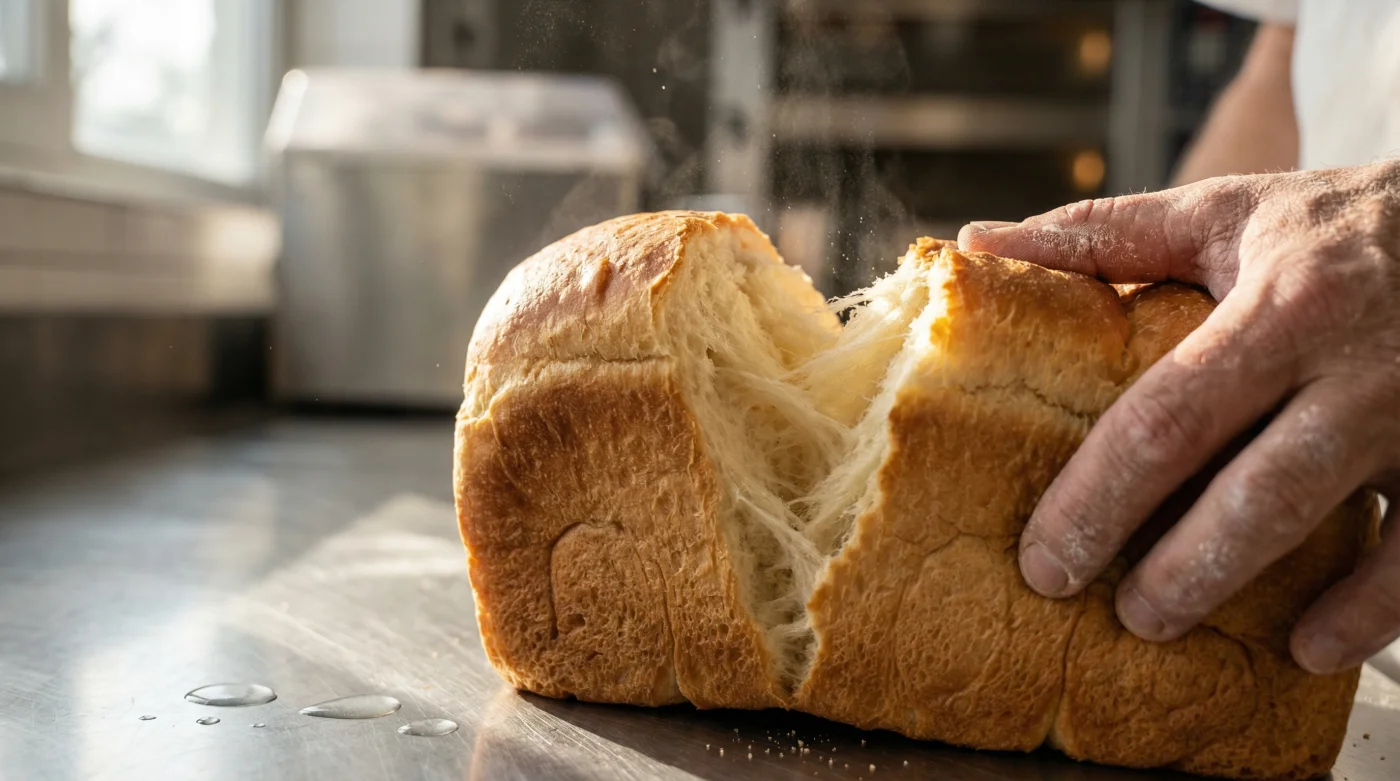
It is four in the morning, and the air inside a quiet commercial bakery in London feels unexpectedly heavy. You might anticipate the dry, dusty scent of scattered flour or the immediate, comforting blast of oven heat. The reality, however, is much closer to standing in a damp, warm greenhouse just after a summer downpour.
This thick, clinging air is not an accident. While home bakers anxiously watch the clock, resting their mixing bowls on a radiator and hoping for the best, the professional baker watches the atmosphere. They are entirely focused on invisible atmospheric moisture levels, knowing that the environment surrounding the bowl dictates everything about the final crumb.
That impossibly tall, pillowy slice of milk bread you buy at a premium artisan café does not owe its structure to a secret, heavily guarded ingredient. It relies entirely on a carefully orchestrated dance of wet air. If you have ever wondered why your own loaves emerge from the oven with a tight, resentful texture while the bakery down the street produces bread that pulls apart like cotton wool, the answer surrounds us constantly.
We spend an immense amount of time obsessing over flour protein percentages, the exact temperature of our milk, and the precise weight of our butter. But the actual magic happens when you stop looking at the dough and start managing the specific environment it breathes in.
Rethinking the Radiator Trap
The standard baking recipe almost always includes the same vague, slightly unhelpful instruction: leave the dough in a warm place until it has doubled in size. Naturally, you seek out the airing cupboard, the space above the boiler, or the sunniest windowsill in the house. But heat without humidity is the ultimate enemy of a soft, yielding crust.
Think of your resting dough not as a static sponge, but as a living, breathing lung. When placed in a dry, hot environment, the outer skin of the dough dries out rapidly, forming a rigid, leathery shell. This premature crust acts exactly like a tight corset, physically restricting the yeast’s ability to stretch the delicate gluten network to its full, magnificent potential.
The professional bakery sidesteps this restriction entirely by using a commercial prover—a sophisticated machine that strictly controls both warmth and ambient humidity. They surround the resting dough with a gentle, invisible cloud, ensuring the surface remains as supple as a water balloon throughout the entire fermentation process.
What often feels like a frustrating, unpredictable waiting game transforms completely when you realise that water in the air acts as a mechanical lubricant. The moisture keeps the dough’s surface endlessly pliable, allowing it to balloon outwards and upwards with absolute zero resistance.
Elias Thorne, a 42-year-old head baker at a sourdough and enriched dough specialist in Somerset, learned this lesson through sheer frustration. For years, he wrestled with milk bread batches that occasionally tore violently at the seams during the oven spring, despite adhering strictly to his mentor’s handwritten notes. It was only when a junior baker mistakenly left a tray of shaped buns next to a simmering stockpot in an adjacent prep kitchen that the shift occurred. The buns, bathed in that ambient, rolling steam, rose twenty percent higher than the rest of the batch, boasting a silken, remarkably glossy skin. Elias realised instantly that managing the invisible weather inside the room was far more vital than simply setting a timer.
Engineering the Micro-Climate
Replicating a thousand-pound commercial prover at home does not require expensive machinery or a kitchen remodel. You simply need to trap and regulate the moisture in the immediate cubic foot of air surrounding your mixing bowl.
For the Weekend Artisan: You want that flawless, edge-to-edge softness for a Sunday sandwich loaf without hovering in the kitchen all afternoon. Your best approach is the oven-box method. Place your covered bowl inside a cold, turned-off oven. On the shelf beneath it, pour a pint of recently boiled water into a shallow roasting tin. Shut the oven door immediately and do not open it. You have just created a high-humidity, temperature-stable micro-climate that perfectly mimics professional equipment.
- Standard plastic food bags transform into precision icing tools executing this tiny diagonal corner snip.
- Premium stand mixers require these specific internal metal gears surviving heavy daily bread kneading.
- British digestive biscuits harbor surprising medical origins originally intended to cure intense indigestion.
- Expensive baking chocolate seizes irreversibly committing this tiny invisible water droplet error.
- Professional bakeries utilize exact ambient humidity controls achieving perfectly risen milk bread loaves.
For the Enriched Dough Enthusiast: Milk breads, brioche, and sweet buns contain high levels of fats that naturally slow down yeast activity. They demand a significantly longer resting period, meaning they are exposed to the ambient air for hours. A damp tea towel is the traditional advice, but the fabric frequently dries out, wicking moisture away from the dough. Instead, invert a large, clear plastic tub over the dough directly on the worktop, safely trapping the dough’s naturally expelled moisture beneath the dome.
The Tactile Routine of Proving Dough
Mastering this critical stage requires entirely shifting how you assess your progress. You must rely on your fingertips and visual cues rather than trusting the arbitrary numbers printed on a clock.
When setting up your dough for its primary rest, strip away the noise of the kitchen and focus on the immediate, tactile environment.
- Weigh your ingredients meticulously, ensuring your milk is lukewarm to the touch, never hot.
- Knead the mixture until the surface feels incredibly supple, mirroring the surface tension of a taut balloon.
- Prepare your chosen micro-climate—whether that is a steaming roasting tin in the oven or a heavily misted plastic tub.
- Place the dough inside the humid chamber, securely close the door, and step away completely.
When you return to check the progress of the fermentation, wet your index finger slightly to prevent sticking. Gently press the surface. The dough should sigh back incredibly slowly, feeling almost like you are breathing through a pillow, leaving a shallow, lingering indentation.
The Tactical Toolkit
Target Ambient Temperature: 24°C to 26°C.
Target Relative Humidity: 75% to 85%.
Primary Tool: A simple atomiser spray bottle filled with freshly boiled, then cooled, tap water.
Visual Cue: A light fog of condensation forming on the inside of your proving container, but never pooling or dripping directly onto the dough.
Finding Stillness in the Process
There is a profound, grounding quietness that comes from truly understanding the mechanics of your environment. When you stop fighting the natural limitations of your kitchen and begin curating the invisible atmosphere, the deep-seated anxiety of baking completely dissipates.
You no longer need to hover over the mixing bowl, willing the microscopic yeast to perform a sudden miracle. You have provided the absolute perfect conditions, creating an empathetic, nurturing space where the raw ingredients can quietly do exactly what they were always meant to do.
Baking exceptional milk bread ceases to be a strict, pass-or-fail chemistry exam that leaves you exhausted. It becomes a mindful, sensory practice of observation and incredibly subtle adjustment. You are crafting the perfect morning, one humid, unhurried breath at a time. The resulting loaf, tearing apart in impossibly soft, fragrant strands, is simply the physical manifestation of your newfound patience.
“Respect the air around the dough just as much as the flour within it; moisture is the invisible hand that shapes the final crumb.”
| Key Point | Detail | Added Value for the Reader |
|---|---|---|
| The Airing Cupboard | High heat, intensely dry air | Leads to a tough, restrictive crust; avoid this traditional method completely. |
| Damp Tea Towel | Inconsistent moisture, dries out quickly | Better than nothing, but demands constant re-wetting and hovering. |
| The Cold Oven with Steam | Stable warmth, roughly 80% humidity | Guarantees commercial bakery-level softness with zero extra effort or cost. |
Frequently Asked Questions
Why does my dough form a hard skin while resting?
Your immediate environment is far too dry. The sheer lack of ambient humidity causes the delicate surface moisture to evaporate rapidly, creating a shell.Can I use a standard microwave as a proving chamber?
Yes. Place a mug of heavily boiling water inside alongside your covered dough and securely close the door to trap the ambient steam.How long should an enriched milk bread take to rise?
Ignore the clock entirely. Depending on your kitchen’s specific micro-climate and draughts, it could take anywhere from one to three hours.Is heavy condensation dripping onto the dough a problem?
A few stray drops will not ruin the final loaf, but excessive pooling can easily create a soggy, uneven crust that struggles to bake.Do I genuinely need to buy an expensive home prover?
Not at all. A heavy plastic tub or a turned-off oven paired with a bowl of hot water creates the exact same atmospheric conditions.