The scent of warm vanilla sponge settling on a wire rack brings a specific kind of Sunday afternoon comfort. Rain might be lashing against the kitchen window, but inside, you have created something structurally sound and sweet. Beside the cake, a bowl of stiff, whipped buttercream waits, the cream trembling just slightly as you tap the whisk against the rim.
Then, the familiar panic sets in. You reach into the baking drawer and find nothing but greaseproof paper and rolling pins. You are entirely out of professional piping bags, and the thought of awkwardly slathering that delicate icing with a blunt knife feels like an injustice to your hours of careful measuring. A looming cake decorating disaster threatens to ruin the final presentation.
Yet, the difference between a frustrated home baker and a seasoned pastry chef often lies in resourcefulness rather than expensive equipment. That unremarkable roll of standard food bags sitting next to the cling film holds a secret. With a single, deliberate modification, you can rescue your finish entirely.
The Geometry of a Single Cut
We tend to view plastic sandwich bags as crude vessels, purely designed to keep half a cheddar block from going stale. It is easy to assume that achieving a sharp, fluted edge or a perfect written script requires bespoke polyurethane pastry cones ordered from a specialist supplier.
But a piping bag is fundamentally just a mechanism for controlling tension and focused pressure. When you look at a freezer bag not as a storage pouch but as a funnel waiting to be tensioned, its mundane nature vanishes. The secret to professional-grade pastry piping lies not in the plastic itself, but in the specific angle of the exit wound you create.
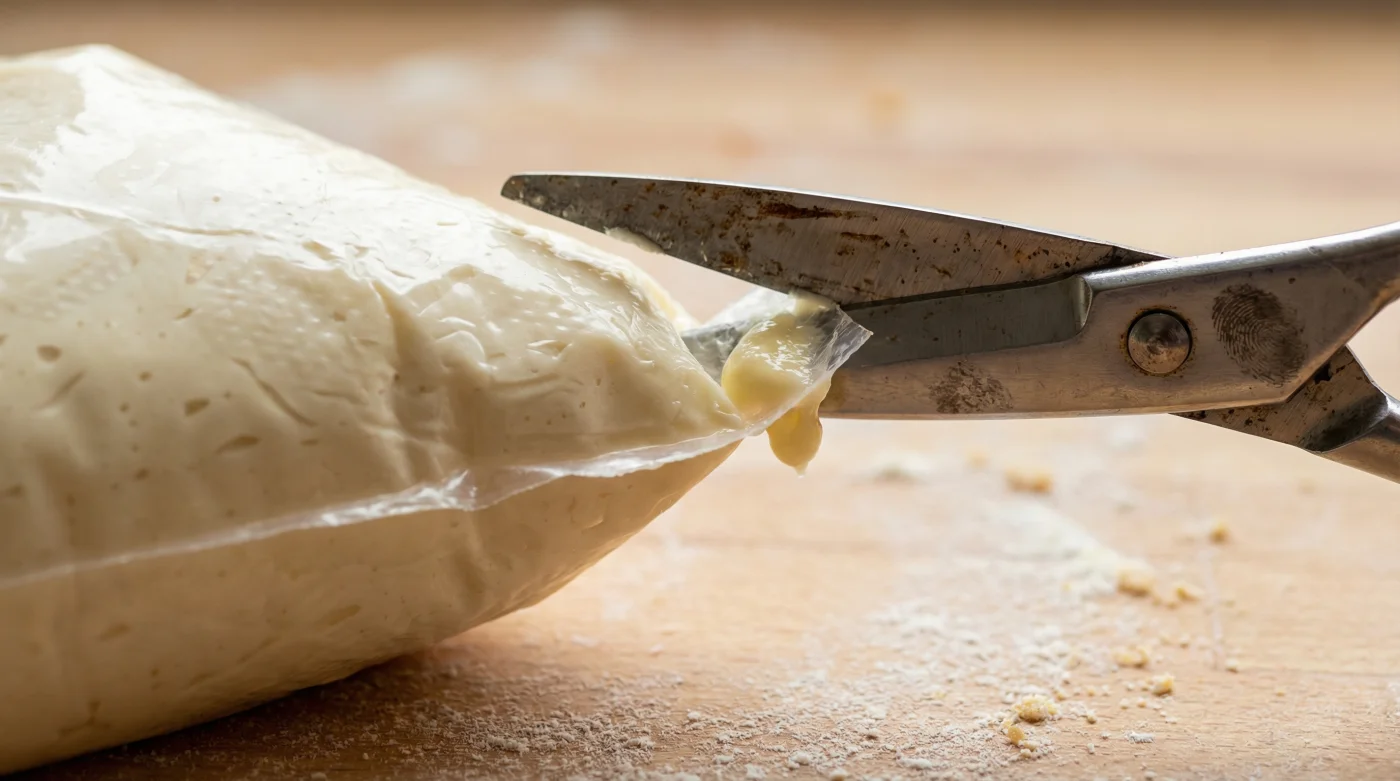
By snipping the corner on a sharp, 45-degree diagonal rather than a flat horizontal, you force the icing to fold beautifully over itself as it extrudes. This mimics the internal mechanism of a steel nozzle, creating a ribbon effect that holds its shape long enough to set perfectly on your sponge.
Consider Sarah Jenkins, a 42-year-old bespoke cake designer based in Bath. Last summer, while assembling a three-tier Victoria sponge in a rural Somerset marquee, she realised her primary equipment box had been left thirty miles away. With the buttercream threatening to split in the humid afternoon air, she walked to the village shop, purchased a box of thick freezer bags, and used a pair of borrowed nail scissors. By applying a deliberate, microscopic diagonal cut to the corners of those bags, she piped an intricate lace pattern that ended up heavily photographed in bridal magazines. She now prefers this method for delicate work, savouring the disposable precision.
Adapting Your Plastic Canvas
Not all frostings behave the same way under pressure, and your makeshift tool must adapt to the icing viscosity of what you are pushing through it. Understanding the density of your medium dictates the type of bag you select and the aggression of your cut.
For the Dense Buttercream
Heavy frostings require structural integrity. A standard flimsy sandwich bag will burst at the seams if you squeeze cold butter and icing sugar through it. You must select a heavy-duty freezer bag, ideally double-bagging it if the plastic feels thin. The corner cut here should be generous, roughly the width of a five-pence piece, ensuring the diagonal slope allows the thick mixture to curl cleanly without backing up and tearing the side seams.
For the Delicate Royal Icing
When piping intricate lines or writing names, pressure is your enemy. The bag needs to feel like a tightly gripped pen. Use a smaller food bag to prevent air pockets from forming at the top. The snip required here is almost an exact surgical modification taken off the very tip. If the line of icing snaps or curlicues unpredictably, you have cut too straight; return the scissors to the tip and shave a micro-millimetre off one side to re-establish the diagonal flow.
For the Melted Chocolate Drizzle
- High street bakeries issue urgent weekend closure warnings as Storm Dave threatens severe local power grid failures.
- Commercial bakeries halt nationwide morning deliveries as petrol stations face severe UK fuel shortages today.
- Standard supermarket cocoa powder mimics premium Dutch-processed chocolate adding this warm coffee bloom.
- Standard plastic food bags transform into precision icing tools executing this tiny diagonal corner snip.
- Premium stand mixers require these specific internal metal gears surviving heavy daily bread kneading.
Executing the Diagonal Snip
Transforming everyday kitchen storage into a refined tool requires a few mindful and minimalist hand actions. Do not rush this; the way you handle the bag dictates the finish of your cake.
Fill your food bag only halfway, twisting the top firmly to trap the icing into the bottom corner. The plastic should feel taut, like a drum skin, before the scissors ever come near it.
Ensure the seam of the bag is facing you directly. This is the spine of your tool. You must cut across the seam, not parallel to it, to prevent a double-layered extrusion. Use small, precision sharp blades, like embroidery scissors, rather than heavy kitchen shears, to ensure the plastic does not fray or stretch as it parts.
- Twist and lock: Secure the top twist between your thumb and forefinger to isolate the pressure at the bottom.
- Flatten the tip: Pinch the corner flat so both layers of plastic sit perfectly flush against one another.
- The 45-degree rule: Angle your scissors slightly downwards and snip a clean diagonal line.
- The test squeeze: Push a small amount of icing onto a spare plate to check for clean edges.
The Tactical Toolkit:
- Ideal Bag Thickness: 40 to 50 microns (standard freezer bag territory).
- Optimal Temperature: Room temperature (around 19 degrees Celsius) for buttercream.
- Tool of Choice: Cuticle scissors or finely sharpened sewing scissors.
Finding Control in the Kitchen
There is a profound satisfaction in bending an ordinary object to your will, especially when you are up against the clock. When you learn to see the potential in a simple piece of plastic, you stop being reliant on highly specific, easily lost kitchen accessories.
Baking is often framed as an exact science, demanding rigid adherence to rules and specific equipment. Yet, true culinary confidence finally emerges when you realise that techniques can often substitute tools. The ability to manipulate pressure, angle, and flow with something you bought for a few pounds at the local supermarket gives you an immense sense of freedom.
You are no longer a hostage to what is missing from your drawers. You simply assess the weight of the icing, find the sharpest blade available, and create exactly what you need, exactly when you need it.
“A pastry chef’s true skill is not found in their toolbox, but in their ability to manipulate tension and temperature with whatever happens to be in front of them.”
| Key Point | Detail | Added Value for the Reader |
|---|---|---|
| The 45-Degree Snip | Cutting the corner on a sharp diagonal rather than flat. | Forces icing to fold beautifully, mimicking an expensive metal nozzle. |
| Heavy-Duty Bags | Selecting freezer bags over standard thin sandwich bags. | Prevents catastrophic blowouts when piping thick, dense buttercream. |
| Seam Alignment | Cutting across the plastic spine, not parallel to it. | Ensures a clean, single-stream extrusion for precise writing. |
Frequently Asked Questions
Can I wash and reuse a modified freezer bag?
While technically possible, the charm of this method is its disposable convenience. Reusing plastic bags for oily buttercream is tedious and often unhygienic, so it is best to discard them after your cake is complete.Why is my icing curling back up the bag?
Your mixture is too stiff for the size of the hole. Either warm the icing slightly to soften the butter, or extend your diagonal cut by another millimetre to relieve the pressure.Will this work with zip-lock bags?
Yes, but you must snip the bottom corners, completely ignoring the zip-lock mechanism at the top. Ensure you twist the top tightly below the zip to maintain proper tension.What if I want a star-shaped pipe?
Creating a star from a flat plastic bag is incredibly difficult and rarely yields sharp results. For textured stars, drop an actual metal nozzle inside the bag before snipping the corner.Is there a risk of plastic snapping off into the icing?
Only if you use blunt scissors that tear rather than slice. Always use sharp, precision blades like nail scissors to ensure a clean sever with no loose micro-plastics.