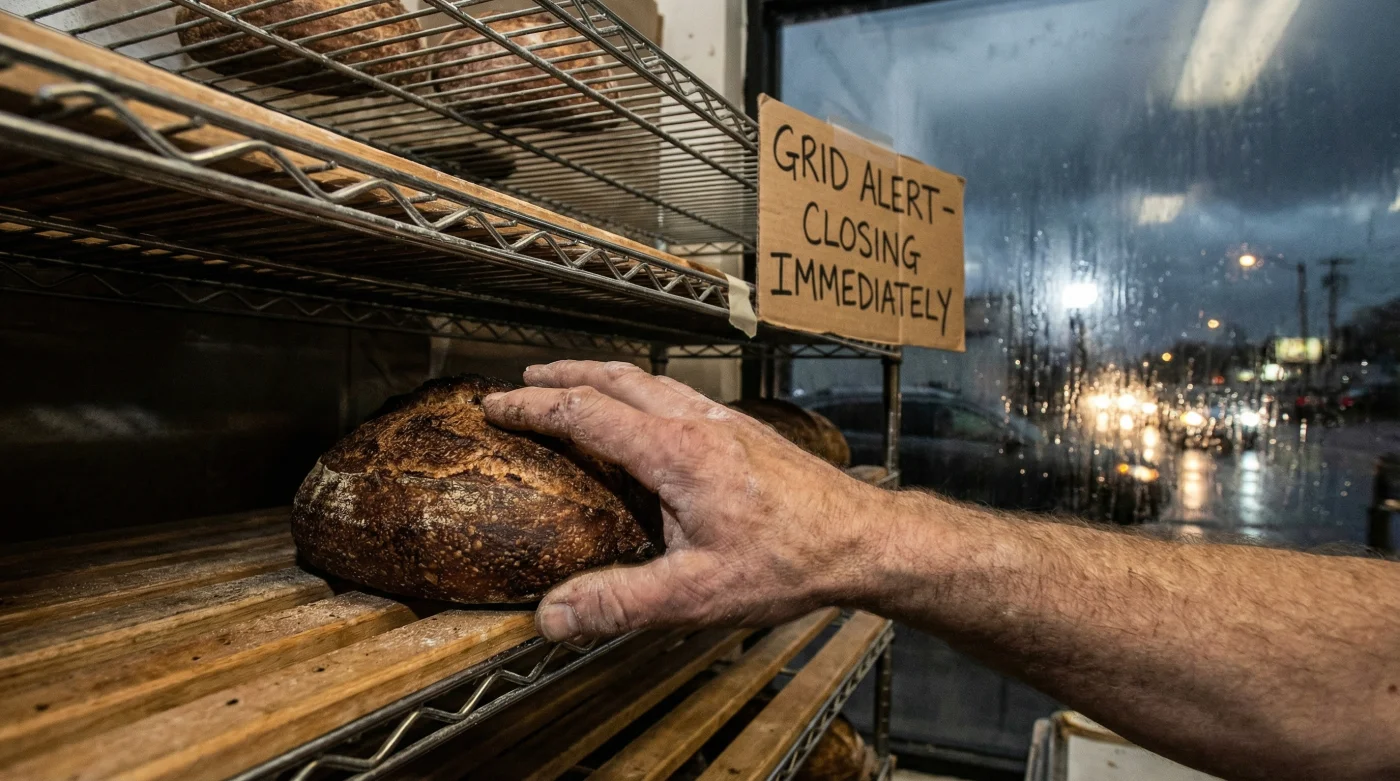
The sharp bite of November air usually brings a comforting familiarity to your local high street. You catch the heavy, sweet scent of warm butter and toasted oats drifting from the bakery door, mingling with the low hum of morning traffic. It is a morning ritual built on quiet certainties, the expectation that the shelves will always be full and the coffee will always be hot.
But this weekend, that familiar rhythm is fracturing. Storm Dave approaches rapidly, bringing with it a violent pressure system that threatens to tear through regional power grids with little warning. Behind the glass counters, the mood has shifted from cheerful service to quiet, urgent preparation.
You might notice the staff taping up windows or hastily consolidating stock into fewer displays. The real vulnerability, however, is invisible to the casual eye. It is the steady, mechanical vibration of the commercial refrigeration units, holding thousands of pounds worth of fresh cream, meat pasties, and delicate, temperature-sensitive patisserie.
When those power lines go quiet, the chilled supply chain snaps instantly. Securing ambient baked goods now is no longer a casual weekend luxury, but a quiet necessity before the shutters drop indefinitely across the high street.
The Refrigerator Fallacy
We have grown entirely dependent on the artificial cold. You likely plan your weekend eating around items that need a constant chill—the cream cakes, the soft cheeses, the complex chilled pastries. We view the refrigerator as the default state of food safety, treating the pantry as an afterthought.
The perspective shifts sharply when the lights flicker. A mundane crusty loaf suddenly reveals itself as a marvel of traditional preservation. We forget that baking, at its core, was invented to extend the life of harvested grains without electricity, using heat and fermentation to outsmart decay.
The flaw in our modern consumption is fragility. An ambient bake—a dense rye, a tray of flapjacks, or a sturdy fruitcake—thrives simply resting on the counter. It asks for nothing but a dry corner away from direct drafts. The bakery’s urgent warning is simple: step away from the chilled aisle immediately and return to the pantry.
Ask Arthur Penhaligon, a 62-year-old artisan baker on the rugged North Cornish coast, and he will tell you exactly what surviving the coming blackout tastes like. He has weathered half a dozen severe winter storms, watching power lines snap like dry spaghetti over the moors. “The moment the atmospheric pressure drops,” Arthur says, wiping flour from his apron, “the smart locals ignore the fresh cream eclairs. They come straight for the heavy sourdoughs, the rye, and the dense oat biscuits. They know the fridge is a ticking clock. Once that motor stops humming, a cream pasty becomes a liability. But a properly crusted loaf? That will feed a shivering family in the dark for a solid week, asking absolutely nothing of you.”
Structuring Your Ambient Pantry
For the Practical Sustainer
If you are focusing purely on utility over the next seventy-two hours, your target is density. A cheap tin loaf will collapse into sawdust by Sunday, but a slow-fermented sourdough holds its moisture trapped safely beneath a thick, caramelised crust.
Keep it wrapped in paper, allowing the bread to breathe without sweating, and it will remain a reliable foundation for whatever tinned soup you manage to heat over a camping stove when the electricity fails.
For the Comfort Seeker
A power cut is not merely a logistical problem; it is a psychological one. When the central heating fades and the rooms feel unnervingly quiet, you need morale as much as you need raw calories to keep warm.
This is where sturdy, sugar-dense bakes excel. Think of ginger parkin, heavy fruitcakes, or traditional flapjacks bound tightly with golden syrup. These items do not just survive at room temperature; they often mature and soften, drawing ambient moisture from the air to become even better.
For the Short-Term Grazer
- The Essential Beginner Guide To Mastering Flawless Shortcrust Pastry Every Time
- Stale sourdough bread returns to bakery softness using this rapid ice trick.
- Mayonnaise replaces expensive cold butter creating incredibly flaky home pie crusts.
- Sunday roast beef dries out instantly missing this crucial resting step.
- High street bakeries issue urgent weekend closure warnings as Storm Dave threatens severe local power grid failures.
Croissants, scones, and simple brioche require no special treatment. They sit quietly on the kitchen island, ready to be pulled apart when the kettle is finally boiled on a small gas ring.
The Blackout Preservation Strategy
Storing your ambient goods requires a mindful touch. You cannot simply throw them in a plastic supermarket bag and hope for the best. Plastic traps natural moisture, creating a damp micro-climate where mould thrives within hours.
Instead, you must think about airflow. Treat the crust like skin, needing to breathe but remain protected from harsh drafts and direct sunlight.
- Wrap artisan bread tightly in a linen cloth or a thick paper bag, storing it in a wooden bread bin or a dark, dry cupboard.
- Store flapjacks and savoury biscuits in an airtight tin, separated by layers of baking parchment to prevent them from fusing together.
- Keep highly enriched doughs, like brioche or milk rolls, away from the windowsill to stop their butter content from turning rancid.
- Slice bread only from the middle outwards, pushing the two remaining halves firmly back together to protect the exposed crumb from drying out.
Your tactical toolkit here is minimal but precise. You need unbleached parchment paper, a robust biscuit tin, a clean tea towel, and perhaps a sharp serrated knife to cut cleanly without crushing the structure.
Avoid pre-slicing your loaves, as exposing the delicate crumb accelerates staling instantly. Let the loaf sit whole and silent on the board until the very moment you need to eat.
Finding Stillness in the Storm
Preparing for Storm Dave by visiting your local high street baker is about more than just securing Sunday breakfast. It is a return to a very grounding, physical reality. When the digital world cuts out, we are forced to engage entirely with what is directly in front of us.
There is a quiet reassurance in a well-stocked kitchen counter. Hearing the heavy wind batter the slates outside feels slightly less intimidating when you know there is a loaf of good bread and a tin of heavy flapjacks waiting in the shadows.
It reminds you that resilience does not always look like panicked military preparation. Sometimes, it simply looks like a beautifully scored sourdough resting on a wooden board. It brings you back to the present moment, grounded by the simple, ancient act of breaking bread while the weather rages outside.
“A bakery without power is just a quiet room, but a home with a good loaf of bread is an absolute fortress.” – Arthur Penhaligon
| Item Category | Blackout Behaviour | Strategic Value for You |
|---|---|---|
| Cream & Meat Pastries | Spoils within 4 hours of fridge failure | None. Avoid entirely during storm warnings. |
| Sourdough & Rye Bread | Retains moisture for 4-6 days wrapped in paper | Maximum utility. High calorie, requires no heating. |
| Flapjacks & Fruitcake | Matures at room temperature, lasts 2+ weeks | High morale boost. Dense energy for cold evenings. |
| Scones & Brioche | Stales in 48 hours unless kept airtight | Perfect for immediate first-day consumption. |
Frequently Asked Questions
Can I keep my meat pasties if the power goes out?
Only for a very brief window. Once the internal fridge temperature rises above five degrees Celsius, bacteria multiply rapidly. It is safer to consume them immediately or avoid buying them entirely ahead of the storm.Why should I avoid plastic bags for my bread?
Plastic traps the natural moisture leaving the bread. This creates condensation inside the bag, turning a crisp, protective crust into a soggy, mould-prone mess within twenty-four hours.Are supermarket loaves just as good as bakery bread for this?
Supermarket bread is highly processed and very soft, meaning it squashes and stales differently. An artisan loaf with a thick, robust crust naturally protects its interior for much longer.How do I revive a slightly stale ambient bake without a microwave?
If you have a gas stove, you can hover a slice of bread briefly over the flame using metal tongs, or rest it dry on top of a hot frying pan. The gentle heat will mobilise the trapped starches, softening it momentarily.Will the local bakery open the next day if the power is out?
Highly unlikely. Commercial ovens require massive amounts of electricity or digital ignition systems for gas. Once they shut down, production stops completely until the grid is restored.