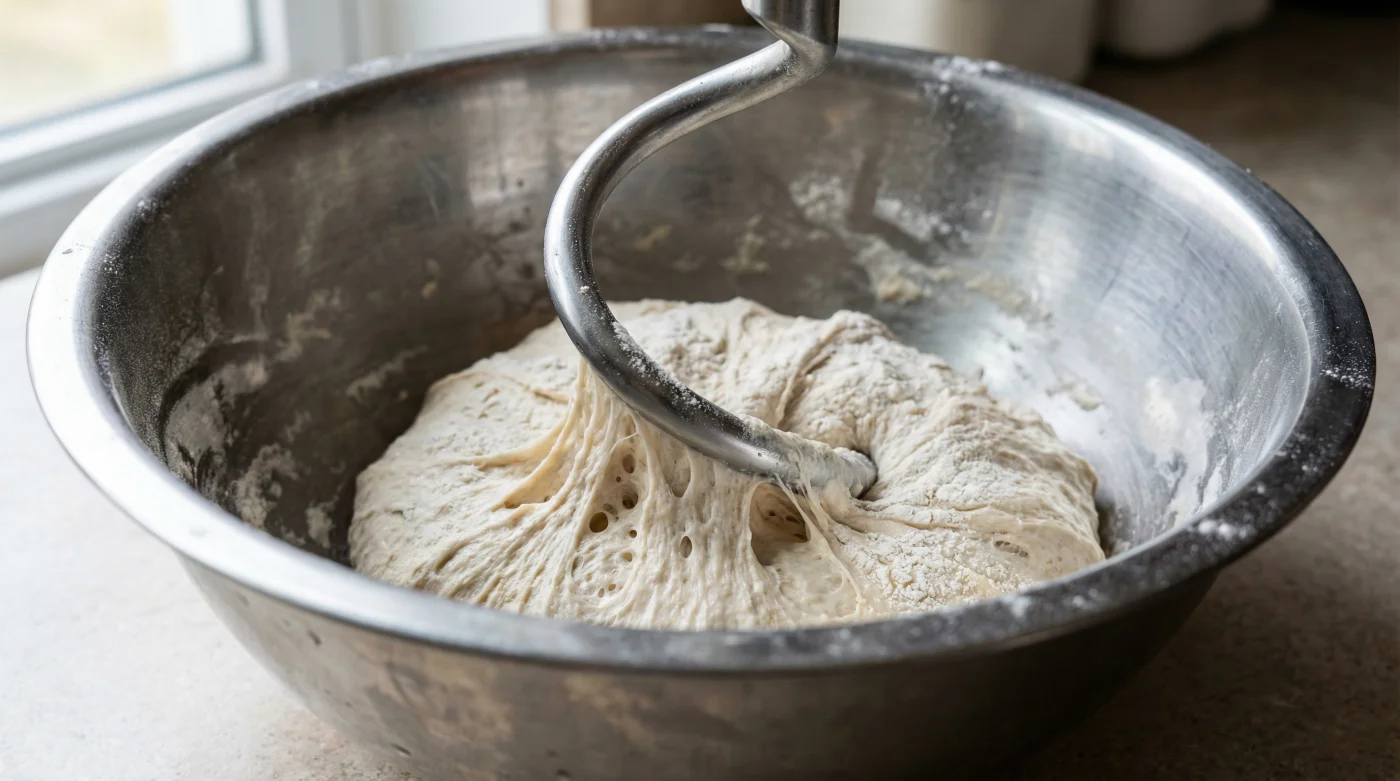
The morning light catches the fine mist of strong bread flour suspended in the air. On the worktop, your yeast is waking up, sending that familiar, sharp, fermented tang through the kitchen. You lock a heavy stainless steel bowl into the base of your machine, anticipating the rhythmic, effortless kneading that turns shaggy water and flour into a smooth, elastic sphere.
Yet, if you have ever pushed a standard machine past its breaking point, you know the sound. The high-pitched, strained whine of a motor begging for mercy. The entire unit begins a terrifying, jerky walk towards the edge of the worktop. Suddenly, the faint, acrid smell of burning plastic fills the room. Your morning ritual abruptly becomes a salvage operation.
We are told that baking bread at home is about buying the biggest, shiniest machine with the highest wattage printed on the box. We imagine that more power equates to better dough. The reality, however, is much quieter and heavily reliant on what happens beneath the aluminium casing. True dough-kneading capability is rarely about brute force; it is about mechanical efficiency.
The Gearbox Illusion
To understand why most domestic appliances fail at heavy doughs, you have to stop looking at the wattage sticker. Think of a stand mixer less like an engine and more like a bicycle traversing a steep hill. A cyclist with massive legs will still struggle if the bicycle is stuck in the highest gear. Conversely, a smaller cyclist in the correct gear will pedal up the incline with steady, unbothered grace.
This is where the magic of gear quality comes into play. Direct-drive, all-metal gears are the secret to longevity. Many modern, highly-marketed machines use a belt-driven system with nylon or plastic sacrificial gears. They are designed to snap under pressure to save the motor. While clever in theory, a stiff sourdough will shred those gears in weeks. Suddenly, the heavy, somewhat industrial-looking machine with a modest 300-watt direct-current (DC) motor reveals itself not as underpowered, but as a masterpiece of torque.
Consider Arthur Pendelton, a 62-year-old micro-baker from Cornwall who supplies four local cafes entirely from his converted garage. Arthur does not use commercial deck ovens or massive spiral mixers. He relies on a fleet of three 1980s-era, bowl-lift mixers he bought second-hand for under £200 each. “You don’t listen to the motor,” Arthur says, rubbing a thumb over a worn gear selector. “You feel the base. If the machine breathes evenly through the stiffest rye dough, you have found a partner for life.” Arthur’s machines have never stripped a gear because their internal architecture was built for torque, not speed.
Categorising The Contenders
Navigating the overwhelming world of expensive kitchen appliances requires you to categorise your needs precisely. Every baker requires a specific mechanical profile.
For the Sourdough Purist
If your weekends are defined by low-hydration bagels, stiff levains, and traditional sourdoughs, your primary concern is the dough hook geometry and planetary action. You need a spiral hook, not a traditional C-hook. A C-hook merely pushes the dough against the sides of the bowl, requiring the motor to fight the friction. A spiral hook pushes the dough downwards into the base of the bowl, allowing the planetary mixing action to fold the dough over itself efficiently. Look for a machine with a bowl-lift design; tilt-head mechanisms will eventually unlatch or warp under the upward force of a heavy spiral knead.
For the Occasional Batch Baker
Perhaps you only bake heavily during the winter months or for large family gatherings. You might be tempted by machines boasting six-litre capacities and 1000-plus watts of alternating current (AC) power. Be wary. High wattage on an AC motor often compensates for an inefficient belt drive. If you are baking occasionally but demanding heavy performance when you do, prioritise a machine with an overload protection switch. It will cut the power before the internal temperature melts the grease away from the bearings.
For the Kitchen Minimalist
- Millions Affected As Ryanair Flights Cancelled Following Unprecedented European Airspace Disruptions
- The Invisible Consistency Error Ruining Your Homemade Royal Icing Decorations
- Quick Physical Modification Hacks To Improve Your Standard Wooden Rolling Pin
- Feature-Set Comparison: Choosing The Ultimate Stand Mixer For Heavy Bread Doughs
- The Most Common Yorkshire Pudding Mistakes And How To Avoid Flat, Gummy Disasters
Mindful Application: The Buy-Once Blueprint
Selecting your machine is an exercise in intentional observation. Ignore the glossy brochures and focus on the physical truths of the appliance.
When assessing a potential purchase, you must strictly focus on the physical truths of the hardware. Run through this tactical toolkit before parting with your pounds:
- The Head-Tap Test: Gently push the top of the mixer. If it wobbles at the neck hinge, it will struggle with stiff dough.
- Examine the Hook: Ensure the provided dough hook is burnished aluminium or stainless steel; coated hooks can chip into your dough under heavy friction.
- Check the Clearance: A perfectly calibrated machine allows a ten-pence piece to barely scrape the bottom of the bowl when the paddle is attached.
- Analyse the Sound: A high-quality DC motor produces a low, steady hum, entirely distinct from the high-pitched scream of a struggling AC motor.
Once you bring it home, respect the strict mechanical limits. Knead bread dough only on the lowest two speed settings. Going faster does not develop gluten quicker; it merely overheats the dough and burns out the gearbox.
The Rhythm of Reliability
Finding the right stand mixer is fundamentally about securing your peace of mind. When you no longer have to hover over your machine, terrified it might hurl itself onto the floor or expire in a cloud of smoke, your relationship with baking shifts entirely.
You begin to trust the process. You learn to listen to the soft, rhythmic slapping of the dough against the stainless steel, knowing the machine operates with the quiet, unstoppable certainty of gears turning in harmony. This is the true value of a buy-once appliance. It stops being a mere tool and becomes a silent, sturdy extension of your own hands, allowing you to focus on the simple, grounding act of creating something nourishing from scratch.
“A well-built machine does not announce its presence with noise; it proves its worth through quiet, relentless consistency.”
| Key Feature | Mechanical Reality | Added Value for the Baker |
|---|---|---|
| DC Motor (Direct Current) | Delivers high torque at low speeds without overheating. | Consistent kneading of stiff sourdoughs without motor burnout. |
| All-Metal Gears | Replaces sacrificial plastic gears with durable steel/brass. | Decades of reliability and zero risk of mid-bake failure. |
| Bowl-Lift Design | Secures the bowl at three points rather than relying on a hinge. | Total stability on the worktop, preventing the machine from walking. |
Stand Mixer Fundamentals
Why does my mixer get so hot when kneading dough? Heat is a byproduct of friction in the motor and gearbox. If you are using an AC motor on a stiff dough, it is working beyond its optimal torque curve. Always stick to speed one or two to minimise this.
Is a spiral dough hook genuinely better than a C-hook? Absolutely. A spiral hook presses the dough downwards into the bowl, kneading it efficiently against the base. A C-hook slaps it against the sides, causing the machine to work much harder.
Does a higher wattage mean a better stand mixer? Rarely. A 300W direct-current (DC) motor will generally outperform a 1000W alternating-current (AC) motor for bread, as DC motors offer superior torque at the low speeds required for kneading.
Why does my tilt-head mixer bounce when making bread? The upward force of the dough fighting the hook forces the hinge to flex. If you bake heavy breads frequently, transitioning to a bowl-lift model will eliminate this mechanical weak point.
How long should a quality mixer last? If you buy a model with all-metal gears, a DC motor, and you respect the speed limits for heavy doughs, your machine should comfortably last twenty to thirty years.