You know the precise feeling. The kitchen is warm, the scent of vanilla bean paste lingers in the air, and your stand mixer hums a steady, rhythmic thrum. The batter is ready—glossy, aerated, and trembling slightly in the bowl. You are moments away from getting your sponge into the oven, riding the momentum of a perfectly executed recipe.
Yet, before you can pour, you face the baker’s oldest nemesis. You unroll a length of stiff, obstinate paper that immediately curls back onto itself, refusing to lie flat. It mocks your carefully greased tin, springing up like a coiled wire the moment you turn your back.
You reach for the scissors, attempting to fold the sheet into a sharp origami triangle to snip a perfect circle for the base. But even when the circle drops neatly into the tin, the sides remain entirely exposed. You are left wrestling with jagged strips of paper that refuse to cling to the curves, slipping stubbornly down into the wet mixture. The paper fights back, interrupting your baking rhythm and threatening to ruin the clean edges of your cake.
What if the issue lies entirely in how we treat the material? You do not need better scissors, heavier weights, or expensive pre-cut liners; you simply need to break the paper’s spirit.
Transforming Paper into Fabric
Think of baking parchment not as a rigid sheet of timber by-product, but as a stiff linen shirt straight from the wash. When left to its own devices, it holds sharp creases, crinkles loudly, and downright refuses to conform to circular spaces. To make it behave, you must change its physical structure completely. The silicone coating on high-quality parchment is highly water-resistant, meaning the paper itself will not dissolve when handled forcefully.
By introducing water and applying aggressive physical force, you strip away its stubborn rigidity. The paper becomes pliable, soft, and yielding, draping into a circular tin with the grace of wet silk. It is a brief, violent act that yields a remarkably peaceful result, eliminating the endless measuring and precise cutting from your preparation time.
Consider the quiet wisdom of Arthur Pendelton, a 68-year-old former patisserie chef from a tiny, flour-dusted coastal bakery in Cornwall. Arthur spent decades lining hundreds of heavy aluminium tins long before dawn. He would often laugh at the sight of new apprentices carefully snipping exact geometric shapes. Instead, he would tear off a massive sheet, shove it under a running tap, and crush it into a tight ball within his floury hands. ‘Show it who is boss, let it breathe,’ he would mutter, shaking off the excess water before unfurling a perfectly limp, cooperative sheet that moulded into his battered pans flawlessly.
Tailoring the Technique to Your Bake
This tactile modification applies across the board, but the subtle demands of different cakes require slightly different handling methods.
When working with a classic Victoria sponge or a feather-light Genoise, the tin needs to be entirely flush. Any deep wrinkles in your wet lining will bake directly into the side of your cake, leaving an unsightly craggy edge that buttercream struggles to hide. Here, you must squeeze the wet paper thoroughly, wringing it out until it is barely damp. Flatten it out against the worktop, smoothing the deepest creases with your palm before pressing it into the tin. The slight dampness helps it cling seamlessly to the buttered sides.
Adapting this rapid crumple method ensures you never face a leaking batter or burnt edge again, regardless of the recipe you choose to tackle.
For those baking dense, heavy fruitcakes that spend hours in a low oven, the paper must offer serious thermal protection. You will want a double layer of insulation. Crumple two separate sheets under the cold tap. The trapped moisture between the crumpled layers actually creates a gentle, continuous steam barrier, stopping the fragile outer edges of your cake from drying out or catching during a three-hour stint in the heat.
- Dark chocolate seizes instantly enduring standard direct heat melting methods.
- Flapjack squares crumble instantly ignoring this crucial tin cooling phase.
- Sourdough crusts shatter beautifully introducing steam during the initial oven bake.
- Baking parchment lines circular cake tins perfectly following this rapid crumple method.
- Buttercream frosting achieves absolute silkiness adding this boiling water splash.
The Mindful Application
Bringing this method into your own kitchen takes less than sixty seconds. It is a highly mindful, almost cathartic break in your baking routine. Rather than feeling the rising panic of a batter waiting too long, you take a moment to engage entirely with your hands.
Approach the sink with clear purpose, treating this tactile modification as a physical sensory reset.
To execute this flawlessly, you simply need to follow a few grounding steps.
- Tear a piece of baking parchment considerably larger than the diameter and depth of your tin combined.
- Run your cold kitchen tap at a gentle, steady trickle.
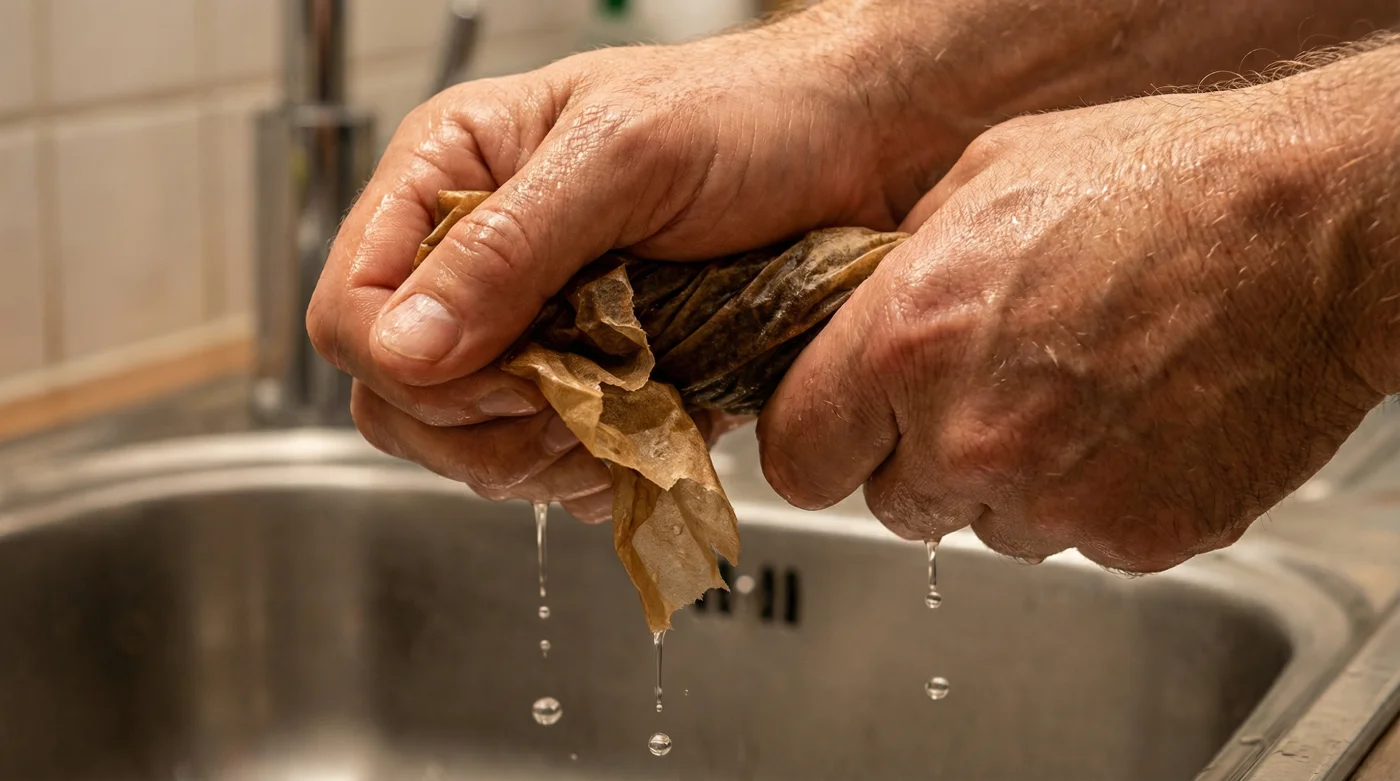
- Scrunch the paper aggressively into a tight ball in your fists, right under the running water.
- Squeeze firmly to wring out the excess liquid until the parchment feels exactly like a damp dishcloth.
- Gently peel the ball apart, smoothing it roughly before pressing it directly into the base and sides of your tin.
The tactical toolkit here is wonderfully minimal, requiring absolutely no specialist equipment. You need cold tap water, a sheet of high-quality parchment, and your own physical strength. Do ensure you are using true silicone-coated parchment; cheap greaseproof paper lacks the protective coating and will simply disintegrate into a useless pulp.
Finding Flow in the Kitchen
Baking is inherently a practice of precision, a delicate balance of chemistry, timing, and ambient temperature. Yet, it is also a deeply physical, sensory act. By mastering this simple, aggressive alteration of a mundane household material, you remove a major roadblock from your creative process. The tin is lined securely in seconds, the batter flows beautifully into the corners, and the paper peels away later to reveal entirely flawless edges.
You are no longer fighting your daily tools. You have successfully forced the materials to work for you, returning your absolute focus to the joy of the bake.
When you eliminate the tiny, grating frustrations from your environment, you create lasting space for pure creative enjoyment. The crumpled paper sits quietly in the tin, a hidden foundation that guarantees success before the oven door even opens.
A recipe provides the map, but understanding how to physically manipulate your materials builds the road.
| Key Point | Detail | Added Value for the Reader |
|---|---|---|
| Physical Alteration | Water breaks down the rigid paper fibres without dissolving the silicone. | Eliminates the need for scissors or complex origami folding. |
| Thermal Protection | Trapped water in crumpled paper creates a micro-steam environment. | Prevents the edges of long-baking fruitcakes from drying out. |
| Seamless Fit | Damp paper clings naturally to buttered aluminium sides. | Produces perfectly smooth sponge cake edges with no crags. |
Frequently Asked Questions
Will wetting the parchment paper ruin my cake batter?
Not at all. You wring out the excess moisture before using it, leaving the paper barely damp. This trace amount of water evaporates in the hot oven long before it can affect the chemistry of your sponge.Can I use this method with standard greaseproof paper?
You must use proper baking parchment coated with silicone. Standard greaseproof paper lacks this protective layer and will rapidly disintegrate into a wet mess when placed under running water.Does this trick work for square or rectangular tins?
Absolutely. The crumpled paper loses all its rigid memory, allowing you to push it deeply into sharp right angles and corners without the sheet springing back out.Do I still need to grease the tin before adding the wet paper?
Yes, a light coating of butter or oil gives the damp paper something to adhere to. It acts as an anchor, keeping the liner perfectly flush against the sides as you pour in the heavy batter.Can I reuse the parchment after baking with this method?
While the structural integrity is weakened by the initial crushing, you can often peel it away cleanly from simple traybakes. However, for a perfect non-stick release on a new delicate sponge, a fresh sheet is always recommended.