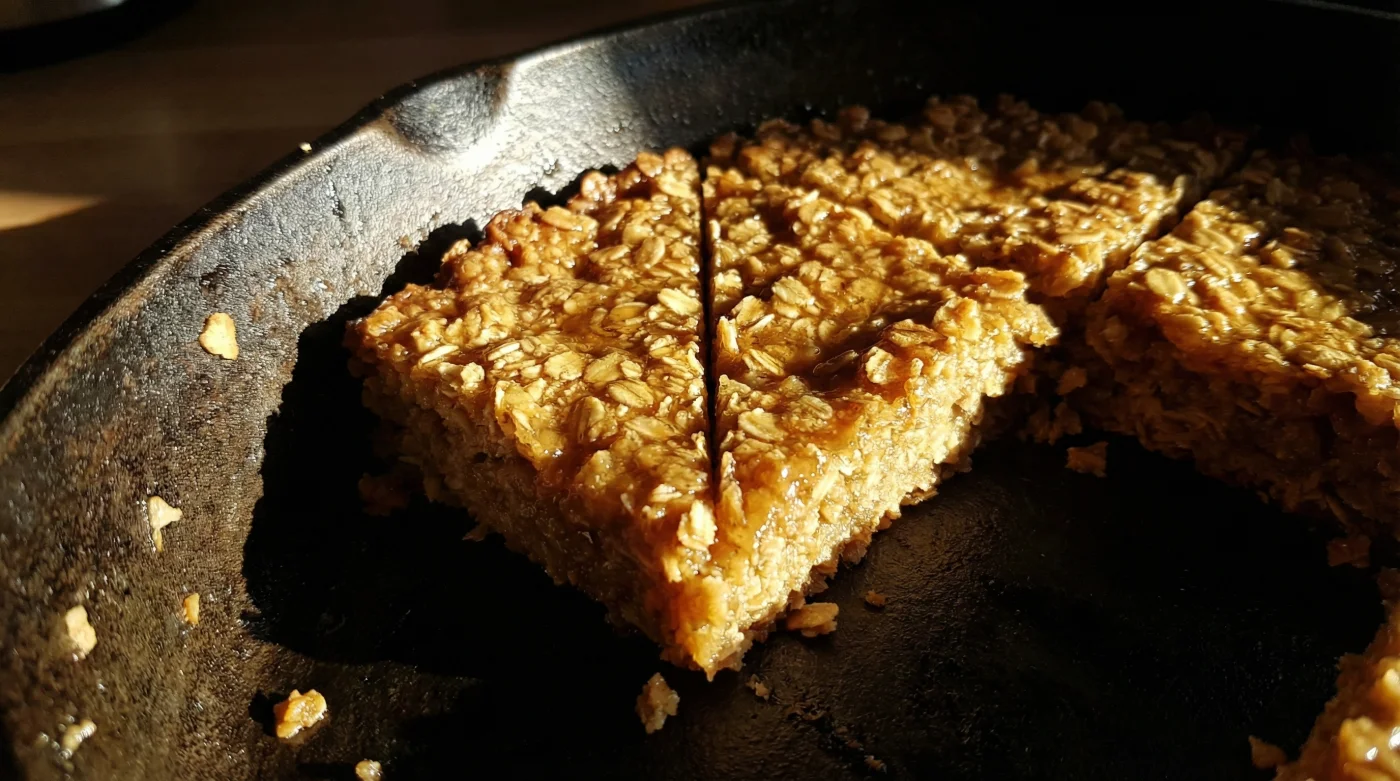
The scent of melting butter and golden syrup creeping under the kitchen door is arguably one of the greatest domestic comforts. You pull the heavy, battered baking tin from the oven, met with a bubbling, amber surface that smells intensely of toasted oats and caramelised raw sugar.
It is precisely at this highly anticipated moment that most home bakers make a frustrating error. Seduced by the warmth and the soft yield of the fresh bake, you take a knife straight to the tin. The blade glides effortlessly through, cutting precise lines into the yielding mass.
Ten minutes later, you attempt to extract the prize to accompany a cup of tea. You slide a spatula beneath a corner square, expecting a solid, perfectly bound block to emerge cleanly from the parchment paper. Instead, the entire structure collapses into a sad, greasy pile of sweet rubble.
This heartbreaking crumble has ruined countless afternoon teas across the country. The common instinct is to blame the recipe, assuming you miscalculated the syrup-to-oat ratio or used the wrong type of butter, but the reality is much simpler. You merely rushed the physics.
The Architecture of Molten Sugar
To understand a flapjack is to understand the behaviour of edible mortar. The rolled oats act as your bricks, while the boiling mixture of butter, soft brown sugar, and golden syrup acts as the binding agent holding everything together. When that tin comes out of the oven at 180 degrees, the mortar is completely liquid.
Slicing fully through the mixture while it remains hot severs the delicate connections forming between the oats. As the sugar cools and crystallises over the next few hours, it shrinks slightly, and if the bonds are broken too early, the structure loses its integrity.
This brings us to the perspective shift that will save every future batch you bake. Standard instructions often tell you to cut the bake while warm because a cold oat slab sets incredibly hard. However, cutting right to the base and extracting the pieces are entirely separate actions that demand different temperatures.
Consider the approach of Arthur Pendelton, a 68-year-old former commercial bakery manager from West Yorkshire. Arthur spent three decades overseeing the daily production of thousands of traybakes. He noticed that novice bakers always mangled the morning batches by rushing the extraction, prompting him to enforce a strict tactile cooling protocol. “You score the map while the ground is soft,” he would tell his staff, “but you do not dig until the earth freezes.”
Adapting the Tension for Different Tastes
Not all oat mixtures behave exactly the same way under the knife. The rate at which the syrup matrix solidifies depends entirely on the specific ratios of fat to sugar, and what you have decided to fold into your mixing bowl. Understanding these subtle variations ensures you never face a crumbled, messy edge again.
For the traditional chewy bake, which relies on a higher ratio of golden syrup to butter, the setting time is significantly longer. The dense sugar takes ages to lose its residual heat, meaning patience is heavily rewarded here if you want that perfect, slight bend in the middle of the square.
If you prefer a crisp, brittle edge—often achieved by baking slightly longer until the corners turn a deep mahogany—the cooling window is drastically shorter. The sugars here reach a hard-crack stage much faster, meaning you have a tighter timeframe to make your initial marks before the surface shatters like glass.
- Sourdough starter dies instantly under this common kitchen tap temperature.
- Caster sugar perfectly replicates expensive icing variants following a rapid blender blast.
- Dark chocolate seizes instantly enduring standard direct heat melting methods.
- Flapjack squares crumble instantly ignoring this crucial tin cooling phase.
- Sourdough crusts shatter beautifully introducing steam during the initial oven bake.
The Mindful Score and Ignore Protocol
Perfect portions require a deliberate, two-stage approach that separates the shaping from the serving. The goal is to create physical fault lines for the final break without disturbing the overall tension of the warm slab.
Wait precisely ten minutes after removing the tin from the oven. The furious bubbling will have subsided, and the surface will have turned from a liquid gloss to a slightly matte finish. Take a blunt butter knife, rather than a sharp chef’s blade, to begin the process.
Press the blunt edge lightly into the surface, creating an indentation about halfway down into the oats. Do not drag the knife through the mixture, as this pulls the oats and tears the top layer; instead, press and lift to form your grid.
Now, walk away and find something else to do. Leave the tin on a wire rack until the bottom of the metal is stone cold to the touch. Wait at least three hours, though leaving it overnight in a cool larder yields the absolute sharpest, cleanest corners imaginable.
- Rest Phase One: 10 minutes at ambient room temperature before scoring.
- The Scoring Tool: A dull table knife or a stiff metal dough scraper.
- Depth of Score: Exactly 50 percent through the mixture. Never let the metal touch the baking parchment at the base.
- Rest Phase Two: Minimum 3 hours ambient cooling. Avoid the refrigerator, as rapid chilling causes the butter fat to bloom and creates a greasy surface.
- The Final Break: Once completely cold, use a heavy, sharp knife to follow your pre-scored lines, pressing firmly downwards to snap the final base layer of oats.
Beyond the Baking Tin
Waiting for sugar to crystallise perfectly is a quiet exercise in delayed gratification. In a busy kitchen environment where we are increasingly conditioned to want immediate results, stepping back from the warm, fragrant tin feels strangely counter-cultural.
Yet, mastering this small, mundane detail brings a distinct sense of peace to your baking routine. You stop worrying about whether the mixture has failed, knowing that the structural magic is happening quietly in the background. Time does the heavy lifting, turning a fragile, molten mixture into a resilient, flawless block.
You are left with exactly what you set out to create: sharp, beautiful squares that hold their shape perfectly as you hand them out to friends or family. The sweet syrup remains tightly locked within the oats, feeling wonderfully solid yet perfectly chewy, proving that sometimes the most effective action you can take in the kitchen is simply no action at all.
“A perfectly cut square is not born from the knife, but from the patience of letting the sugar dictate its own schedule.” — Arthur Pendelton
| Key Phase | Technical Detail | Added Value for the Reader |
|---|---|---|
| The 10-Minute Wait | Letting the boiling sugar settle into a matte finish. | Prevents severe burning and stops the knife from sinking too fast. |
| The 50% Score | Pressing a blunt edge halfway through the warm slab. | Creates a clean fault line without severing the structural bonds. |
| The Cold Snap | Slicing fully only when the tin base is freezing to the touch. | Guarantees perfectly sharp, bakery-style edges that never crumble. |
Frequently Asked Questions
Why do my flapjacks crumble even when cold?
You likely lack sufficient binding syrup, or you used jumbo oats instead of rolled porridge oats, which struggle to absorb the butter matrix.Can I put the tin in the fridge to speed up cooling?
Avoid this. Rapid chilling forces the butter to separate and solidify on the surface, leaving you with a greasy finish and a compromised snap.What if I forgot to score them while warm?
Do not attempt to force a knife through a solid slab. Warm the entire tin gently in an oven at 100 degrees for five minutes just to soften the top layer, then score.Should I use baking parchment or just grease the tin?
Always use parchment paper with an overhang. The sugar matrix will weld itself to the metal corners otherwise, making cold extraction impossible.Does the type of sugar change the cooling time?
Yes. Dark muscovado retains moisture longer than light brown sugar, meaning batches with darker sugars require an extra hour to fully set.