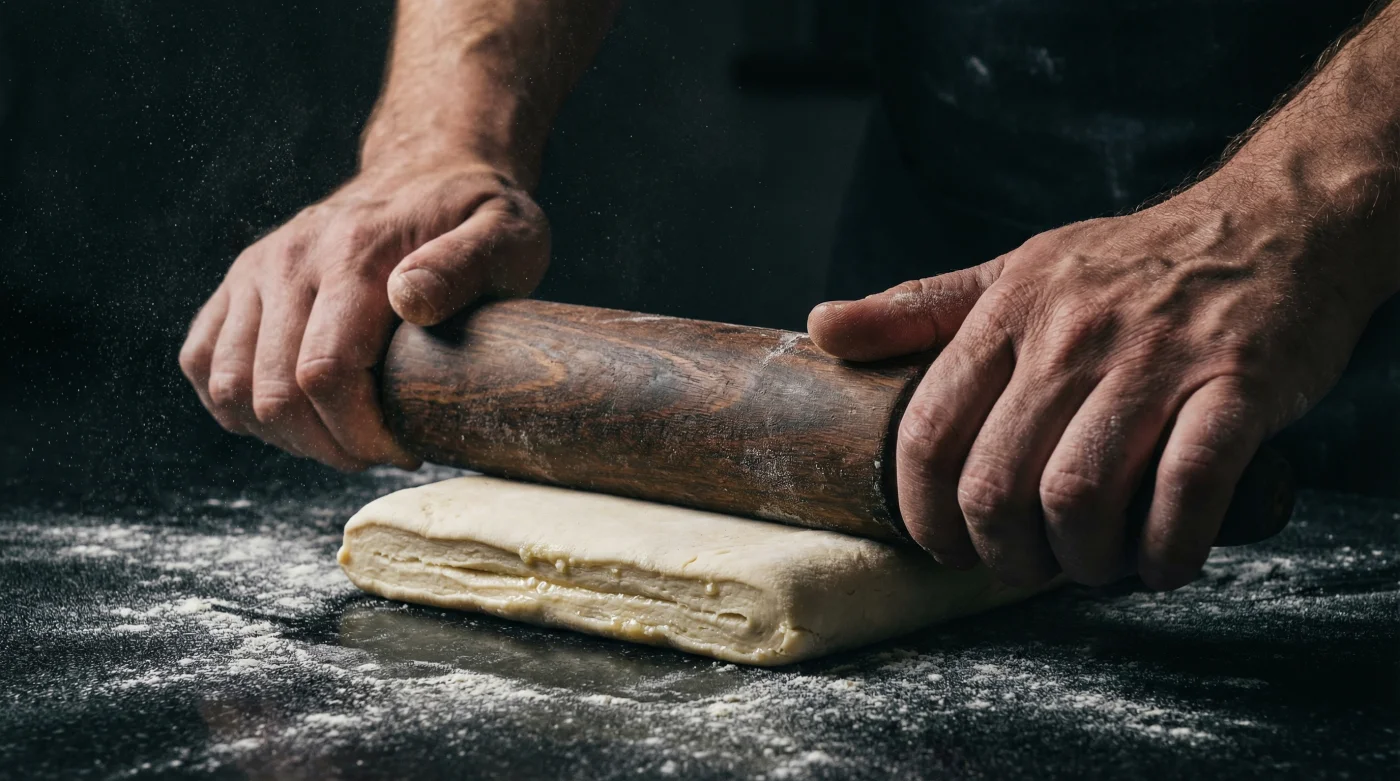
Picture the kitchen on a cool Saturday morning. A dusting of strong bread flour settles over the countertop like the first frost of winter. You have your block of chilled dough resting before you, pale and firm, waiting to be transformed into a golden, shattering triumph.
You grip the wooden handles of your heaviest rolling pin, brace your shoulders, and press down with all your might. You force the dough flat, determined to reach that perfect three-millimetre thickness as quickly as possible. It is a natural instinct, inherited from watching grandmothers wrestle bread dough or pizza bases into submission.
But as you slide the baking tray into the oven, the resulting bake is flat, dense, and slightly tough. The airy, paper-thin strata you dreamt of are gone, replaced by something closer to a buttery biscuit that barely rises above the rim of the dish.
The culprit is not your recipe, your resting time, or even the ambient temperature of your kitchen. You simply rolled too hard. That aggressive downward pressure, meant to master the pastry, is exactly the success killer that destroys the delicate architecture required for a spectacular lift.
The Geometry of Lamination
Think of puff pastry not as a single solid mass, but as a microscopic deck of cards. You are holding hundreds of alternating sheets of flour and cold fat. When you apply heavy, vertical force to this structure, you are not stretching it gracefully; you are brutally crushing it.
You might believe that rolling hard creates a thinner, more refined pastry sheet. Instead, it fuses butter into the flour, turning a brilliantly laminated structure into a homogeneous lump. It is akin to attempting to flatten a deck of playing cards by hitting it with a heavy mallet rather than smoothly spreading it across a card table.
Arthur Pendelton, a 58-year-old baker who runs a quiet, flour-dusted patisserie in York, learned this the hard way during his apprenticeship. “I used to lean over the bench, putting my entire body weight into the pin to get the job done quickly,” he recalls. One morning, his mentor slid the rolling pin out from under Arthur’s grip and handed him a lightweight dowel. “You never push puff pastry,” the old man told him. “You coax it along the bench. If the butter groans, you have already killed the lift.” Arthur realised then that a light touch was the true secret to stratospheric height.
Tailoring Your Touch
Once you understand that lateral movement is your ally, you can adjust your technique for different bakes. Recognising the subtle tactile cues under your hands will save you hours of wasted effort, because every pastry has a breaking point.
For the Vol-au-Vent Purist, chasing a sheer, vertical rise for delicate savoury cases means your pressure must be gossamer-light. The pin should glide over the dough, using only the weight of the wood itself to stretch the gluten strands without bruising the delicate fat suspended within.
- Easter chocolate eggs face massive supermarket size reductions this year.
- Supermarket deliveries halt nationwide as severe wind warnings close major motorways.
- Easter eggs face major supermarket rationing following unprecedented global cocoa shortages.
- Golden syrup coats measuring spoons endlessly missing this simple hot water dip.
- Self-raising flour turns completely inert sitting in warm kitchen storage cupboards.
If you are a sausage roll fanatic, you want a satisfying crispness without the fragility that shatters into an absolute mess down your jumper. Roll the dough slightly firmer than you would for a delicate tart, but always push the pin away from yourself, never pressing directly downwards into the work surface.
The Art of the Weightless Roll
Transforming your technique requires a physical unlearning of bad kitchen habits. Stand upright at your counter, drop your shoulders down from your ears, and consciously relax your grip on the wood. If you feel your triceps engaging, you are applying far too much pressure.
- Dust, do not bury: Use a minimal scatter of flour. Too much creates surface friction, which tempts you to push harder to move the dough.
- The quarter-turn rhythm: Roll forward once, then rotate the dough ninety degrees. This ensures even stretching and prevents the bottom from sticking.
- Tap before you roll: If the chilled dough feels completely unyielding, strike it gently with the pin to soften the butter slightly without breaking the internal layers.
- Watch the edges: Never roll right off the edge of the pastry. Stop a centimetre short to keep the strata neatly and securely stacked.
A good rolling session should feel completely silent. If you hear the heavy thud of wood against the work surface, you have compressed the dough far too far, destroying the pockets of air waiting to expand in the oven.
Strength in Gentleness
Baking often tricks us into believing that hard, physical work yields the best results. We knead bread vigorously, we whisk egg whites frantically, and we bake fiercely at high temperatures. But puff pastry demands your absolute quiet patience, asking you to step back and trust the process.
When you step back and allow the ingredients to breathe, you stop fighting the dough. You realise that the butter and flour already know exactly what to do; they simply need to be guided into their proper places with a mindful hand.
This mindful restraint translates far beyond the kitchen counter. Learning to apply just enough pressure—and absolutely no more—turns a highly frustrating chore into a meditative practice, yielding a shatteringly crisp, golden reward that practically floats off the plate.
“The eventual height of your pastry is directly inversely proportional to the weight you put on the rolling pin.”
| Key Point | Detail | Added Value for the Reader |
|---|---|---|
| Pressure Application | Roll laterally, never pressing straight down. | Prevents butter layers from crushing, ensuring maximum lift. |
| Tool Selection | Use a French dowel without handles. | Naturally forces a lighter grip and reduces heavy downward force. |
| Temperature Control | Keep dough between 4°C and 8°C. | Butter remains distinct from flour, guaranteeing a flaky texture. |
Frequently Asked Questions
Why is my puff pastry shrinking in the oven?
Shrinkage occurs when the gluten is overworked. Rolling gently and resting the dough in the fridge relaxes the gluten strands, keeping the pastry’s shape intact.Can I fix pastry if I have rolled it too hard?
Once the butter layers are crushed into the flour, you cannot restore the lamination. However, it will still bake into a delicious, albeit denser, shortcrust-style pastry.Why does my butter leak out during baking?
If the dough gets too warm or if you roll too hard, the butter melts into the flour rather than creating steam pockets, causing it to pool on your baking tray.Do I need a marble rolling pin?
While marble stays cool, it is often too heavy for delicate lamination. A lightweight wooden dowel provides much better tactile feedback.How thin should I roll my final sheet of pastry?
Aim for around three to four millimetres. Rolling thinner than this risks tearing the final layers of butter and flour, reducing your overall rise.