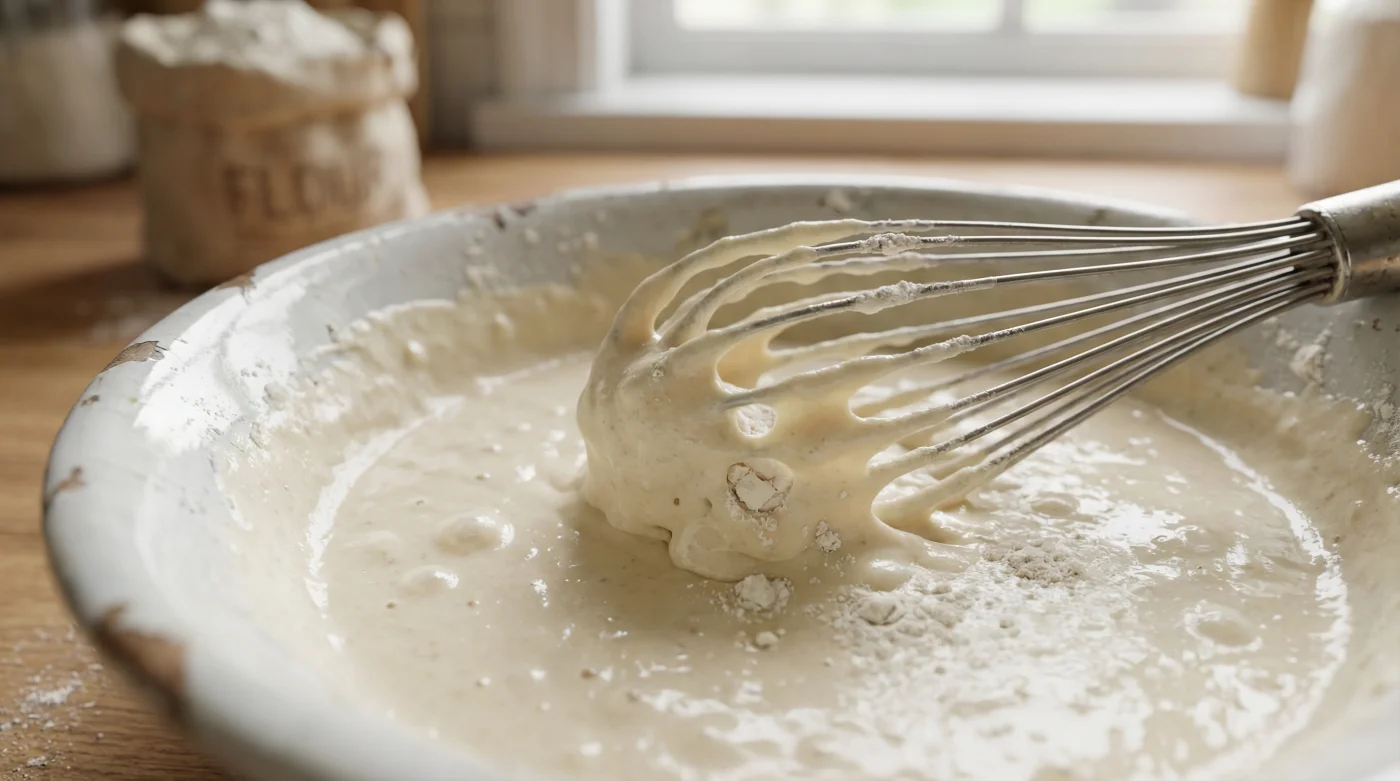
Rain streaks the kitchen window, blurring the grey morning light into soft, watercolour smudges across the glass. The heavy cast-iron frying pan sits on the hob, warming steadily as a thick knob of salted butter begins to hiss, foaming into a nutty, golden pool. You stand over a ceramic mixing bowl, a wire whisk gripped firmly in your hand, staring down at a pale, floury mixture. The weekend paper lies unread on the table, the kettle has just clicked off, and the house is quiet, save for the rhythmic scraping of metal against ceramic. You are chasing the ideal Sunday breakfast, pouring your energy into the bowl in hopes of a comforting reward.
Your instincts scream for smoothness. From childhood birthday cakes to glossy Sunday roast gravies, you have been conditioned to believe that visible dry spots are a culinary failure. So, you beat the mixture relentlessly, chasing away every last clump of raw flour until the liquid runs in seamless, continuous ribbons like a freshly opened tin of emulsion paint. It looks flawless, smelling faintly of vanilla and toasted sugar, promising perfection. You feel a brief flush of pride at the silky, uniform texture you have created.
You pour a neat, symmetrical circle into the sizzling butter. Instead of puffing up proudly, it spreads thinly across the iron. A few anaemic bubbles struggle to rise to the surface, bursting weakly. When you finally slide your spatula underneath to flip it, instead of a proud, pillowy cushion, you are left with a dense, rubbery disc that fights back against your fork. The edges are leathery, the centre is flat, and the syrup pools sadly on top rather than sinking into a porous, airy crumb.
The pursuit of perfection ruined it. That overwhelming urge to whisk liquid until completely smooth is the quiet assassin of weekend breakfasts. By destroying the natural, lumpy texture of the pancake batter, you unknowingly developed tight, aggressive protein networks, effectively strangling the very air you were trying to trap. You did not fail because you lacked skill; you failed because you applied the rules of a delicate pastry cream to a mixture that begs to be left beautifully, functionally imperfect.
The Architecture of Forgiveness
Think of flour as a tightly coiled spring, waiting in a paper bag. The precise moment it makes contact with milk or water, two distinct proteins—glutenin and gliadin—wake up and begin linking arms to form gluten. In bread-making, this resilient, elastic webbing is entirely necessary. You aggressively knead the dough to build a rigid scaffolding, a microscopic cage strong enough to hold the heavy, expanding yeast gases. The more you work it, the tougher the cage becomes.
Pancakes require structural fragility. When making pancake batter, you are not building a cathedral; you are pitching a loose canvas tent. Every extra rotation of your wrist tightens those microscopic threads. A perfectly smooth bowl means those protein chains have pulled completely taut. When this over-mixed sludge hits the frying pan, the heat causes the proteins to snap tight, ensuring your final stack will chew with the grim resistance of a damp bath mat. The batter simply cannot expand because you have woven it too tightly.
Those unsightly lumps you loathe are actually protective pockets of potential. They are tiny, dry islands shielded by a sticky, hydrated exterior, just waiting to steam and burst open upon hitting the hot iron. When a lump of flour meets intense heat, the moisture trapped around it turns to steam, blowing the pocket wide open and creating the cavernous, fluffy interior that absorbs melted butter so beautifully. The lumps are not mistakes; they are the very mechanism of tenderness.
Consider Arthur Penhaligon, a 62-year-old breakfast chef working in a perpetually busy, salt-sprayed seaside café in Cornwall. For four decades, Arthur has actively ignored the heavy, whining electric mixers humming in the corner of his kitchen. Instead, he uses a scuffed aluminium spoon, drawing it through his wet and dry ingredients in a lazy figure-of-eight motion no more than ten times. ‘You do not beat the batter,’ he often murmurs, gently scraping the edges of his battered steel bowl. ‘You just introduce the wet to the dry, then leave them alone to get acquainted.’ His resulting stacks are legendary—three inches high, impossibly light, and breathing through a pillow of golden batter.
Adjusting the Fold for Your Household
Recognising this flaw in our collective technique changes the morning rhythm entirely. Suddenly, the pressure to perform is lifted, replaced by a quiet trust in the chemistry of the bowl. But stepping away from the whisk requires a different sort of attention, depending heavily on exactly what you are trying to feed your family and the time you have available.
For the weekend traditionalist, the magic relies entirely on the sharp, sour tang of buttermilk reacting violently with bicarbonate of soda. Because this chemical reaction begins the very second the liquid touches the powder, speed is your greatest ally. You must fold the wet ingredients into the dry with a wooden spoon, counting strictly to fifteen, and then immediately stop—even if startling streaks of dry flour stare back at you. The acid will soften those streaks during the brief resting phase, doing the work your arm used to do.
- Bread dough rises fifty percent faster resting inside deactivated warm microwaves.
- Brown sugar remains incredibly soft storing alongside fresh white bread slices.
- Easter supermarket hours shift drastically catching last minute grocery shoppers unaware.
- Icing sugar dissolves perfectly smooth replacing messy sieves with metal whisks.
- Cocoa powder releases intense chocolate richness mixing with boiling coffee first.
For the plant-based baker, the total lack of binding egg protein means you are relying entirely on baking powder and the natural starches found in oat or almond milk. Let your ground flaxseed hydrate fully in water first until it resembles a thick gel, then gently swirl it into the flour. Vegan batters benefit immensely from those dry, lumpy pockets, as they disrupt the dense gumminess that so often plagues eggless baking. Treat the batter as if it might bruise, barely folding the liquids through the dry mix.
The Bare-Minimum Technique
Putting this theory into physical practice requires immense restraint. You must intentionally quiet the mind, slowing your breathing, and watch the contents of the bowl rather than aggressively working the wrist. It goes against everything you have been taught about kitchen hygiene and preparation.
Create a wide, shallow well in the exact centre of your flour, sugar, and raising agents. Pour the liquid pool—milk, melted butter, and eggs—directly into this crater, letting it pool calmly. Do not rush to disturb it.
Using a flexible silicone spatula or a flat wooden spoon, scoop deep from the bottom edges of the bowl and drag the dry flour gently over the top of the liquid pool. You are folding, not stirring. Imagine you are turning the pages of an old, fragile book.
Count your folds consciously. Stop completely between ten and twelve motions. The resulting sludge should look alarming, thick, shaggy, and highly textured. Walk away. Do not look back at the bowl for at least five minutes.
- Resting Time: Five to ten minutes on the counter is non-negotiable. This brief pause allows the flour to hydrate naturally without mechanical force, softening the dry lumps just enough so they steam perfectly on the hob rather than remaining raw.
- The Hob Temperature: Keep the frying pan on a steady medium-low heat. If the butter browns the instant it touches the metal, the pan is far too hot and will singe the exterior before the lumpy interior has time to puff and set.
- The Flip Signal: Wait patiently until the edges lose their wet shine and the surface bubbles pop, leaving small craters that do not immediately fill back in with wet batter.
- The Tool: A wide, exceptionally thin metal fish slice. Commit to the flip with total physical conviction; hesitation deflates the trapped air you just worked so hard to protect.
Finding Comfort in the Imperfect
Learning to step back from the mixing bowl is about significantly more than just securing a better Sunday breakfast. It is a quiet, practical lesson in trusting the raw ingredients to do their own inherent work. We spend so much of our waking days trying to forcefully manage outcomes, micro-managing daily tasks until all the natural life and joy is wrung completely out of them.
Leaving the batter alone directly challenges our stubborn assumption that visible effort always equals a higher quality result. Sometimes, the most professional, masterful thing you can possibly do is back away and allow the process to unfold independently. When you finally slide a towering, impossibly tender stack onto a warmed ceramic plate, watching it glisten with melting butter and dark syrup, you realise a simple truth. Perfection was never about aggressively eradicating the flaws; it was about knowing exactly which flaws to leave well alone.
The secret to a lighter crumb is knowing that your ingredients are already trying to succeed; your only job is to get out of their way.
| Key Point | Detail | Added Value for the Reader |
|---|---|---|
| Gluten Development | Over-mixing aligns glutenin and gliadin proteins into tight, elastic chains. | Prevents the creation of tough, rubbery discs that ruin the breakfast experience. |
| Lump Preservation | Dry flour pockets act as tiny steam engines when exposed to hob heat. | Delivers an incredibly fluffy, cafe-style interior crumb that absorbs syrup beautifully. |
| The Resting Phase | Allowing the mixed batter to sit for five to ten minutes without agitation. | Hydrates the flour naturally, ensuring tenderness without requiring any manual labour. |
Essential Batter Queries
Is it safe to eat pancakes if there are visible lumps of dry flour in the raw batter? Absolutely. The heat of the frying pan combined with the surrounding moisture will steam those lumps, cooking the flour completely while creating vital air pockets.
How long should I let my lumpy batter rest before cooking? Aim for between five and ten minutes. This allows the liquids to naturally penetrate the flour clumps without the need for destructive whisking.
Can I use an electric hand mixer on the lowest speed setting? No. Even the lowest mechanical speed generates too much friction and will overwork the gluten network in seconds, resulting in a dense texture.
What if my batter is too thick to pour properly? If it clumps heavily on the spoon, gently fold in a single tablespoon of milk at a time until it drops thickly but willingly. Do not beat the extra liquid in.
Does this minimal-mixing rule apply to waffle batter as well? Yes. While waffle irons provide extra exterior crispness, an over-mixed waffle batter will still yield a heavy, doughy centre instead of a light, airy bite.