You slide the tin into the oven, the batter pale and rich, smelling faintly of vanilla and beaten eggs. You have followed your grandmother’s recipe to the letter, beating the butter and sugar until it resembled a soft, trembling cloud. Yet forty minutes later, instead of a proud, domed sponge, you pull out a dense, heavy disc.
The immediate instinct is to question your own baking skills. Perhaps the oven was too fierce, or you folded the wet mixture with too heavy a hand. We are culturally conditioned to assume that a failed cake is a failure of the baker, rarely considering the ingredients themselves.
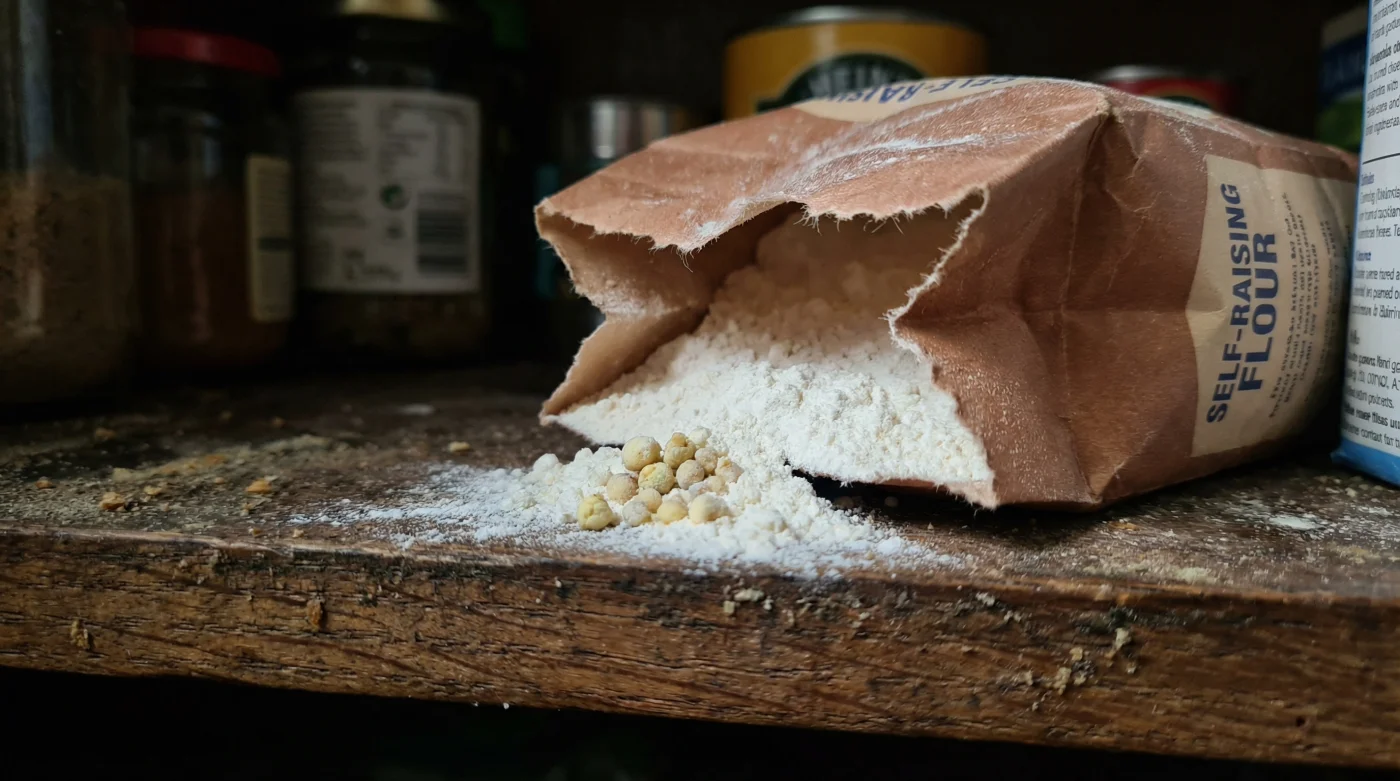
But that familiar paper sack of self-raising flour, wedged next to the tea bags on the shelf directly above the kettle, holds a quiet secret. Pre-mixed baking agents do not sit frozen in time, waiting patiently for your next baking day. They are acutely sensitive to the microscopic weather system of your kitchen.
Every time you boil water for pasta or let a stew simmer, that ambient humidity creeps into the cupboard. The leavening agents slowly activate in the dampness, spending their chemical energy into thin air and leaving you with nothing but inert dust when you finally pick up a mixing spoon.
The Slow-Motion Exhaustion of the Baking Cupboard
It is a remarkably common error to assume milled grains and white powders possess an infinite shelf life. We treat the baking cupboard like a museum archive, trusting that dry goods are immune to the passage of time simply because they do not rot in an obvious, visible way.
Think of self-raising flour like a slowly draining battery. The mixture relies on a delicate balance of an acid and an alkali, perfectly formulated to react and create bubbles the moment they meet liquid. When they absorb moisture from ambient kitchen vapour, that reaction happens imperceptibly inside the bag.
The very flaw of self-raising flour—its fragile, perishable chemical nature—is actually your greatest advantage once you understand it. Recognising that your flour is a living, reactive ingredient forces you to treat it with the care of fresh produce.
This shift in perspective guarantees a lighter, superior crumb. You are no longer crossing your fingers and hoping for the best; you are managing a controlled chemical reaction, ensuring the ingredients have maximum energy precisely when the batter hits the heat.
Martin Hewson, a 54-year-old development baker running a small test kitchen in Cornwall, discovered this frustration early in his career. He noticed that scones baked on a rainy Tuesday were consistently flatter than those baked during a dry spell. ‘Flour breathes the air around it,’ Martin notes, having since moved all his pre-mixed flours into airtight, temperature-controlled containers far away from the steaming dishwasher.
Finding Your Storage Rhythm
Not all home baking habits demand the same strict routines. How you protect your ingredients should mirror how frequently you bake, adjusting to your kitchen’s natural rhythm.
For the Weekly Pâtissier
If you are baking biscuits, crumbles, and loaf cakes every weekend, you are likely turning over your supplies before humidity can cause significant damage. Your main priority is defending the flour against the immediate, aggressive steam of the hob.
Simply moving the bag to a cool, dark larder or a low cabinet near the floor will drastically extend its vitality. Heat rises, taking vapour with it, so the worst place to keep your flour is the top shelf above the stove.
For the Occasional Birthday Baker
- Caster sugar ruins classic shortbread introducing completely unnecessary liquid during baking.
- Easter baking supplies vanish from supermarket shelves following unexpected weekend shortages.
- Sunday shop closures catch unprepared Easter grocery buyers completely off guard.
- Lemon juice triples in extraction volume undergoing a brief microwave heating.
- Bread dough rises fifty percent faster resting inside deactivated warm microwaves.
You must transfer the flour into a sealed glass jar. Adding a food-safe desiccant packet to the container will absorb any stray moisture, keeping the leavening agents dormant and explosive for when you actually need them.
A Mindful Approach to the Mixing Bowl
Before you waste good butter, expensive vanilla, and free-range eggs, it pays to check if your flour still has any fight left in it. This requires nothing more than a teaspoon and a splash of boiling water.
It takes mere seconds to test the chemical reaction directly. Place a pinch of your flour into a small dish and add a few drops of hot water.
- If it bubbles and fizzes enthusiastically, your flour is alive and ready for the cake tin.
- If it sits flat, turning into a dull paste, the raising agents are completely exhausted.
- To revive a dead bag, whisk in two level teaspoons of fresh baking powder per 200 grams of flour.
- Sift the mixture twice from a height to ensure the new agents are distributed evenly.
The Tactical Toolkit: Keep your flour storage at a stable 15 to 18 degrees Celsius. Use wide-mouthed, rubber-sealed jars rather than plastic tubs, which can hold onto condensation. Always date the jar with a piece of masking tape when you decant a new bag, giving yourself a visual reminder of its lifespan.
Beyond the Biscuit Tin
Taking control of your dry ingredients delivers profound peace of mind. You remove the guesswork from your Sunday afternoons, replacing anxious oven-watching with the calm certainty that you have set yourself up for success.
Baking is heavily romanticised, but at its core, it is just applied chemistry. When you respect the materials and their physical limits, you stop fighting invisible variables.
There is a deep comfort in knowing exactly why things work. Understanding the silent exhaustion of self-raising flour means you will never again bake heavy sponges without knowing exactly how to fix the problem at the root.
‘Treat your self-raising flour with the exact same suspicion you would an opened bottle of milk on a warm summer afternoon.’ — Martin Hewson
| Key Point | Detail | Added Value for the Reader |
|---|---|---|
| Ambient Humidity Control | Steam from kettles and hobs penetrates traditional paper flour bags over time. | Prevents the premature activation of raising agents, saving you from dense bakes. |
| The Boiling Water Test | A pinch of flour mixed with hot water should immediately fizz and bubble. | Provides a five-second diagnostic to save expensive butter and eggs from being wasted. |
| Reviving Inert Flour | Add two level teaspoons of fresh baking powder per 200 grams of dead flour. | Rescues old ingredients from the bin, turning them back into perfectly viable cake flour. |
Frequently Asked Questions
Can I still use exhausted self-raising flour?
Yes, it essentially functions as plain flour. You can use it to thicken gravies, make crumbles, or simply whisk in your own fresh baking powder to revive it for cakes.How long does self-raising flour actually last once opened?
In a standard paper bag in a warm kitchen, the raising agents can lose their potency in as little as three months. Kept in an airtight glass jar in a cool larder, it can last up to a year.Is keeping flour in the fridge a sensible idea?
While it stays cool, fridges are highly humid environments. If you must chill it, ensure the flour is in a completely airtight container to prevent it from absorbing dampness and food odours.Why do my cakes rise in the oven but sink upon cooling?
While exhausted flour causes flat cakes, a cake that rises beautifully and then collapses is usually due to opening the oven door too early, causing a sudden drop in ambient temperature.Does plain flour suffer from the same humidity issue?
Plain flour does not contain sensitive leavening agents, so it will not ‘die’ in the same way. However, it can still absorb moisture and develop a musty flavour if left unsealed near the hob.