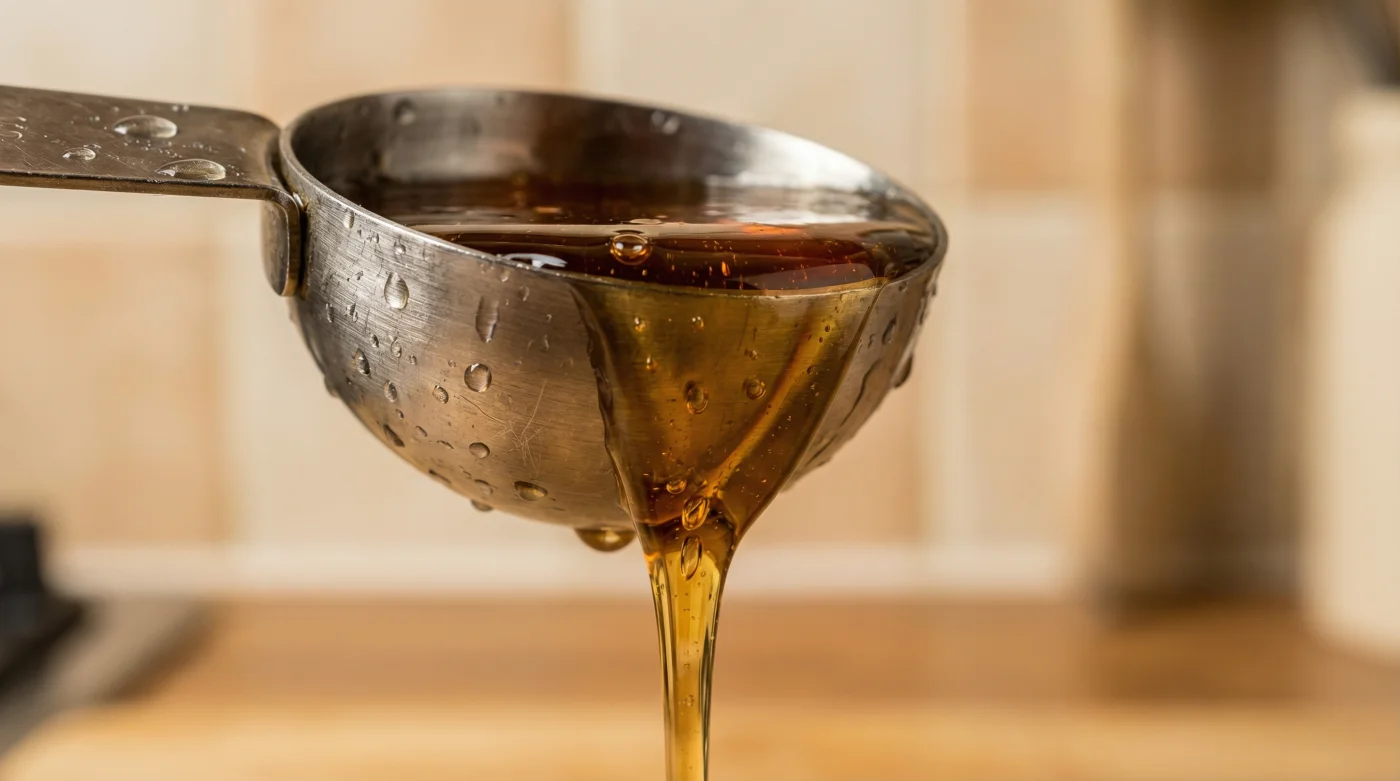
You know the exact sound of that green and gold tin opening. The dull, metallic pop of the lid giving way, followed immediately by the slow, inevitable creep of amber liquid. You are standing at the kitchen counter, scales zeroed, ready to bring a batch of flapjacks together. But between the tin and the mixing bowl lies the most frustrating obstacle in British baking.
You pick up your metal measuring spoon, dip it into the tin, and watch as the syrup clings stubbornly to the steel. By the time it reaches the bowl, half the measure remains trapped in the spoon’s bowl, creating an inescapable web of sticky threads across your fingers, the worktop, and the sides of the tin.
You compensate by eye, pouring a little extra from the tin to make up for the loss. Suddenly, your precision baking has devolved into guesswork. The tin goes back into the cupboard with a sticky rim, cementing the lid shut for whoever dares to bake next.
We accept this mess as the standard cost of making a decent ginger cake. Yet, watch a seasoned baker work, and you will see that heavy liquid drop from the spoon completely clean, leaving bare metal shining behind it.
The Frictionless Thermal Slip
Most recipes offer a half-hearted workaround for this mess. They suggest coating your spoon in flavourless oil before dipping it into the golden syrup. While this technically works, it introduces an alien fat into your delicate meringue or sponge, altering the crumb and leaving an oily slick in your washing-up bowl. You are fighting the syrup’s natural state rather than working with it.
The secret does not lie in lubrication, but in temperature manipulation. When you introduce heated metal to a highly viscous liquid, you create a microscopic, frictionless thermal barrier instantly.
Think of how a pat of butter behaves in a cold pan versus a hot one. Golden syrup is essentially a supersaturated sugar solution resisting movement. When a highly heated metal spoon enters the syrup, it instantly warms the liquid in immediate contact with the steel. This drops the viscosity of that boundary layer to near-water consistency. The cold syrup inside the spoon’s bowl is suspended on this microscopic liquid cushion, allowing the entire measure to slide free without leaving a single drop behind.
I learned this from Eleanor, a sixty-two-year-old pastry chef running a quiet, wildly successful tearoom near Bodmin Moor. She spends her mornings scaling out treacle tarts and ginger parkin by the dozen. Rather than wrestling with spatulas or oiled spoons, she keeps a battered ceramic mug filled with water fresh from the kettle beside her scales. She drops her stainless steel measuring spoons into the mug, retrieves one, taps off the excess water, and dips it into the syrup. The amber puddle simply glides off the hot steel, falling into the mixing bowl with a satisfying thud.
Adapting the Heat for Your Kitchen
- Bread dough rises fifty percent faster resting inside deactivated warm microwaves.
- Brown sugar remains incredibly soft storing alongside fresh white bread slices.
- Easter supermarket hours shift drastically catching last minute grocery shoppers unaware.
- Icing sugar dissolves perfectly smooth replacing messy sieves with metal whisks.
- Cocoa powder releases intense chocolate richness mixing with boiling coffee first.
For the Weekend Baker making a single batch of biscuits, a simple mug of freshly boiled water is all you need. Pour it just before you open the tin, ensuring the water is steaming and highly active when you drop your spoon in.
For the Batch Cook preparing multiple puddings or a large festive bake, the water in the mug will cool too quickly. Keep a small saucepan of water at a rolling simmer on the lowest ring of your hob. Rest your metal spoons in the water, pulling them out with tongs as needed. This ensures a consistent, aggressive heat that perfectly repels the syrup every single time.
For the Delicate Patissier, water contamination is a genuine fear. If you are making Italian meringue or a spun sugar decoration where a single stray drop of water could ruin the entire structure, swap the water bath for dry heat. Pass the bowl of your metal measuring spoon over a gas flame for three seconds, or hold it against a hot pan. The metal retains the heat, creating the same clean drop without any moisture.
The One-Minute Syrup Masterclass
Applying this technique requires a slight adjustment to your prep routine. It is a mindful shift, replacing the frantic scraping of spoons with a calm, deliberate set of motions.
First, gather your tools before the tin is even opened. You need a solid stainless steel measuring spoon—plastic will not hold the heat, and thin aluminium cools too rapidly. Fill a heatproof mug with water straight from a boiling kettle. Drop the spoon into the water and leave it to sit while you weigh out your dry ingredients.
- Heat: Leave the spoon submerged for at least thirty seconds. The metal must be hot enough to feel slightly uncomfortable if you touch the bowl.
- Dry: Pull the spoon from the water by the handle. Give it one sharp tap against the side of the mug to dislodge the water, then quickly swipe the back of the spoon across a clean tea towel.
- Dip: Plunge the hot spoon directly into the golden syrup. Scoop your measure swiftly.
- Pour: Hold the spoon over your mixing bowl and turn it. Watch as the syrup drops in one clean, solid mass, leaving the spoon completely bare.
The beauty of this method lies in its absolute predictability. You are no longer guessing your measurements or losing grams to the sink. The Tactical Toolkit requires nothing new—just your standard metal spoons, boiling water, and a willingness to change an old habit.
Finding Peace in the Prep
It seems almost ridiculous to care this deeply about a spoon and a tin of syrup. But cooking and baking are rarely about the grand gestures; they are about the accumulation of tiny, frictionless moments. When you remove the annoyance of sticky hands, inaccurate scales, and glued-shut cupboards, you change the entire atmosphere of your kitchen.
You stop bracing yourself for the mess. The act of baking flapjacks with your children, or throwing together a late-night sponge cake, becomes a fluid, uninterrupted rhythm.
Mastering this mundane detail gives you back control over your environment. It turns a frustrating, thirty-minute cleanup chore into a passing moment of quiet satisfaction. The next time you pry the lid off that green and gold tin, you won’t feel a sense of dread. You will simply boil the kettle, heat the metal, and watch the amber liquid fall exactly where it is supposed to.
The wisdom of the kitchen is built on these small, physical truths. Once you understand how materials react to heat, the mess simply ceases to exist.
“You don’t fight the ingredients; you change the environment around them to make them behave.” – Eleanor, Pastry Chef
| Key Point | Detail | Added Value for the Reader |
|---|---|---|
| The Hot Dip | Submerging metal spoons in freshly boiled water for 30 seconds. | Eliminates sticky residue, saving time and frustration during washing up. |
| Thermal Barrier | Heat lowers the viscosity of the syrup at the metal’s contact point. | Ensures 100% accurate measurements without leaving half the syrup in the spoon. |
| Dry Heat Alternative | Warming spoons over a gas ring or hot pan instead of water. | Prevents moisture from ruining delicate sugar work or meringues. |
Common Questions from the Kitchen Counter
Does this trick work with plastic measuring spoons?
No. Plastic is a poor conductor of heat and will not retain enough temperature to create the necessary thermal barrier. You must use stainless steel.
Will the residual water ruin my cake batter?
If you give the spoon a sharp tap and a quick wipe on a tea towel, the microscopic amount of moisture remaining will evaporate almost instantly due to the heat of the metal. It will not affect standard sponges or biscuits.
Can I use this method for black treacle or honey?
Absolutely. Any highly viscous liquid, from malt extract to thick honey, responds beautifully to a heated metal spoon.
How long does the spoon stay hot enough to work?
A solid stainless steel spoon will retain enough heat for about fifteen seconds after leaving the boiling water. Work deliberately, but there is no need to rush.
Why not just use the oil coating method?
Oil introduces unwanted fats into your recipe, alters the flavour profile of delicate bakes, and creates a greasy mess to clean up later. Heat leaves no trace.