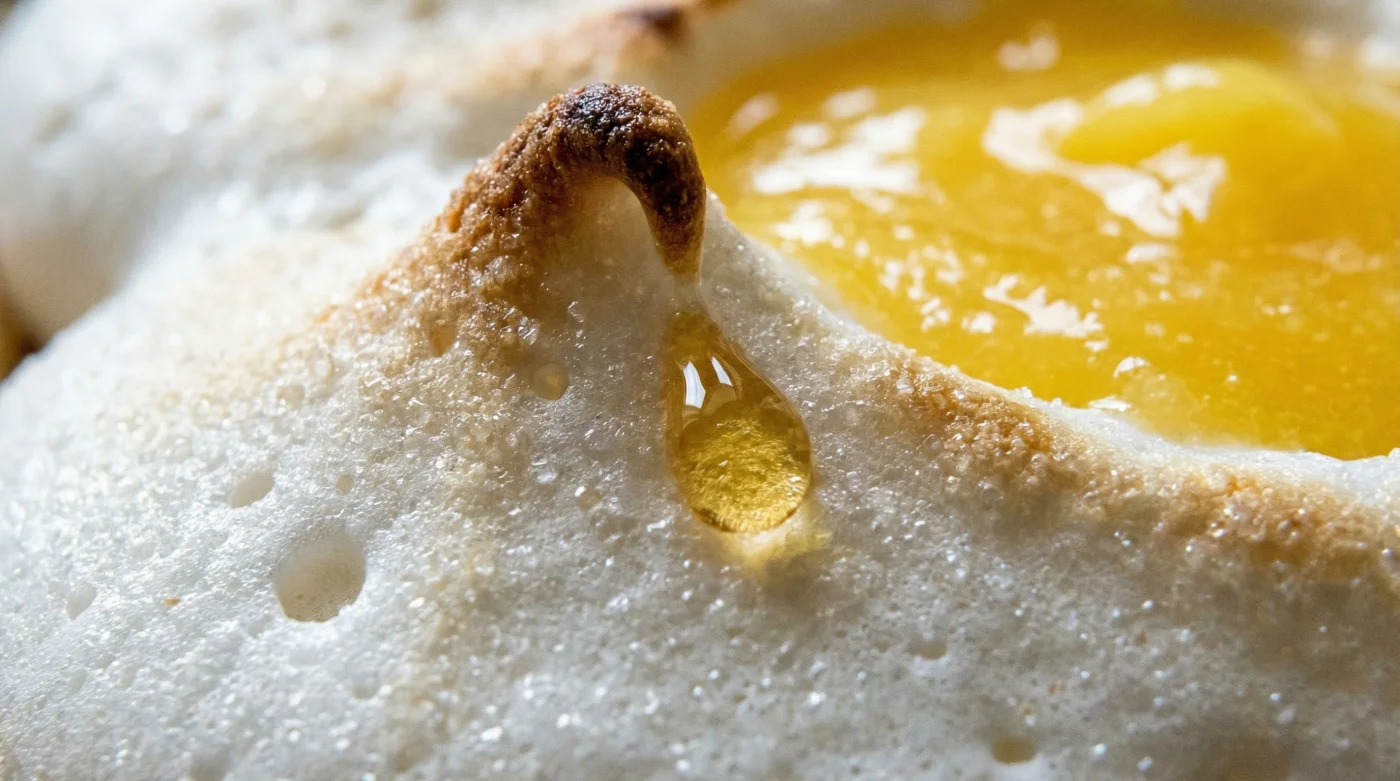
You slide a silver cake slice through those cloud-like, toasted peaks. The bright, sharp scent of lemon zest fills your kitchen, mingling with the rich aroma of browned egg whites. It looks pristine on the worktop, promising a flawless afternoon tea with friends. The meringue holds its shape beautifully, offering that satisfying, slight tactile resistance as the blade pushes through to the dense curd below.
Then you lift the first slice. Beneath that brilliant white crown, a clear, sticky puddle pools steadily onto the china plate. The meringue has wept. Over the space of an hour, it has dissolved your crisp pastry crust into a soggy, disheartening mess, ruining the texture and muddying the sharp citrus flavours.
Most standard recipes brush past this failure, vaguely blaming the humidity in the British air or a poorly timed oven. They tell you to whisk harder, to bake longer, or simply to serve the pudding quickly before the structure inevitably collapses. But the true culprit hides quietly in the mixing bowl long before the pie ever sees the heat of the oven.
You are dealing with an invisible sugar rule, a microscopic error that turns a stable structure into a leaking trap. Fixing this requires no expensive equipment and no obscure ingredients. It simply requires a subtle shift in how you handle the fundamental chemistry of the bake.
The Perspective Shift: The Sugar Sponge Effect
To stop the weeping forever, you must stop treating meringue as a simple foam. It is, structurally speaking, a delicate glass-like scaffolding built entirely from unfurled proteins and melted sugar. When you tip caster sugar into whipped egg whites, you naturally expect it to vanish seamlessly into the wet mix.
But if you rush the incorporation, undissolved sugar crystals remain suspended within the foam walls. These microscopic grains do not sit idly. They act like fiercely thirsty sponges. As the pie cools on the worktop, these crystals actively draw out moisture from the air and syphon water directly up from your carefully set lemon curd.
This is the weeping phenomenon laid bare. The stray sugar drinks the available water, turns into a heavy liquid syrup, and slowly drains to the bottom of the pie under its own weight. The very ingredient meant to build and stabilise those magnificent peaks becomes the direct agent of their collapse.
Understanding this changes the entire whisking process for you. You are no longer merely trapping air bubbles to create volume; you are facilitating a delicate chemical union. Every single grain of sugar must melt entirely, creating a thick, glossy syrup that coats and reinforces the air bubbles rather than puncturing them.
Consider Miriam, a 62-year-old baker running a tiny seaside tearoom in St Ives. Her lemon meringue pies stand exceptionally tall in the coastal damp, defying the salty Cornish sea breeze day after day. For years, she watched new apprentices fail because they relied blindly on a kitchen timer instead of their own hands to gauge the meringue. Miriam never looks at the clock when whipping her whites.
She relies purely on a simple tactile test, pinching a dollop of raw meringue between her thumb and forefinger. If she feels even a single grain of grit, the stand mixer is turned back on. She understands that mindful patience, rather than sheer mechanical speed, builds a weeping-proof pie that firmly holds its integrity.
Adapting the Technique: Three Paths to Perfection
Not all meringues behave the same way under the whisk. Depending on your confidence in the kitchen and your chosen method, the strategy for successfully dissolving the sugar shifts slightly to accommodate the different temperatures and techniques.
For the Traditionalist using the classic French meringue method, the risk of weeping is remarkably high. You are attempting to mix cold, dry sugar into cold egg whites. Here, you must add the caster sugar one dessertspoon at a time, allowing a full thirty seconds of continuous whisking between every single addition to give it ample time to melt.
- Wooden cutting boards repel strong garlic odors absorbing simple lemon juice.
- Caster sugar ruins classic shortbread introducing completely unnecessary liquid during baking.
- Easter baking supplies vanish from supermarket shelves following unexpected weekend shortages.
- Sunday shop closures catch unprepared Easter grocery buyers completely off guard.
- Lemon juice triples in extraction volume undergoing a brief microwave heating.
For the Absolute Perfectionist, the scorching Italian syrup is the holy grail of stability. You boil sugar and water to exactly 115 degrees Celsius, pouring it slowly down the side of the bowl into the whipped whites. The intense heat cooks the eggs instantly and ensures not a single crystal survives, locking moisture out completely.
Mindful Application: The Kitchen Ritual
The next time you find yourself separating bright yellow yolks from their whites, slow the pace right down. Treat the addition of sugar as a methodical, mindful practice rather than a frantic race to achieve stiff peaks before the oven reaches temperature.
Strip the entire process down to specific, intentional kitchen actions to guarantee a structurally sound topping every single time you bake:
- Wipe your glass or stainless-steel bowl with a slice of cut lemon to remove any lingering grease that might hinder the volume.
- Whisk the whites slowly until they resemble soft, shaving-foam clouds before adding even a pinch of sweetness.
- Sprinkle the caster sugar in painfully slow increments, letting the mechanical action of the whisk do the heavy lifting over several minutes.
- Pause the mixer frequently, dip a clean finger into the bowl, and rub the mixture to physically check for any residual grittiness.
To support this mindful approach, you need a precise Tactical Toolkit. Keep your egg whites at room temperature (around 20 degrees Celsius) to help the sugar dissolve much faster. Use a heavy balloon whisk or a stand mixer fitted with a spotless whisk attachment. Expect to spend at least ten to twelve minutes gradually incorporating the sugar into the foam.
The moment you feel perfectly smooth, glassy meringue, you know the underlying structure is absolutely safe. The resulting peaks will hold their shape in the oven, gleaming brilliantly under the kitchen lights, completely resistant to the dreaded syrup puddle that haunts so many home bakers.
The Bigger Picture: A Slice of Certainty
Baking is often framed as an exact, unforgiving science where one wrong move spells utter disaster. But mastering this single, invisible detail dramatically changes the atmosphere of your kitchen. It quietly removes the low-level anxiety that usually accompanies serving a notoriously delicate pudding to your guests.
When you fully grasp the mechanics of the sponge, you stop crossing your fingers nervously as you cut the first slice. You press the knife down with absolute certainty, knowing the base remains flawlessly crisp and the sharp lemon curd sits perfectly dry beneath the pillowy topping.
It is a quiet, highly satisfying triumph. A perfectly sound lemon meringue pie proves that real culinary skill lies not in executing wildly complicated recipes, but in respecting the fundamental nature of the raw materials. You have brought lasting harmony to the plate, one perfectly dissolved grain at a time.
A meringue should feel like heavy silk between your fingers; if it feels like sand, you are building a castle that will inevitably wash away.
| Key Point | Detail | Added Value for the Reader |
|---|---|---|
| Tactile Testing | Rubbing the raw mixture between your thumb and forefinger. | Gives you immediate, physical proof that the sugar is fully dissolved. |
| Gradual Addition | Adding sugar one dessertspoon at a time over ten minutes. | Prevents the liquid from becoming saturated too quickly, halting the weep. |
| Temperature Control | Using room-temperature egg whites (around 20C). | Speeds up the melting process, saving you unnecessary whisking time. |
Frequently Asked Questions
Why does my meringue shrink away from the crust?
This happens when the meringue cools too quickly or was not anchored to the pastry edge. Always spread the foam so it physically touches the crust all the way around the pie.Can I use standard granulated sugar instead of caster sugar?
It is highly discouraged. The larger, heavier crystals in granulated sugar take far too long to dissolve in egg whites, almost guaranteeing a weeping pie.Does cornflour actually help stabilise the topping?
Yes, blending a single teaspoon of cornflour into the final spoon of sugar can absorb stray moisture, adding an excellent extra layer of insurance against weeping.Should I put the meringue onto hot or cold lemon curd?
Always spread your meringue onto piping hot curd. The residual heat from the filling immediately starts cooking the underside of the meringue, sealing the bond between the two layers.How long can I store the pie before it naturally weeps?
A perfectly made, structurally sound pie will sit happily for up to two days in the fridge, though the pastry crust is always at its crispest on the day of baking.