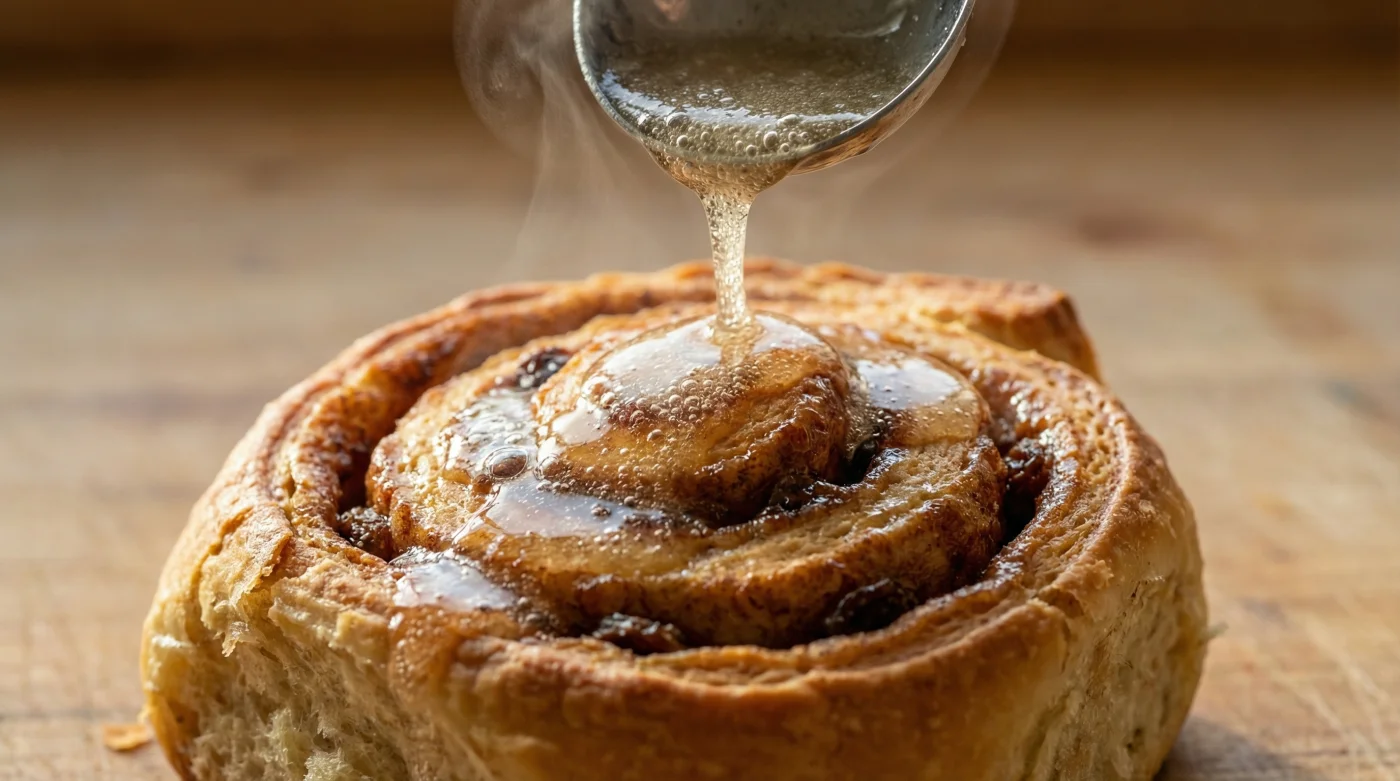
The scent of warm dough laced with cinnamon and heavy, dark fruit fills the kitchen, pulling you toward the oven door. You watch the coils of pastry rise, turning a deep, rich mahogany as the butter melts into the crevices. There is a specific anticipation that comes with baking a Chelsea bun, a quiet promise of pulling apart that sticky, spiralled geometry on a lazy Saturday afternoon with a strong pot of tea.
But then, the betrayal happens. You pull them from the tin, transfer them to a wire rack, and wait. The standard cookbooks and Sunday supplements always instruct you to let the bake cool before brushing over a gentle, room-temperature sugar wash. This polite patience is the standard room-temperature lie that ruins countless weekend bakes.
Look at the buns resting on the cooling rack. Every minute they sit naked in the open air, they are aggressively losing moisture. The steam escaping from the golden crust is the very softness you are trying to preserve, vanishing into the atmosphere. By the time the dough is cool enough for that tepid glaze, the interior crumb has already begun its rapid march toward becoming stale, brittle, and utterly disappointing by the next morning.
The true magic happens when you throw out the gentle approach entirely. Striking the pastry while it is practically screaming from the oven heat is how you capture the steam entirely and force a dramatic structural change.
The Anatomy of a Flawed Standard
Think of a freshly baked Chelsea bun not as a solid object, but as a lung that has just taken a massive breath of hot air. As it cools, it exhales. When you brush a cold or ambient glaze over a cooling bun, the liquid simply pools on the surface, drying into a thin, separate crust. It sits on top of the dough like a cheap raincoat, doing absolutely nothing for the layers beneath.
Applying a boiling syrup glaze directly to dough straight out of the oven reverses this process. The thermal shock of the boiling liquid meeting the scorching crust creates a sudden, forceful vacuum. It forces the moisture straight into the baked core, trapping the hydration inside the spiralled layers before it has a chance to escape.
This osmotic shock means the syrup doesn’t just sit on the top; it penetrates the outer millimetres of the pastry, fusing the glaze and the bread into a single, cohesive barrier. The water from the boiling syrup evaporates violently on contact, leaving behind a hard, glassy seal of sugar that traps the bun’s internal steam. You are not just making it sweet; you are performing structural engineering on the crumb.
Once you understand this physical reaction, the old instructions to ‘cool completely on a wire rack’ seem almost tragic. You realise you have been passively allowing the staling process to begin the moment the oven door opened.
The Master Baker and the Copper Pan
Eleanor Vance, a sixty-two-year-old master baker operating out of a small, flour-dusted kitchen in a North Yorkshire market town, built her local reputation on this exact science. While other bakeries serve buns that turn to sawdust by midday, Eleanor’s remain remarkably damp and yielding for days. She watches her oven timer not to check the bake, but to time her copper pan. “You have exactly thirty seconds,” she mutters over the roaring heat of the commercial ovens. For four decades, she has kept a pan of golden caster sugar and water at a furious, rolling boil, painting the pastries the absolute fraction of a second they leave the heat. The aggressive hiss of the boiling sugar hitting the scorching dough is the sound of moisture closing its doors permanently.
Tailoring the Thermal Shock
Not all boiling glazes need to be identical. Once you grasp the mechanics of the thermal seal, you can begin to manipulate the liquid to suit the exact profile of your bake. The technique remains rigid, but the ingredients offer a quiet space for adaptation.
For the Traditionalist
If your goal is pure, unadulterated preservation of the classic flavour, you need nothing more than equal parts water and granulated sugar. The simplicity allows the butter and dried fruit to remain the undisputed focal points. This basic syrup, brought to a violent bubble, creates the cleanest, most transparent protective layer imaginable.
For the Weekend Artisan
When you want to introduce a subtle complexity without altering the dough itself, the boiling glaze becomes a vehicle for aromatics. Replacing half the water with freshly brewed Earl Grey tea, or dropping a bruised cardamom pod and a strip of unwaxed lemon peel into the boiling sugar, forces those volatile oils deep into the crust. Because the liquid is boiling, the infusion is rapid and aggressive.
For the Make-Ahead Baker
If you are baking on a Friday evening for a Sunday morning gathering, you need maximum longevity. In this scenario, substituting a small percentage of the sugar with a tablespoon of liquid glucose or golden syrup prevents the boiling glaze from crystallising too firmly. It maintains a flexible, sticky moisture barrier that easily survives forty-eight hours in an airtight tin.
The Mindful Application
Executing this technique requires a shift in your kitchen rhythm. The margin for error is measured in seconds, not minutes. Preparation is your only safety net; you cannot wait until the tin is on the counter to begin looking for your pastry brush.
- Wooden cutting boards repel strong garlic odors absorbing simple lemon juice.
- Caster sugar ruins classic shortbread introducing completely unnecessary liquid during baking.
- Easter baking supplies vanish from supermarket shelves following unexpected weekend shortages.
- Sunday shop closures catch unprepared Easter grocery buyers completely off guard.
- Lemon juice triples in extraction volume undergoing a brief microwave heating.
Follow this exact sequence to ensure the moisture lock holds securely against the crust:
- Combine equal weights of sugar and water in a heavy-bottomed saucepan ten minutes before the bake finishes.
- Place over a medium-high heat, swirling gently until the sugar dissolves completely.
- Allow the mixture to reach a fierce, rolling boil for exactly two minutes to drive off excess water.
- Pull the heavy tin from the oven and immediately begin brushing the boiling liquid over the blistering dough.
- Work from the outside edges inward, ensuring the exposed spiralled layers receive a generous coating.
The Tactical Toolkit
To master this, you need three specific things. First, a natural bristle pastry brush; synthetic silicone bristles will simply push the hot syrup around rather than holding it. Second, a heavy-gauge saucepan that retains heat when moved from the hob to the work surface. Finally, you need a targeted temperature: your syrup must be hovering around one hundred and ten degrees to guarantee the instant evaporation of its water content upon contact.
Beyond the Bake
Mastering this single, fleeting interaction between boiling sugar and scorched dough shifts your entire kitchen approach. You stop seeing recipes as a rigid set of arbitrary instructions and start viewing them as a sequence of physical reactions that you can manipulate and control.
There is a profound peace of mind in knowing exactly why a technique works. When you sit down on a Sunday morning, break apart a pastry you baked the day before, and find the interior still incredibly damp, you realise the value of questioning the established norms.
It is not just about avoiding a dry crumb; it is about respecting the effort you invested. You spent hours kneading the dough, waiting for the yeast to bloom, rolling the butter, and slicing the spirals. Protecting that labour requires nothing more than a pan of boiling water, a spoonful of sugar, and the willingness to act decisively while the oven is still exhaling its heat.
“A cold glaze on hot bread is an insult to the yeast; a boiling glaze is a protective embrace.”
| Method | The Mechanics | Added Value for the Baker |
|---|---|---|
| Standard Room-Temperature Glaze | Sits on the surface of cooling dough, drying into a separate, brittle crust. | Allows the interior crumb to dry out rapidly; buns become stale within 24 hours. |
| Immediate Boiling Syrup Glaze | Thermal shock forces moisture inward; creates a fused, vacuum-sealed barrier. | Traps steam instantly, ensuring the crumb remains soft and yielding for up to three days. |
| No Glaze | Leaves the crust entirely exposed to the ambient air during the cooling phase. | Results in a dull finish and a highly vulnerable pastry that dries out almost immediately. |
The Baker’s Common Questions
Can I reheat the syrup if the buns are already out of the oven?
You can, but you will have missed the critical window. The dough must be radiating its maximum heat to create the vacuum effect. Timing the boil to finish alongside the bake is non-negotiable.
Will a boiling glaze make the buns excessively sweet?
No. The boiling process evaporates much of the water, leaving a concentrated seal rather than a thick, sugary icing. It acts more as a structural barrier than a heavy flavour addition.
What is the precise ratio for the boiling syrup?
Weigh your ingredients rather than using cups. Equal parts by weight—for example, fifty grams of golden caster sugar to fifty grams of water—provides the perfect viscosity for a tight seal.
Can I use a silicone brush for the boiling liquid?
It is highly discouraged. Silicone bristles repel liquid, meaning you will flick hot syrup across the kitchen. A natural bristle brush holds the heavy liquid and paints it smoothly into the crevices.
How should I store the buns once the glaze has set?
Allow them to cool completely in the tin to protect the sides, then transfer them to an airtight tin. The boiling glaze will do the heavy lifting, keeping them soft at ambient kitchen temperature.