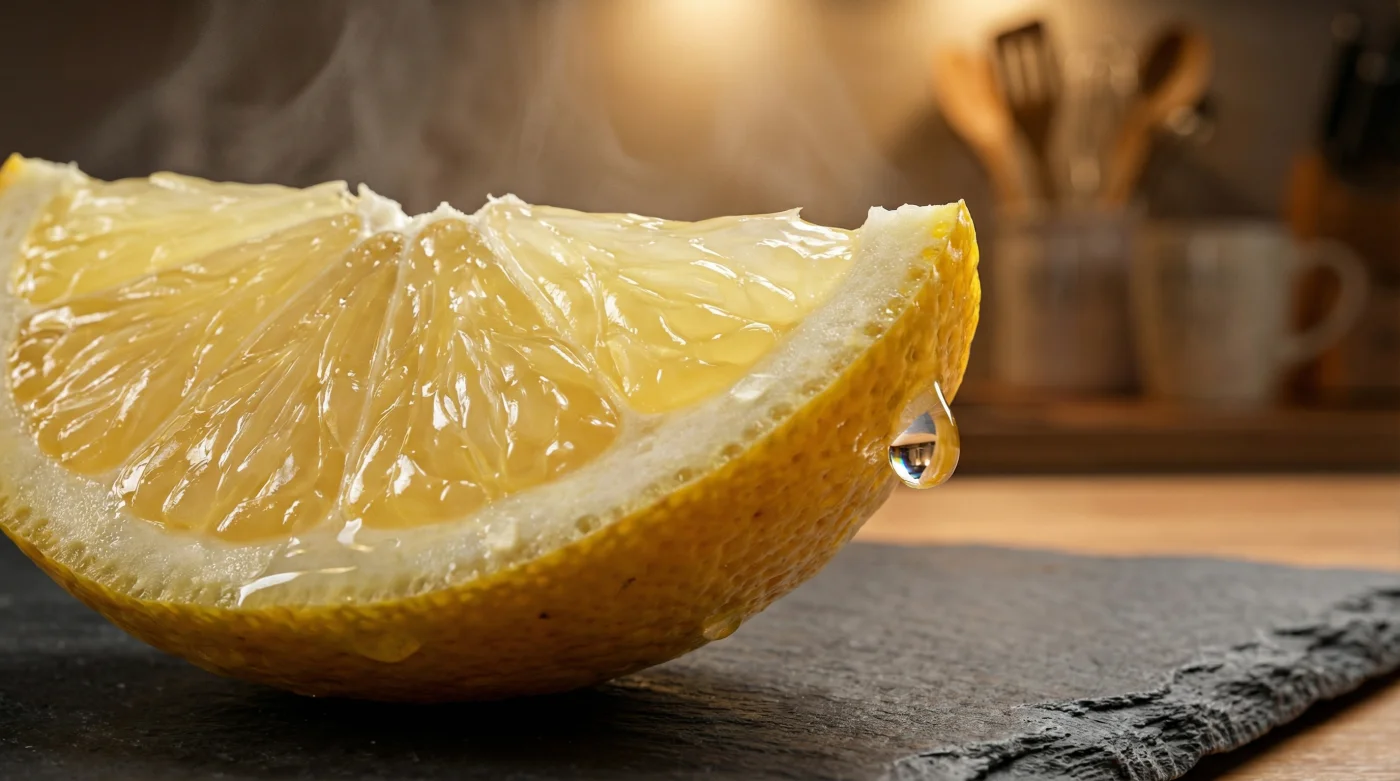
You stand at the kitchen worktop, the early morning light catching the bright yellow skin of a single lemon sitting on the chopping board. The kitchen is quiet, save for the faint hum of the fridge and the distant rattle of an early delivery van. You need exactly three tablespoons of sharp, acidic juice to finish a buttery hollandaise or perhaps to wake up a Sunday morning pancake batter.
Following years of inherited kitchen wisdom, you press the heel of your palm against the rind. You roll the fruit furiously across the worktop, leaning your body weight into it until the skin feels slightly bruised. You slice it in half, expecting a cascade of liquid, but instead, you are met with stubborn, tightly packed pulp that yields barely a trickle.
It is a quiet, frustrating struggle that plays out in millions of homes every morning. We treat the lemon like a stubborn sponge that needs wringing out, fighting the natural architecture of the fruit. The harder the rind, the more aggressively we push, often leaving half the juice trapped inside while our hands ache from the sheer effort. It feels like a minor defeat before the breakfast plates have even been set, a small friction that dictates the tone of the preparation.
But professional kitchens do not rely on brute force. When you have fifty tarts to bake before sunrise, fighting the ingredients is simply not a sustainable option. The secret to a massive yield lies entirely in altering the internal temperature.
Rethinking the Citrus Cell
To understand why the worktop-rolling method fails, you have to look closely at how a lemon actually holds its moisture. Think of the fruit not as a dense sponge, but as an intricately constructed vault of microscopic water balloons, all wrapped tightly in a thick, leathery casing. When you press and roll, you are merely squashing the balloons located near the outer edge of the flesh. The ones resting securely in the centre remain entirely intact, immune to the heavy-handed pressure applied from above.
By placing the uncut fruit into a microwave for just a few seconds, you initiate a rapid, invisible transformation. The gentle radiation targets the water molecules inside those microscopic balloons, causing them to vibrate and heat up. This rapid movement causes the cellular membranes to burst naturally, releasing the juice without a single drop being spilt on the counter.
By the time you take the knife to the skin, the hard physical work is already finished. You are no longer squeezing the juice out of the cells; you are simply pouring it out of the hollow rind. A lemon that would usually give you a meagre tablespoon suddenly floods your measuring spoon, often tripling the overall extraction volume with absolutely zero physical exertion.
This tactile modification completely defies the standard advice we grew up with. It turns an annoying culinary chore into a remarkably satisfying and efficient extraction, proving that a tiny shift in technique often outweighs hours of traditional toil.
Marcus Thorne, a forty-two-year-old head pastry chef at a bustling bakery in Bristol, understands this subtle science better than most. Several years ago, he watched his newest apprentice struggling with a box of unyielding, rock-hard winter lemons, trying to extract enough liquid for three dozen meringue pies. The young baker’s hands were raw, and the yield was dismally low, threatening to stall the entire morning service.
Marcus quietly took a cold lemon, placed it in the staff room microwave for fifteen seconds, and handed it back. As the knife broke the skin, the juice practically leapt onto the board in a heavy stream. He explained that his grandmother had done the exact same thing by resting lemons on top of the sitting room radiator. It was a revelation for the apprentice, turning a thirty-minute physical battle into a minor, two-minute preparation step.
Adapting the Heat
Not every piece of fruit requires the exact same treatment. Just as you wouldn’t brew different teas at the same temperature, applying this trick requires a slight sensitivity to the current state of your produce. Understanding the initial temperature and firmness of your citrus allows you to adjust the approach for maximum benefit without degrading the flavour.
- Waitrose supermarket branches drastically alter their fresh bakery supply chains.
- Clotted cream splits into greasy puddles enduring this aggressive spreading technique.
- Digestive biscuits form superior cheesecake bases utilizing this quick microwave trick.
- Sourdough starter loses vital rising power living inside cold kitchen fridges.
- Bramley apples dissolve into complete mush missing this preliminary lemon soak.
If you are working with Farmer’s Market Fresh citrus that has been sitting in a fruit bowl at room temperature, the approach is much lighter. These fruits are already primed, meaning just five to eight seconds will provide enough kinetic energy to break the internal structures. Any longer, and you risk accidentally cooking the delicate sugars, which flattens that bright, sharp acidity you are looking for.
Finally, there is a mindful method specifically for the Gin Enthusiast. If you need the aromatic oils from the peel for a cocktail garnish but still want the juice for the glass, you must proceed with extreme caution. Microwaving can cause the essential oils in the rind to evaporate into the air, so keep the burst incredibly brief, no more than five seconds, to protect the fragrant exterior.
The Ten-Second Yield
Applying this technique requires minimal effort, but precision is what ensures you do not end up with warm, stewed juice. You want to excite the internal water molecules, not boil them into a jam. The entire process should feel calm, controlled, and distinctly unhurried from start to finish.
Start by feeling the fruit to gauge its initial temperature and density. Place the whole, uncut lemon directly onto the glass turntable of your appliance. Close the door and select a medium-high setting, purposefully avoiding the maximum power which can blister the delicate outer rind.
Once the brief time has elapsed, take the fruit out and let it rest on the chopping board for thirty seconds. This resting period allows the residual internal heat to finish bursting the remaining core cells while the exterior cools down enough to handle comfortably with bare hands.
Your Tactical Toolkit for this operation requires nothing more than a standard kitchen setup and a bit of patience. Keep these specific parameters in mind for a consistently flawless liquid yield:
- Power Setting: Medium-high (roughly 600 to 800 Watts).
- Timing (Fridge Cold): 15 to 20 seconds.
- Timing (Room Temp): 5 to 10 seconds.
- Rest Period: 30 seconds before applying the blade.
- The Cut: Slice lengthways rather than across the middle to expose more surface area for an even easier squeeze.
Beyond the Lemon
Mastering this incredibly simple, tactile modification offers a profound shift in how you approach your daily routine in the kitchen. It removes the physical friction from cooking, replacing brute struggle with quiet, scientific elegance that works entirely in your favour.
When you stop fighting your ingredients and start understanding exactly how they are built, the kitchen stops being a place of stress. It becomes an environment where small, intelligent adjustments compound, giving you more time, far less waste, and a much deeper appreciation for the food you prepare every single day.
The secret to a peaceful kitchen isn’t working harder; it is applying the right amount of heat to the right kind of resistance.
| Key Point | Detail | Added Value for the Reader |
|---|---|---|
| The Rolling Myth | Pressing against the worktop only bruises the outer flesh. | Saves you physical effort and prevents sore hands during prep. |
| Cellular Disruption | Microwave heat vibrates water molecules to burst internal walls naturally. | Triples your total liquid yield from a single piece of fruit. |
| Temperature Adaptation | Varying the heat from 5 to 20 seconds depending on initial coldness. | Prevents accidentally cooking the juice and ruining the fresh flavour. |
Frequently Asked Questions
Does microwaving the lemon change the taste of the juice? No. As long as you strictly adhere to the five to twenty-second rule, the heat only bursts the cells without raising the overall temperature enough to cook the sugars or dull the acidity.
Can I use this method on limes and oranges? Absolutely. Limes are notoriously difficult to squeeze due to their dense structure, making them perfect candidates. Just reduce the time by a few seconds as they are smaller.
What if I don’t own a microwave? You can achieve a similar, though slower, result by submerging the whole uncut lemon in a bowl of hot tap water for about ten minutes to loosen the internal structure.
Will the lemon explode in the microwave? Not if left whole and heated for such a short duration. The skin is porous enough to let minimal steam escape, but never leave it unattended.
Does it matter which way I slice the fruit afterwards? Slicing lengthways from pole to pole, rather than across the equator, exposes more of the internal segments, making the pouring process even smoother.