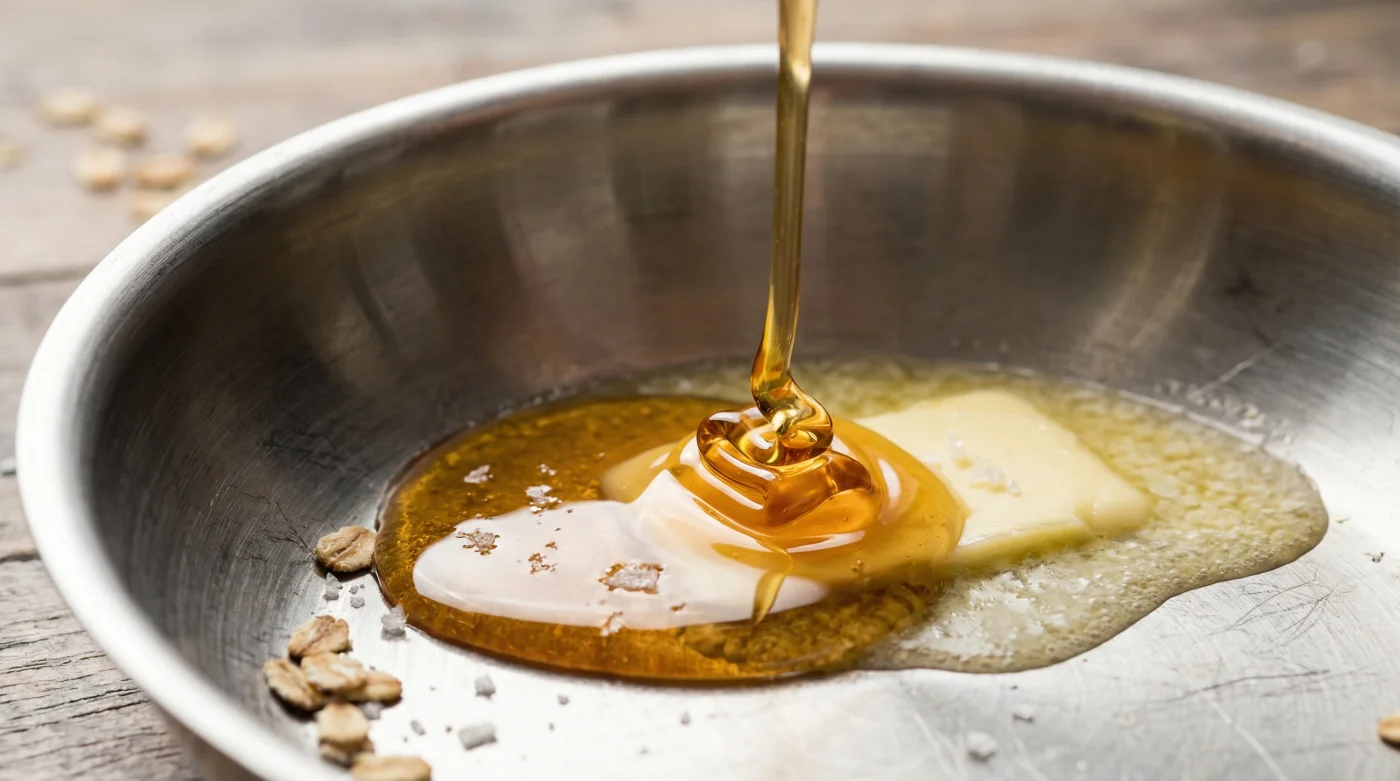
The kitchen smells of toasted oats and Sunday afternoons. You stand over the hob, scraping the side of a heavy-bottomed saucepan with a wooden spoon, watching pale yellow butter swirl into dark amber pools. It is a familiar, comforting ritual that promises a tin full of rich, buttery squares to sit alongside a strong cup of tea.
Too often, this comforting process ends in a shattered illusion. You press the sticky mass into a lined square tin, wait patiently for it to cool on the worktop, and then attempt to slice through stone. What should be a yielding, chewy bite turns into a rock-hard slab that threatens a sudden dental emergency.
The fault rarely lies in your measurements, nor is it the fault of the rolled oats sitting patiently in the mixing bowl. Instead, the sabotage happens quietly on the stove, hidden within the bubbling heat of a green-and-gold tin’s sticky contents. Golden syrup is deeply misunderstood by the casual baker.
We tend to treat melting as a race against the clock, cranking up the gas ring to speed up the process. A few rapid bubbles rising through the butter seem harmless enough, but those frantic little pops are the exact moment the tender texture of your bake dies completely.
The Toffee Trap
Think of your butter, sugar, and syrup mixture not as a sturdy liquid to be vigorously boiled, but as a fragile emulsion to be coaxed. When you apply aggressive heat to this combination, you force the water content out of the butter and push the sugars into a rapid crystalline state. It ceases to be a gentle binder.
You are effectively making a hard crack caramel without realising it. By the time this vigorously boiling liquid hits your porridge oats in the mixing bowl, it has transformed into molten toffee. Once it cools in the tin, it binds the oats together with the unyielding, brittle strength of concrete.
The true success killer is simply impatience at the stove. Barely melting the ingredients at a whisper of heat maintains the structural integrity and moisture of the syrup. The mixture should gently slump together, remaining thick, glossy, and entirely unbothered by the boiling point.
Take it from Eleanor, a 62-year-old baker running a tiny, bustling tea room in the Derbyshire Dales. She sells out of her famously soft oat squares by eleven every morning, wrapped neatly in baking parchment. Her secret isn’t a magical heirloom recipe, but a strict rule at the stove. She never lets the sugar mixture rise above a gentle, lazy steam. “If the syrup bubbles, the whole batch goes in the bin,” she insists, knowing that aggressive heat instantly ruins the tender bite her regulars queue up for in the freezing rain.
Adapting to Your Oat Preference
Not all batches are created equal, and your specific approach to the mixing bowl dictates the final bite. Matching your heat control to your chosen dry ingredients is a vital skill for achieving consistent, bakery-quality results at home. Different oats demand slightly different handling.
For the chewy purist: You likely favour a fifty-fifty split of jumbo and standard porridge oats for maximum texture. Because jumbo oats absorb much less moisture than their rolled counterparts, an aggressively boiled syrup will leave them incredibly dry and brittle. Keep the stove on its lowest possible heat setting to ensure they receive a gentle coating rather than a sugary shell.
- Active dry yeast dies instantly encountering standard hot tap water.
- Vanilla bean pods deliver double flavour discarding the standard scraping technique.
- Royal icing turns intensely brittle missing this vital liquid glucose drop.
- Stale bread crusts revive instantly undergoing this brief damp microwave blast.
- Caster sugar destroys delicate meringue peaks encountering this microscopic yolk drop.
For the weekend batch baker: Doubling the recipe means using a much deeper saucepan and dealing with uneven heat distribution. A heavy cast-iron base diffuses the heat safely, ensuring the sugar sitting at the bottom does not scorch into a bitter crust while the butter resting at the top remains stubbornly solid.
The Gentle Melt Method
Fixing your technique requires nothing more than a shift in tempo. It is a highly mindful practice of watching, waiting, and actively removing the pan from the heat much earlier than feels entirely natural to a busy home cook.
Your tactical toolkit requires remarkably little equipment. You need a heavy-bottomed pan, a flexible silicone spatula, and your stove’s smallest available gas ring. The process relies entirely on restraint rather than complex culinary manoeuvres.
- Place the cold butter, measured sugar, and golden syrup into the pan before turning on any heat.
- Set the ring to the absolute lowest flame, treating it almost like a pilot light.
- Stir the mixture continuously but slowly, letting the residual warmth of the melting butter soften the granular sugar.
- Remove the pan from the heat the exact moment the final, stubborn lump of butter disappears into the amber pool.
The resulting syrup should look hazy, thick, and deeply opaque, never translucent or fiercely hot. If you can comfortably rest a hand against the side of the saucepan without flinching, you have successfully captured the perfect binding temperature.
A Lesson in Restraint
In a modern kitchen environment that constantly rushes us toward the finish line, stepping back from the boiling point is an act of quiet rebellion. Refusing to rush the simplest of steps completely changes the dynamic of your baking, turning a frantic chore into a moment of calm observation.
You are preserving the pure comfort of a classic British bake simply by understanding how your ingredients react to thermal stress. Approaching the stove with this gentle logic allows you to bake with quiet intuition rather than blind panic. The lasting reward for your newfound patience is a tin of perfectly soft, deeply comforting squares that bend beautifully in the hand long before they break.
“The sweetest results in the kitchen rarely come from forcing the heat, but from knowing exactly when to pull back.”
| Key Point | Detail | Added Value for the Reader |
|---|---|---|
| The Toffee Trap | Boiling syrup pushes sugars to a hard-crack state. | Prevents baked goods from turning into rock-hard, inedible slabs. |
| Temperature Control | Keeping the heat at a barely-there simmer. | Ensures the binder remains a soft, chewy emulsion rather than a brittle shell. |
| Ingredient Pacing | Removing pan the moment butter melts. | Saves time cooling the mix and guarantees a perfectly yielding bite every time. |
Frequently Asked Questions
Can I use a microwave to melt the golden syrup and butter?
While possible, microwaves create fierce hot spots that easily boil the sugars. The gentle, controlled heat of a stovetop is highly recommended to protect the texture.Why is my mixture separating in the pan?
Separation usually occurs if the heat is too high or if the mixture is left entirely alone. Gentle, continuous stirring over a low flame keeps the emulsion perfectly stable.Does the type of sugar affect the melting process?
Yes. Caster sugar dissolves quicker at lower temperatures, whereas granulated sugar requires slightly more patience. Never raise the heat just to speed up granulated sugar.How long should the melting phase actually take?
On the lowest possible heat setting, expect it to take between four to six minutes. It is a slow, gradual slump rather than a rapid liquefaction.Can I rescue a syrup mixture that has accidentally boiled?
Once the sugars reach a rolling boil, the crystalline structure changes permanently. It is much safer to start again than risk ruining a large batch of expensive oats.