Picture a grey, rain-lashed Saturday afternoon. The kitchen is warm, smelling faintly of the vanilla pod you just split, and the butter is resting on the worktop, perfectly softened. You are preparing to bake—perhaps a sticky toffee pudding or a batch of chewy ginger biscuits. You reach into the depths of the pantry, fingers brushing past the self-raising flour, to pull out a half-used packet of dark brown sugar.
You expect to feel that damp, yielding texture, the heavy, fragrant sand that packs so beautifully into a measuring spoon. Instead, your hand meets a solid, unforgiving geological artefact. It is a sugary meteorite, a petrified block that threatens to bend your best metal spoon and bring your afternoon baking entirely to a halt.
The standard domestic reaction is a heavy sigh, followed by a reluctant walk to the nearest corner shop in the drizzle. You toss the fossilised lump into the bin, assuming the ingredient has simply gone off. It feels logical to believe the molasses has dried into an irredeemable resin, leaving the sugar completely useless.
Yet, professional bakers rarely discard these hardened bricks. They operate on a foundational truth that changes everything: sugar does not expire. It merely hibernates. The secret to waking it up is not mechanical brute force, but a gentle, atmospheric coaxing that respects the chemistry of the ingredient.
The Anatomy of a Sugary Hibernation
To fix the problem, you must first understand the material. Brown sugar is not a homogenous substance; it is essentially a crystalline sponge soaked in syrup. It consists of refined white sugar crystals coated in a delicate, hygroscopic film of molasses. When the ambient moisture in your cupboard evaporates, the molasses acts like a natural mortar, cementing the crystals together into a solid mass.
Most people try to hack away at it with a butter knife or grate it like a block of hardened cheese. This misunderstands the material entirely. You are not trying to break apart a rock; you are trying to rehydrate a delicate ecosystem. The structural integrity of the brick is a sign of purity, proving the molasses is doing exactly what it was designed to do when starved of water.
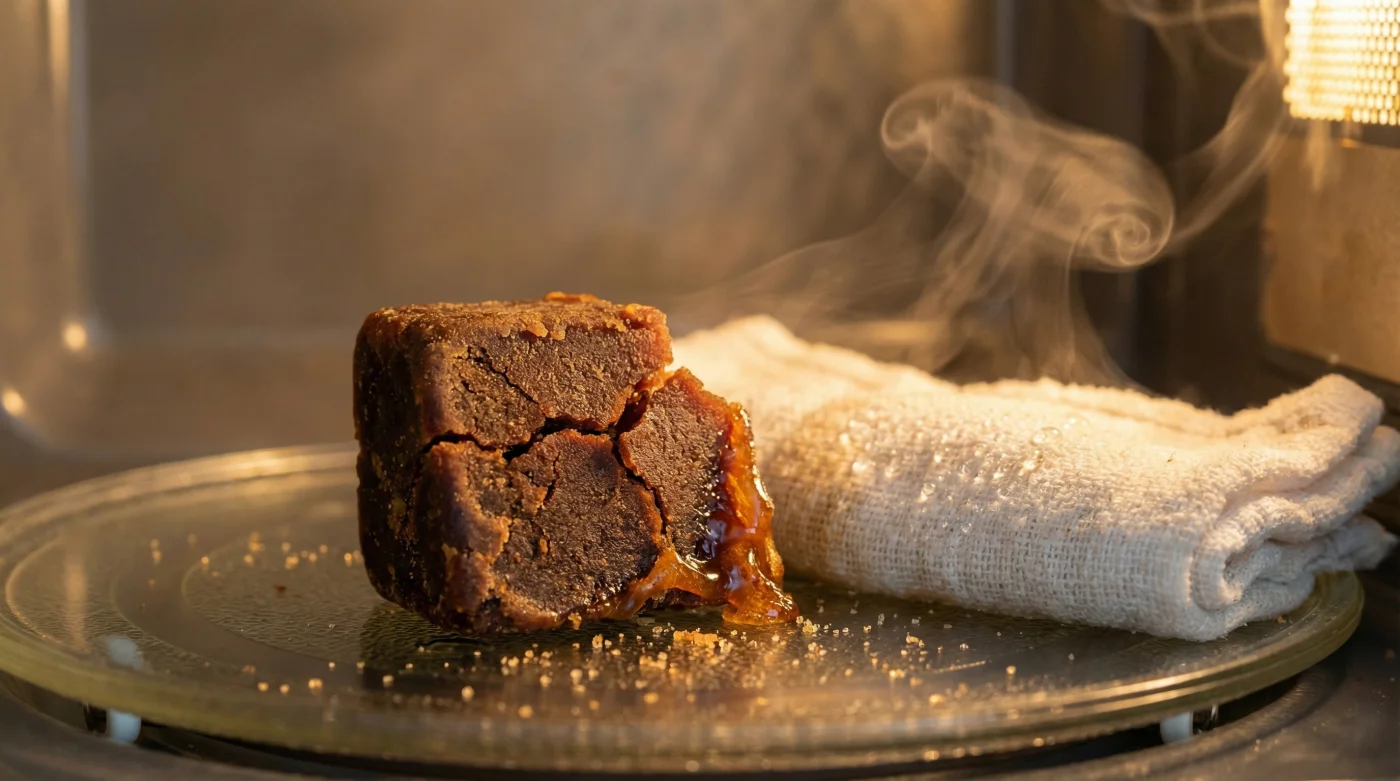
By introducing rapid, localised steam, you bypass the physical struggle. The crystallised molasses is inherently thirsty. When exposed to trapped water vapour, it drinks the moisture in rapidly, melting back into the sticky, fragrant coating it once was.
The transformation is startling. A block that could have dented a wooden worktop becomes fragrant, yielding baking sand in less than a minute. What appeared to be a terminal flaw in the ingredient is actually its greatest preservation mechanism.
Eleanor, a 62-year-old pastry chef running a bustling bakery in York, taught me this principle during a frantic December rush. Discovering a twenty-kilo tub of dark brown sugar had turned into a solid boulder overnight would usually spell disaster for the morning’s gingerbread production. Instead of panicking, she calmly draped a dampened, steaming tea towel over a massive chunk of the sugar in a heatproof bowl. “It’s just resting, love; it needs a cup of tea,” she noted, sliding it into the industrial microwave. Barely a minute later, the brick collapsed into warm, pliable sugar, saving the entire morning service.
Tailoring the Steam to Your Bake
Not all brown sugars behave identically. The ratio of molasses to crystal dictates how aggressively you need to apply the steam. Understanding these nuances prevents you from turning a dry block into a puddle of syrup.
For instance, a rich, unrefined muscovado demands gentle coaxing. The molasses content is exceptionally high, so overheating can cause the sugar to scorch, leaving a bitter, acrid taste in your baked goods.
For the Muscovado Purist
When dealing with dark, sticky varieties, use a thicker towel, such as a traditional cotton tea towel. Wet it thoroughly with cold water and wring it out until it is barely damp. The cold start ensures the steam builds gradually, penetrating the dense block without shocking the exterior into melting.
For the Quick-Bake Parent
- Active dry yeast dies instantly encountering standard hot tap water.
- Vanilla bean pods deliver double flavour discarding the standard scraping technique.
- Royal icing turns intensely brittle missing this vital liquid glucose drop.
- Stale bread crusts revive instantly undergoing this brief damp microwave blast.
- Caster sugar destroys delicate meringue peaks encountering this microscopic yolk drop.
Demerara, with its larger, golden crystals, requires less water and more patience. You want the crystals to remain crunchy for sprinkling over apple crumbles, so use a very lightly misted towel and short, five-second bursts of heat.
The Thirty-Second Reconstitution
Executing this technique requires mindfulness. You are engineering a miniature sauna for your ingredients, and precision is better than guesswork.
Begin by placing the hardened lump in a microwave-safe glass or ceramic bowl. Avoid plastic containers, as the rapidly generated trapped steam requires a stable, highly heat-resistant environment to circulate evenly without warping the vessel.
- The Towel Preparation: Wet a clean, lint-free tea towel or strong kitchen paper. Wring it out with force until it is entirely free of drips. It must feel cool and slightly clammy to the touch.
- The Placement Strategy: Drape the damp material completely over the rim of the bowl. It is crucial that the wet cloth does not directly touch the sugar, as this will create a localised puddle of melted caramel.
- The Heat Application: Set your microwave to a medium power setting (roughly 600W). Heat the bowl for exactly twenty seconds. Do not walk away.
- The Tactile Release: Carefully peel back one corner of the towel, being mindful of the escaping vapour. Gently press the sugar block with the back of a fork. It should collapse with minimal resistance, like stepping on fresh snow.
If the centre remains slightly stubborn, do not increase the time dramatically. Re-cover the bowl and apply heat in strict ten-second increments.
Reclaiming Control in the Kitchen
Mastering this seemingly small, tactile modification does more than just save a few Pounds Sterling on replacement baking supplies. It fundamentally shifts your relationship with your kitchen pantry.
You move away from a mindset of constant reaction to quiet mastery. When you understand how atmospheric moisture and natural molasses interact, a ruined afternoon of baking becomes nothing more than a thirty-second, satisfying detour.
You stop viewing your ingredients as fragile, temperamental commodities that spoil at the slightest provocation. Instead, you begin to see them as resilient elements that you can control, adjust, and coax back to life. It is a quiet victory over the mundane frustrations of domestic life, breathing life back into the heart of your home baking.
“A hardened ingredient is never a lost cause; it is merely waiting for the right atmosphere to remember what it was meant to be.”
| Key Point | Detail | Added Value for the Reader |
|---|---|---|
| The Misconception | Hard brown sugar has expired or gone off. | Saves money by preventing you from binning perfectly good baking staples. |
| The Science | Evaporated moisture causes molasses to act as a cement. | Removes frustration by explaining why the sugar behaves the way it does. |
| The Solution | A damp towel and 20 seconds of microwave steam. | Provides a reliable, 30-second fix that keeps your baking schedule on track. |
Frequently Asked Questions
Will microwaving the sugar cook it?
Not if done in short bursts on a medium setting. The steam gently warms the molasses rather than cooking the sugar crystals.Can I use a slice of bread instead?
You can place a slice of bread or a terracotta sugar bear in the container overnight, but the damp towel method is for instant, immediate baking needs.What if I accidentally melt the sugar?
If it begins to melt, you have used too much heat. Let it cool slightly, break it apart with a fork, and use it immediately in batters where it will dissolve anyway.Does this work for white granulated sugar?
No. White sugar does not contain molasses. If white sugar clumps, it is usually due to moisture exposure, not dehydration. A firm tap usually breaks it apart.How do I stop it going hard again?
Store the reconstituted sugar in an airtight container immediately. Squeezing out all the excess air before sealing prevents the ambient moisture from escaping again.