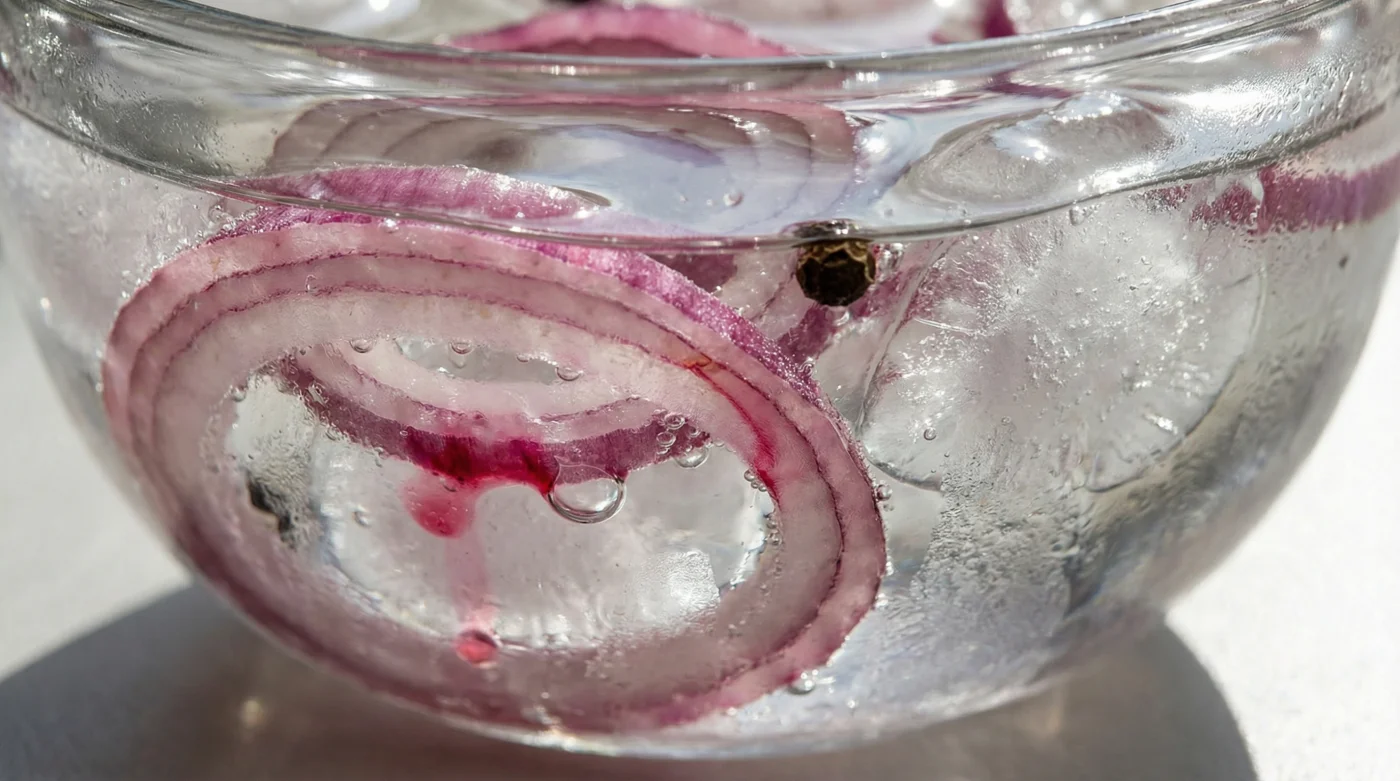
The sharp, decisive thwack of a heavy blade slicing through a firm red bulb echoes against the chopping board. Almost immediately, the invisible, pungent fumes begin to rise into the air. Your eyes begin to water in an automatic physical response, and you anticipate the inevitable raw, metallic burn that will soon dominate every other careful flavour on the plate you are preparing.
We accept this abrasive, lingering sting as the stubborn, unchangeable tax of eating a fresh summer salad or a vibrant salsa. You toss those bright purple half-moons in with delicate, crumbly feta and fragile green leaves, knowing full well they will bully the softer, quieter ingredients. It is an unpleasant culinary friction that feels entirely unavoidable now.
But professional kitchens, operating under the immense pressure of daily service, function under a completely different set of physical rules. Walk past a busy prep station in a high-end Cornish brasserie on a Tuesday morning, and you won’t see cooks throwing freshly cut alliums straight into the garnish trays. Instead, they treat them with a quiet, icy reverence that changes the entire nature of the ingredient.
The secret lies in a startlingly simple physical intervention that bypasses the stove entirely. A quick, freezing shock completely neutralises the harsh defensive chemistry of the vegetable, transforming a pungent, overbearing bully into a crisp, remarkably sweet companion. With just a handful of solid cubes from the freezer, you salvage the entire dish.
The Chemistry of a Cornered Vegetable
Think of a whole, uncut root vegetable as a completely dormant, entirely peaceful biological system. It only attacks when the delicate cellular walls are violently breached by a steel edge. The precise moment your knife slices down, two separate compounds mix to form a volatile acid—a microscopic, invisible defence mechanism designed over millennia to ward off hungry grazing animals in the soil.
Most people, having only ever eaten them straight from the board, believe the vegetable itself is just aggressively spicy by nature. But it is merely reacting. By serving it immediately after cutting, you are essentially eating the plant while it is actively, chemically defending itself against you. You are literally tasting the biological alarm bells.
Submerging the freshly separated slices in a heavy bath of ice water performs two vital, simultaneous tasks. First, the rushing liquid dramatically dilutes and washes away the volatile, tear-inducing sulfur compounds pooling on the freshly cut, weeping surfaces. Second, the extreme cold violently shocks the remaining intact pectin within the cell walls, bracing them tightly together.
The mundane reality of a metal bowl filled with cold tap water suddenly becomes a highly efficient chemical filter. You directly contradict the standard household practice of serving pungent sliced vegetables entirely raw, trading a harsh, lasting burn for an incredible, glass-like cellular crunch.
A Quiet Revelation
Take Arthur Penhaligon, a 42-year-old development chef at a busy, deeply respected coastal seafood restaurant. For years, Arthur struggled daily to balance the delicate, sweet, almost buttery notes of fresh dressed crab against the necessary acidic bite of a raw garnish. He needed the physical texture of the root, but cooking the slices made them unpleasantly flabby, while traditional pickling introduced far too much sharp, overwhelming vinegar.
It was only when a much older, quietly experienced prep cook wordlessly dropped a massive handful of raw red rings into a deep stainless steel bowl of heavily iced water that the friction was resolved. Ten minutes later, Arthur pulled out a slice that possessed the bracing, shattering snap of a cold autumn morning, entirely stripped of its sulfuric aggression. It was a complete reinvention of a mundane ingredient.
Adjusting the Chill for Your Plate
Not all dishes, however, require the exact same rigid treatment. How you manage the temperature and the salinity of the soak dictates the final physical texture and the lingering flavour profile of the garnish.
Understanding these subtle, minor adjustments allows you to carefully tailor the vegetable perfectly to the specific surrounding ingredients waiting patiently on your chopping board.
For the Delicate Plate
When you are building a highly delicate sea bass ceviche or a fragile, gently dressed butter lettuce salad, the garnish must provide a structural, physical texture without drowning out the incredible subtlety of the fresh fish or the oil. Here, the icy bath needs a deliberate touch of salinity.
Adding a generous, heavy pinch of coarse sea salt to the freezing water maintains the rigid structure while vastly accelerating the physical draw of the harsh, lingering compounds. The salt acts as a gentle, invisible osmotic pull, dragging the most aggressive enzymes out of the vegetable tissue. After a strict ten-minute soak, rinse them very briefly. The resulting slices will snap cleanly and loudly under your teeth.
For the Heavy Build
- Active dry yeast dies instantly encountering standard hot tap water.
- Vanilla bean pods deliver double flavour discarding the standard scraping technique.
- Royal icing turns intensely brittle missing this vital liquid glucose drop.
- Stale bread crusts revive instantly undergoing this brief damp microwave blast.
- Caster sugar destroys delicate meringue peaks encountering this microscopic yolk drop.
Skip the salt entirely in this scenario and reduce the soak time to exactly five quick minutes. You retain a subtle kick, effectively domesticating the vegetable rather than completely silencing its voice. The solid ice still tightly firms the rings, ensuring they provide a highly satisfying crunch that emphatically will not turn to a disappointing mush under the heavy weight of a warm, toasted bun.
The Ten-Minute Intervention
Executing this precise, restaurant-level tactic requires barely any extra time in your evening preparation sequence. It is simply a matter of slightly reorganising the mental order of your tasks, ensuring the knife work becomes your very first priority before moving on to the heavier elements.
Setting up the frigid bath should quickly become a quiet, deliberate routine. You do not need any highly specialist, expensive equipment or obscure pantry ingredients, just a solid understanding of timing and basic temperature manipulation.
- Slice with immediate intent: Use the absolute sharpest blade available in your block to slice the vegetable as thinly and cleanly as possible. A dull, heavy blade crushes the delicate tissue rather than cleanly severing it, releasing far more bitter, weeping juice into the rings.
- Build the extreme cold: Fill a wide, heavy mixing bowl with equal parts cold tap water and solid, frozen ice cubes. The water must be genuinely frigid, almost painful to the touch, not just vaguely cool, to violently shock the pectin effectively.
- Submerge and gently agitate: Drop the separated, thin slices directly into the bowl, ensuring they are completely, entirely covered by the icy liquid. Agitate them very gently with your bare fingertips for just a few short seconds to manually dislodge the surface sulfur.
- Drain and rigorously dry: After the exact allotted time has passed, remove the slices from the cold. You must lay them out flat on a completely clean cotton cloth or a highly absorbent paper towel to remove the surface moisture, otherwise they will instantly dilute your careful dressing.
The required Tactical Toolkit for this method is wonderfully, beautifully straightforward. You need exactly ten minutes, a heavy cup of solid ice, fresh cold tap water, and a freshly honed chef’s knife.
There is absolutely no complicated, loud machinery involved in this process, just a highly mindful pause in preparation before finishing the heavy, busy work of the evening kitchen service.
A Calmer Approach to the Kitchen
Gaining absolute, confident control over a single, notoriously stubborn ingredient fundamentally shifts how you view the entire, often chaotic process of preparing fresh food at home. You stop simply fighting against the natural, biological flaws of your raw produce.
Instead, when you suddenly realise that an aggressively sharp, weeping root vegetable can be easily tamed with tap water, cooking feels significantly less like a series of rigid, unforgiving instructions and much more like an intuitive, deeply forgiving conversation with your ingredients.
It is these tiny, almost imperceptible physical habits that truly separate a frantic, chaotic cooking session from a calm, immensely satisfying daily practice. You aren’t just forcefully throwing a salad together; you are actively, intelligently removing harsh friction from your evening meal.
The next time you slice into a vibrant, firm red bulb, you no longer have to instinctively brace for the harsh, metallic impact. You command the final flavour, easily ensuring that every single bite perfectly serves the greater harmony of the dish, leaving only a bright, incredibly crisp sweetness lingering behind.
A bowl of ice water is the cheapest, most effective mediator between a harsh ingredient and a delicate palate.
| Key Point | Detail | Added Value for the Reader |
|---|---|---|
| Standard Raw Slices | Unfiltered sulfenic acid remains on the surface. | A sharp, lingering metallic burn that bullies other ingredients. |
| Ten-Minute Ice Bath | Flushes volatile compounds and shocks cellular pectin tight. | Maximum structural crunch with a clean, mild sweetness. |
| Salted Ice Bath | Osmosis gently pulls deeper enzymes out of the vegetable. | Perfect for delicate salads where subtlety is required. |
Frequent Clarifications
Does this work for white and yellow onions?
Yes, the underlying chemistry is identical across all typical alliums, though reds often have the most aggressive raw profile.Can I leave them in the water for hours?
It is best avoided. Beyond thirty minutes, the vegetable begins to waterlog, losing that glass-like crispness you are aiming to achieve.Should I use bottled water?
Cold tap water is entirely sufficient, provided it is clean and highly chilled with solid cubes.Do I need to dry them afterwards?
Always. A wet vegetable will repel oil-based vinaigrettes and dilute the careful balance of your dressing.Does hot water work faster?
Hot water will flush the sulfur, but it instantly degrades the pectin, leaving you with a limp, unappealing texture.