You stand at the kitchen counter, the low hum of the stand mixer vibrating through the worktop. Rain streaks the windowpane on a damp Sunday afternoon, but inside, you are crafting something delicate. You watch the wire whisk tear through the egg whites, waiting for that magical transformation from translucent slime to brilliant, opaque snow. You sprinkle in the caster sugar, trusting its fine granules to weave everything into glossy, stiff perfection.
But seconds stretch into minutes, and the cream refuses to tremble. Instead of sharp, defiant peaks that hold their shape against gravity, you are left with a sullen, frothy puddle. The sugar, usually your greatest ally in building structure, seems to have turned against you, dissolving into a weeping, granular mess.
You review your steps. The eggs were fresh, the sugar weighed to the gram, the mixer speed carefully calibrated. Yet the failure feels absolute, almost personal. What the recipe books rarely mention is that the culprit is rarely the sugar, the temperature, or the speed.
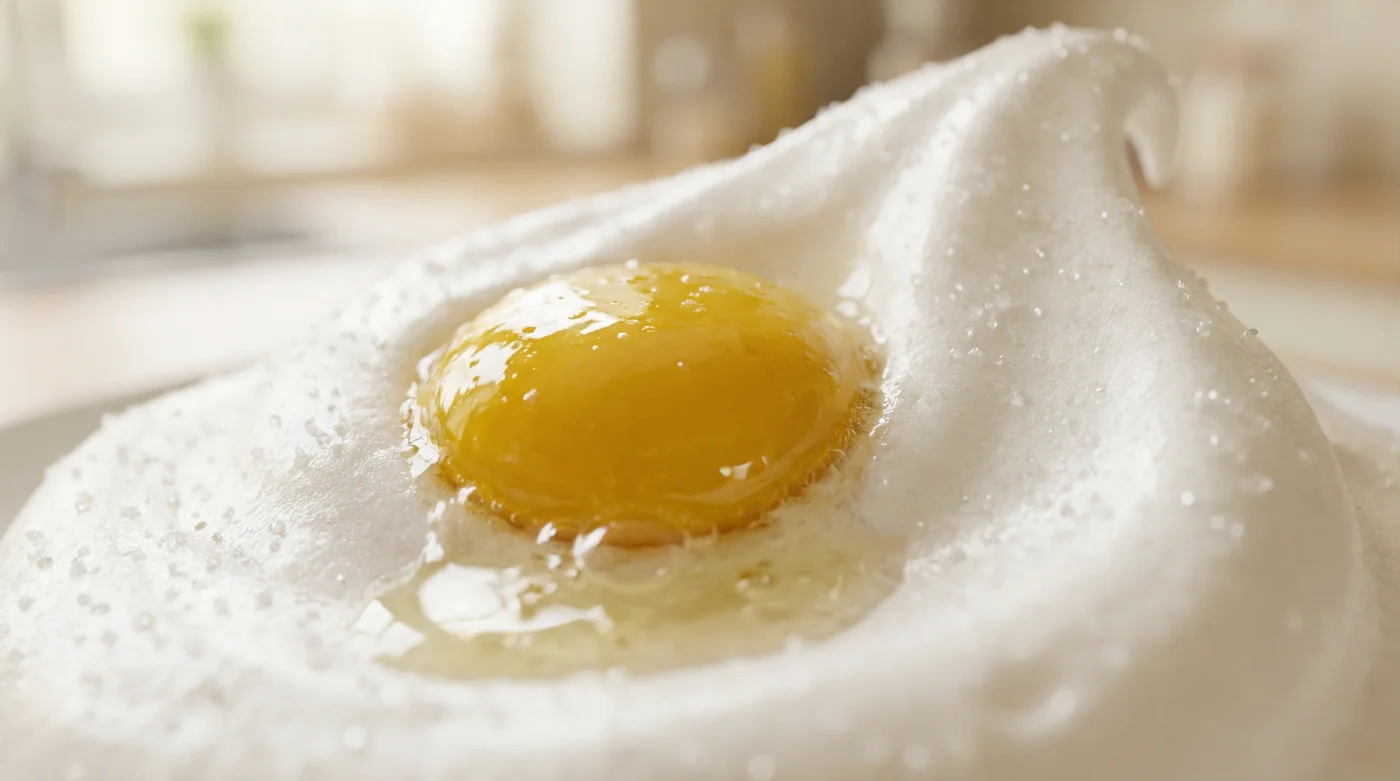
The silent assassin was introduced long before the whisk began to turn. A microscopic droplet of yolk, barely the size of a pinhead, sneaked into the bowl during separation, quietly lying in wait to shatter your structural matrix entirely.
The Architecture of Air
To understand why your meringue collapsed, you have to look at egg whites as a microscopic construction site. When you whisk the whites, you are uncoiling tight bundles of protein, stretching them out to trap tiny bubbles of air. The caster sugar is supposed to act like mortar, sliding between those stretched proteins, holding them apart, and preventing the water from escaping. It is a delicate, beautiful feat of engineering.
However, a rogue fat molecule changes the entire environment. Think of fat as a wrecking ball through glass. The lipids in that minuscule drop of egg yolk aggressively coat the uncoiled proteins. Because fat repels water, it forces the protein strands to slide past one another instead of bonding. When the caster sugar enters this compromised environment, it has nothing to grip. The matrix shatters, the air escapes, and your peaks flatten into a sad syrup.
Consider Arthur Pendelton, a 58-year-old pastry chef who has spent three decades running a fiercely traditional patisserie in York. Arthur views separating eggs with the intense scrutiny of a bomb disposal expert. He recalls a busy Tuesday morning when an apprentice cracked forty eggs into a single massive copper bowl, only to pierce the forty-first yolk. Rather than attempting to scoop out the yellow speck, Arthur poured the entire batch down the sink. ‘Fat is a virus in the pastry kitchen,’ Arthur insists. ‘Once it touches the whites, the structural integrity is gone. You cannot out-whisk a lipid.’
Your approach to guarding against this invisible saboteur depends entirely on your daily kitchen habits. The way you prep your workspace will define the height and stability of your final bake.
For the Casual Weekend Baker
If you are throwing together an impromptu Eton Mess after Sunday roast, your biggest enemy is often the equipment itself. Plastic bowls are notorious for harbouring invisible layers of grease from past washing up. That faint residue acts exactly like a drop of yolk. Always switch to glass, metal, or ceramic, and wipe the interior with a wedge of lemon before you even look at an egg.
For the Ambitious Host
- Baking parchment lies completely flat inside metal trays adopting this crinkle.
- Dry yeast achieves rapid bakery-style rising absorbing microscopic ginger powder pinches.
- Cocoa powder yields intensely fudgy brownies skipping traditional raw flour mixtures.
- Icing sugar creates perfect glossy frostings bypassing standard aggressive mechanical whipping.
- Sweet potatoes achieve blistered skins skipping standard fork piercing routines.
For the Purist
When perfection is the only acceptable outcome, temperature and humidity join the battle. Cold eggs separate cleanly because the yolk membrane is firmer, drastically reducing the chance of a microscopic tear. However, room temperature whites whip into a greater volume. The purist separates the eggs straight from the fridge, covers the pristine whites, and lets them sit on the counter for an hour before the whisk ever touches them.
The Clean-Bowl Protocol
Recovering control over your bakes requires a deliberate, almost meditative approach to your prep. You are no longer just throwing ingredients together; you are curating a sterile environment for protein bonds to form. Take a breath, clear the counters, and work with quiet precision.
- Wash your glass or metal bowl with intensely hot water and neat washing-up liquid, rinsing twice to remove any soap film.
- Dampen a piece of kitchen towel with white vinegar or fresh lemon juice, wiping the entire inner surface of the bowl and the whisk attachment.
- Use the cold-separation method, handling the shells gently to prevent jagged edges from piercing the fragile yolk membrane.
- Introduce your caster sugar only after the egg whites resemble a soft, opaque shaving foam, adding it a tablespoon at a time.
The tactical toolkit requires specific controls: store eggs at 4°C for separation, rest whites at 21°C for whipping, and allow thirty seconds of whisking between each spoonful of caster sugar to ensure complete dissolution.
Beyond the Bake
Mastering the temperament of egg whites offers a quiet lesson in respecting boundaries. When you realise how violently a single drop of fat can dismantle a bowl full of potential, you stop rushing. You begin to appreciate the fragile chemistry happening under your hands. Baking stops being a frantic race against the clock and transforms into a deliberate, mindful practice.
It brings a deep sense of satisfaction to know exactly why things work. The mystery of collapsed peaks is replaced by the confident knowledge of the underlying mechanics. When you respect the raw ingredients and protect their environment, they reward you with towering, crisp structures that seem to defy gravity, dissolving perfectly on the tongue.
‘Structure in baking is rarely about force; it is about setting the perfect stage for fragile things to hold their ground.’
| Key Point | Detail | Added Value for the Reader |
|---|---|---|
| Bowl Material | Swap plastic for glass, copper, or metal. | Eliminates hidden grease traps that invisibly flatten your mixture. |
| Temperature Focus | Separate while cold, whip at room temperature. | Gives you the cleanest separation without sacrificing the final volume. |
| Acid Application | Wipe the mixing bowl with a wedge of lemon. | Provides a pristine, fat-free surface for the proteins to grip securely. |
Frequently Asked Questions
Can I rescue egg whites if a tiny bit of yolk gets in?
Unfortunately, no. Even a pinhead-sized speck introduces enough fat to coat the proteins, preventing them from bonding. It is always better to discard the contaminated white and start fresh.Why does caster sugar sometimes make my meringue weep?
Weeping usually occurs when sugar is added too rapidly before the egg white matrix is stable, or if undissolved sugar granules sink and draw out moisture. Adding it slowly solves this.Is granulated sugar an acceptable substitute for caster sugar?
It is highly discouraged. Granulated sugar crystals are too large and heavy; they will not dissolve fast enough in the delicate protein matrix, leaving a gritty texture and causing weeping.Why do professionals recommend copper bowls?
Copper ions naturally bind with a protein in egg whites called conalbumin. This interaction creates an incredibly stable matrix that is much harder to over-whip compared to using glass or steel.How do I know when to start adding the sugar?
Wait until your egg whites have transformed from large, soapy bubbles into a tight, opaque foam that holds soft trails from the whisk. Adding sugar before this point severely stunts their volume.