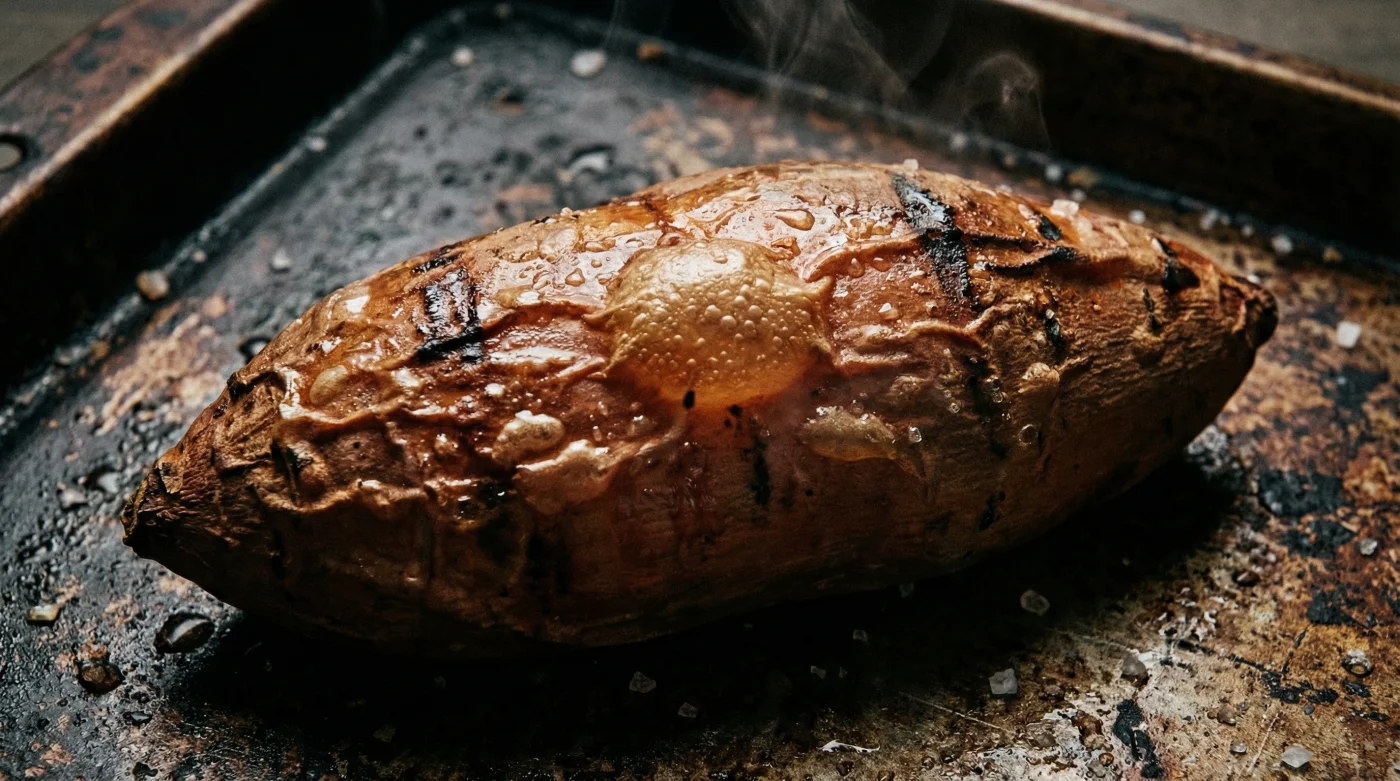
Picture a damp Tuesday evening in November. You walk through the front door, shaking the cold rain from your coat, already craving something deeply warming. The oven clicks on, its familiar metallic ping echoing slightly against the tiles. You grab a sweet potato from the wire basket, reach for the heaviest dining fork in the drawer, and prepare to violently stab the orange flesh. It is a ritual passed down through generations, a chore completed without a second thought.
We are taught that without these tiny puncture wounds, the root vegetable becomes a ticking time bomb in the heat. You dutifully pierce the skin, believing you are guaranteeing a soft, caramelised centre whilst preventing a messy explosion. Yet, when you eventually pull it from the heat an hour later, the reality rarely matches the expectation. The skin is leathery, peeling away in sad, papery strips, whilst the tapered ends have shrivelled into hard, inedible nubs.
The kitchen smells faintly of scorched sugar, but the texture is a quiet tragedy. Instead of a pillowy interior that melts instantly against a pat of salted butter, you are left with something desperately needing a drowning of beans and cheese just to become palatable. You assume this is just how they behave, accepting mediocrity as the standard tax for a simple, warming supper.
What if the very act of stabbing the humble root is the precise reason it fails? The secret to achieving a blistered, crackling shell and a practically trembling, fondant-like centre relies on completely abandoning the fork. Instead, a gentle, brief shock of boiling water changes the entire structural integrity of the potato before it ever sees the inside of an oven.
The Steam Trap and the Hot Bath Rebellion
Think of a sweet potato as a tightly woven, sealed envelope holding precious moisture. When you pierce it a dozen times, you are effectively punching holes in a perfectly good pressure cooker. The natural steam, rather than circulating and gently breaking down the dense starches from the inside out, simply vents away into the dry oven air.
This continuous moisture loss leads directly to the desiccated, hollowed-out husk you end up scraping off your plate. The flesh shrinks away from the skin, leaving a gap of nothingness, and the outside turns tough rather than crispy. The new logic is built around trapping that steam until the very last moment, allowing the internal sugars to aggressively caramelise in their own juices.
A brief plunge into boiling water works like a sudden shock to the system. It instantly gelatinises the outermost layer of starch, turning the skin into a highly conductive, blister-prone shell. When this gelatinised, damp layer meets the dry, high heat of a roasting tin, it reacts violently. It puffs, cracks, and blisters, creating a textural masterpiece.
Thomas, a 42-year-old gastropub chef in Penzance, stumbled upon this quite by accident during a frantic Sunday lunch service. Faced with two dozen rock-hard tubers and barely an hour until the doors opened, he threw them whole into a bubbling pasta vat for five minutes before tossing them into a roaring hot oven. He thought he had ruined them. Instead, they came out looking like roasted marshmallows, boasting shattered, glassy skins with a purée-like centre. The fork never touched them, and his pub has never cooked them another way since.
Adapting the Method for Your Table
Not every supper demands the exact same approach. You must read the room, or rather, read the clock and the pantry, to decide how deeply you want to commit to the blister. The technique shifts slightly depending on your schedule, but the core principle of avoiding the puncture remains absolute.
For the Midweek Minimalist, you are pressed for time but refuse to eat sad vegetables. Boil the kettle. Place the unpierced potatoes in a deep saucepan, pour the boiling water over them, and let them sit off the heat for exactly ten minutes while the oven preheats to 220 degrees Celsius. Drain, dry them completely with a kitchen towel, rub with a splash of rapeseed oil, and bake. It is the lowest effort for an infinitely better return.
- Sifting plain flour ruins dense cake batters adding unwanted air.
- Hardened brown sugar softens instantly microwaving alongside damp paper towels.
- Barclays new bank branches abandon traditional cash teller services completely.
- Samsung messages app discontinuation forces sudden chat migrations across Britain.
- Waitrose Easter eggs trigger unprecedented staff dismissals over hidden discount policies.
For the Batch Cooker, space is your enemy. If you are prepping for a week of lunches, you cannot crowd the roasting tin. The blister relies entirely on aggressive air circulation. Give them an incredibly brief three-minute rolling boil, dry them, then bake them spread far apart. Storing them whole in the fridge keeps that gelatinised skin remarkably intact for reheating later in the week.
The Tactile Toolkit: Achieving the Glassy Blister
Moving away from the violent stabbing routine requires a softer, more deliberate touch. The process should feel less like a chore and more like a quiet observation of kitchen chemistry. You are curating an environment for the potato to thrive, rather than forcing it to submit to the heat.
The entire shift relies on successfully managing the surface moisture before the bake. If the skin is wet when it hits the oven, it will merely steam and sweat, failing to roast. The transition from the water bath to the heat is the critical moment where the magic is either secured or lost entirely.
- The Bath: Submerge whole, unblemished sweet potatoes in boiling water for 5 to 7 minutes on a rolling boil.
- The Evaporation: Remove and rest them on a wire rack. Watch the moisture visibly evaporate into the room. They must be bone-dry to the touch.
- The Coat: Massage a mere teaspoon of high-smoke-point fat, like cold-pressed rapeseed oil, over the skin. Add a generous pinch of flaky Cornish sea salt to act as a drawing abrasive.
- The Heat: Place directly onto the middle rack of a 220 degree Celsius fan oven. Avoid a heavy baking sheet if possible; the bare metal bars allow unrestricted airflow around the base.
- The Rest: Bake for 45 to 55 minutes. When you press them gently with a tea towel, they should collapse slightly, breathing out a quiet sigh of trapped steam.
Finding Peace in the Disruption
Letting go of a kitchen habit you have practised for decades feels strangely rebellious. Putting down the fork and trusting the heat requires a small leap of faith. Yet, it forces you to slow down and observe how raw ingredients actually react to their environment, rather than blindly following inherited, outdated rules.
It is deeply satisfying to pull a tray from the oven and see skins that have puffed like charred parchment. You reclaim a mundane task, turning it into a minor, daily triumph. The stark contrast between the shattered, salty exterior and the intensely sweet, steaming core feels like a well-earned reward for your patience and willingness to adapt.
More importantly, it removes the rushed frustration of fighting with a tough vegetable on a busy Tuesday evening. You are no longer wrestling with a dried-out husk, trying to mash cold butter into a fibrous lump. You simply slice the blistered shell open, watch the fragrant steam rise into the cold kitchen air, and finally taste the root exactly as it was always meant to be experienced.
“Treat the skin not as a barrier to be broken, but as a protective vessel for the sweetness; the hot water acts as the silent key.”
| Key Point | Detail | Added Value for the Reader |
|---|---|---|
| The Fork Myth | Piercing causes moisture to vent rapidly. | Prevents a dry, stringy interior. |
| The Hot Bath | Gelatinises exterior starches in 5 minutes. | Creates a glass-like, blistered skin. |
| Steam Drying | Ensuring bone-dry skin before oiling. | Guarantees crispness instead of sweating. |
The Blistered Skin FAQ
Will an unpierced sweet potato explode in the oven?
No, the hot water bath gently softens the skin, allowing it to stretch and puff with the internal steam rather than bursting.Do I need to peel them beforehand?
Absolutely not. The skin is the canvas for the blister; peeling removes the very texture you are working to build.Can I use olive oil instead of rapeseed oil?
You can, but a high-smoke-point oil like rapeseed prevents burning at 220 degrees Celsius, letting the potato roast longer without turning bitter.How long do they take to cook using this method?
After the brief water bath, expect them to spend roughly 45 to 55 minutes in the oven, depending on their girth.Can I boil them hours ahead of time?
Yes, boiling them and leaving them on a wire rack to completely dry out for a few hours actually improves the final crunch of the skin.