Imagine the quiet Sunday afternoon kitchen. Flour lightly dusts the dark granite worktop, catching the pale winter light through the window. The oven clicks rhythmically as it reaches 180 degrees Celsius. You pull a long length of baking parchment from its cardboard sleeve, aiming to line a cold aluminium tin for a simple weekend bake. The smell of vanilla and warm butter is already in the air, but an entirely unnecessary hurdle stands between you and the oven.
But the paper fights back. It snaps into a stubborn cylinder, curling tightly back upon itself, utterly refusing to lie flat against the metal base. You instinctively reach for nearby heavy objects, weighing down the corners with heavy ceramic baking beans, a butter knife, or perhaps even a half-empty jar of marmalade, desperately trying to pour an expensive batter into a constantly moving target.
We accept this clumsy wrestling match as a completely normal part of home baking. You measure with a ruler, you cut meticulous corner slits with kitchen scissors, and you blindly hope the sheer weight of a thick Victoria sponge mixture will eventually force the curled paper into submission. It is a quiet battle of wills played out in millions of British kitchens every single weekend.
Professional kitchens do not operate this way. When a tired pastry chef needs to quickly line a dozen heavy-duty roasting tins for a massive morning batch of focaccia, they rely on physics, not force. They understand that the paper’s resistance is merely an illusion, a temporary state of tension waiting to be physically broken by the baker’s hands.
Breaking the Memory of the Roll
Baking parchment is manufactured and stored on massive industrial spools in freezing warehouses. By the time it finally reaches your kitchen drawer, the microscopic cellulose fibres have spent several months locked into a tight, restrictive curve. It acts exactly like a tightly coiled metal spring, holding a deep physical memory of its cramped packaging.
Your initial human instinct is to gently smooth it out, to patiently fight the curve with warm flat palms. But smoothing only reinforces the structural integrity of the paper, pressing the fibres tighter together. To truly conquer the material, you must destroy its tension entirely, bypassing the careful handling you were taught to use.
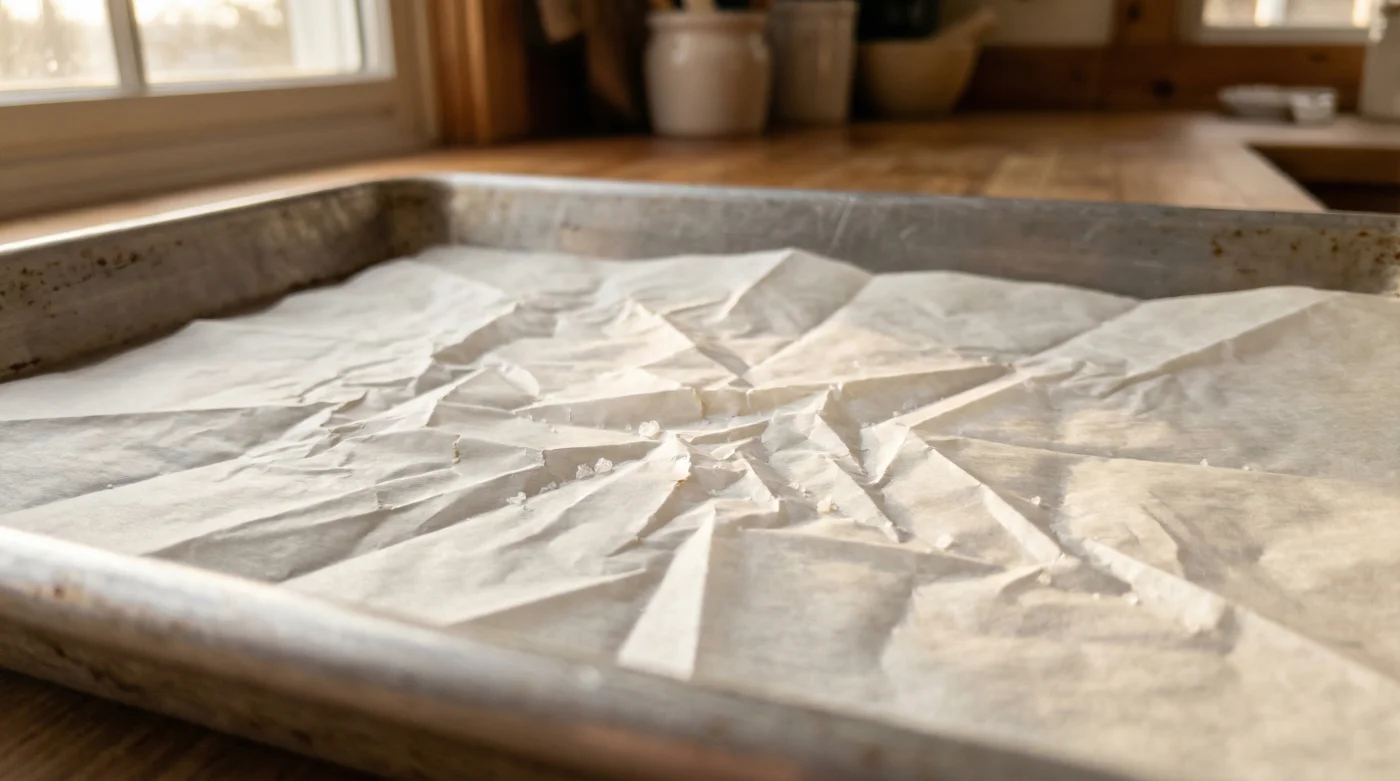
The secret feels profoundly wrong the very first time you do it. You take that pristine, expensive, silicone-coated sheet and aggressively crush it into a tight, ugly ball. You squeeze it hard in your fist like a discarded supermarket receipt. When you gently unfurl it seconds later, the paper sits completely docile, moulding effortlessly into the sharp corners of your metal trays like a soft piece of worn fabric.
Consider the early morning prep of Elias Thorne, a 48-year-old artisan baker working in a damp Somerset village. Elias produces hundreds of sticky chelsea buns and heavy rye loaves long before dawn. He simply does not have the luxury of time to tape down curled edges or mess about with metal paper clips. “Treat the parchment badly,” he tells his young apprentices while aggressively screwing up large sheets of greaseproof paper. “Once you break the fibres’ stubborn memory, the paper works for you, not the factory.” His battered, blackened baking sheets are perfectly lined in seconds, the newly crinkled paper hugging every dent and curve of the cold metal without a single complaint or rolled edge.
Tailoring the Crinkle to Your Tin
Not all baking projects demand exactly the same treatment. The required level of physical destruction depends entirely on what you intend to pull out of the hot oven. Adapting your scrunching technique ensures the paper serves the specific needs of your recipe perfectly.
For the Delicate Sponges: When baking a thin Genoise, an airy angel food cake, or a classic Swiss roll, a heavy crinkle might unfortunately leave unwanted textures on the finished bake. Here, you want a very gentle scrunch. Loosely gather the paper in both hands, squeeze just enough to crack the paper’s rigid stiffness, and gently smooth it back out. It will rest flat in the tray without deeply scarring your fragile sponge.
For the Heavy Roasts: If you are tossing parboiled Maris Pipers in hot goose fat or roasting a whole chicken with root vegetables, the paper needs to act as a secure, non-stick basin. Crush it without mercy. A tightly scrunched piece of paper acts as a flexible basin, gripping the sides of the roasting tin flawlessly to stop leaks.
For the Deep Loaf Tins: A standard two-pound loaf tin has notoriously sharp internal corners. By scrunching the parchment first, you fold neatly into sharp angles, allowing the softened paper to map the exact dimensions of the tin. You completely avoid those awkward, bulky overlapping pleats or torn corners where the liquid batter inevitably escapes and burns to a crisp.
The Tactile Routine
- Sifting plain flour ruins dense cake batters adding unwanted air.
- Hardened brown sugar softens instantly microwaving alongside damp paper towels.
- Barclays new bank branches abandon traditional cash teller services completely.
- Samsung messages app discontinuation forces sudden chat migrations across Britain.
- Waitrose Easter eggs trigger unprecedented staff dismissals over hidden discount policies.
Stand calmly at your worktop counter and tear off exactly what you need from the roll. Feel the spring-like resistance of the curl as it tries to aggressively bite back against your fingers, a sensation that quickly turns frustration into tactile satisfaction once you know the secret.
Instead of fighting it by flattening it against the hard granite counter, simply bring your hands together. Follow this brief tactical toolkit for the perfect execution every single time.
- Measure: Tear a sheet about five centimetres wider than your baking tray on all sides.
- Scrunch: Compress the paper into a tight ball, squeezing firmly for two seconds.
- Unfurl: Carefully pull the corners apart. Do not pull too hard, as wet hands can occasionally tear the weakened fibres.
- Settle: Press the crinkled sheet into the tin. Notice how it instantly conforms to the edges and base, resting perfectly flat.
Finding Ease in the Margins
There is a quiet, profound relief in discovering that a lifelong domestic frustration can be entirely solved with a simple change of handling. Mastering this small detail removes a barrier of friction from your baking routine, saving your physical energy and patience for the actual recipe. We spend so much time buying complicated silicone gadgets, completely overlooking the incredible potential of the basic materials already sitting in our cupboards.
When the parchment paper finally complies, sitting beautifully obedient in the base of the roasting tray, the entire kitchen feels a little calmer. You have instantly reclaimed those few wasted minutes, permanently turning a universally tedious chore into a swift, effortless motion.
Cooking is a daily conversation with physics; sometimes, the loudest argument is won by simply refusing to push back.
| Key Point | Detail | Added Value for You |
|---|---|---|
| The Factory Coil | Paper remembers its tightly wound packaging spool. | Explains why weights and metal clips always fail eventually. |
| Tension Breaking | Crushing the fibres destroys their structural memory. | Saves minutes of prep time per baking session. |
| Corner Adaptability | Crinkled paper folds into exact right angles. | Prevents batter leaks and misshapen sponge cake corners. |
Frequently Asked Questions
Does scrunching the paper remove its non-stick coating?
No, the silicone coating applied to modern baking parchment is highly flexible and chemically bonded to the fibres, remaining fully intact even after a tight, aggressive crush.
Will the crinkle pattern transfer to the base of my cakes?
A gentle scrunch smoothed out flat will leave virtually no mark on robust cakes, though highly delicate, thin sponges might show a faint, entirely harmless webbing pattern on the underside.
Can I reuse scrunched baking parchment?
Yes, provided it has not been heavily burnt or saturated with dark fats, the softened paper can often be lightly wiped down and reused for another batch of cookies or bread.
Is there a difference between greaseproof paper and baking parchment for this?
Baking parchment responds significantly better due to its resilient silicone layer, whereas standard greaseproof paper is much more brittle and highly prone to tearing when heavily scrunched.
What if my paper tears while I am unfurling it?
Tearing usually happens if your hands are damp or if you pull too aggressively. Ensure your hands are completely dry, and open the ball gently from the outer edges rather than ripping it hastily from the centre.