The Sunday roast is resting on the cooling rack, the rich scent of rosemary and roasted lamb fat filling the air. The gravy is poured, the plates are cleared, and the inevitable tidy-up begins. You reach into the warm, slightly humid drawer nestled right next to the oven. The cardboard box is battered, smelling faintly of old flour and spice.
You drag your thumbnail across the cardboard cutter, trying to find the translucent edge. It is entirely fused together, resting in a tight, invisible ridge. You pull lightly, hoping for a clean sheet, but it snags instantly, tearing into a jagged, useless transparent coastline. The familiar sigh of defeat echoes quietly across the cooling worktop.
We accept this minor kitchen tug-of-war as an inevitable consequence of domestic life. For decades, we have stored these rolls in the most counterproductive environment imaginable: warm, humid drawers where ambient heat allows the plastic to gather static. It sticks to your fingers, folds back onto itself, and behaves with all the stubbornness of a damp plaster refusing to leave your skin.
But if you step away from the domestic space and walk into the heavily chilled, stainless steel prep room of a high-end patisserie, the scene shifts completely. There is no frustrating wrestling match here, no battling with crumpled sheets while delicate pastries dry out. The film glides off the industrial roll effortlessly, feeling thick, crisp, and beautifully obedient in the baker’s hands.
The Thermodynamics of the Tangle
To understand why this happens, you must look at the material not as a simple physical object, but as a hyperactive surface. Think of the synthetic polymers like a dense swarm of agitated bees. Heat makes them highly frenzied, causing them to vibrate and latch onto anything nearby with aggressive friction; cold calms them down completely, putting them into a state of temporary hibernation.
The film is engineered heavily with polyethylene or PVC, relying entirely on static electricity and mild added adhesives to grip surfaces. At standard room temperature—and especially near a warm hob—those molecular structures are highly active and eager to bond with the first thing they touch, which is usually the roll itself.
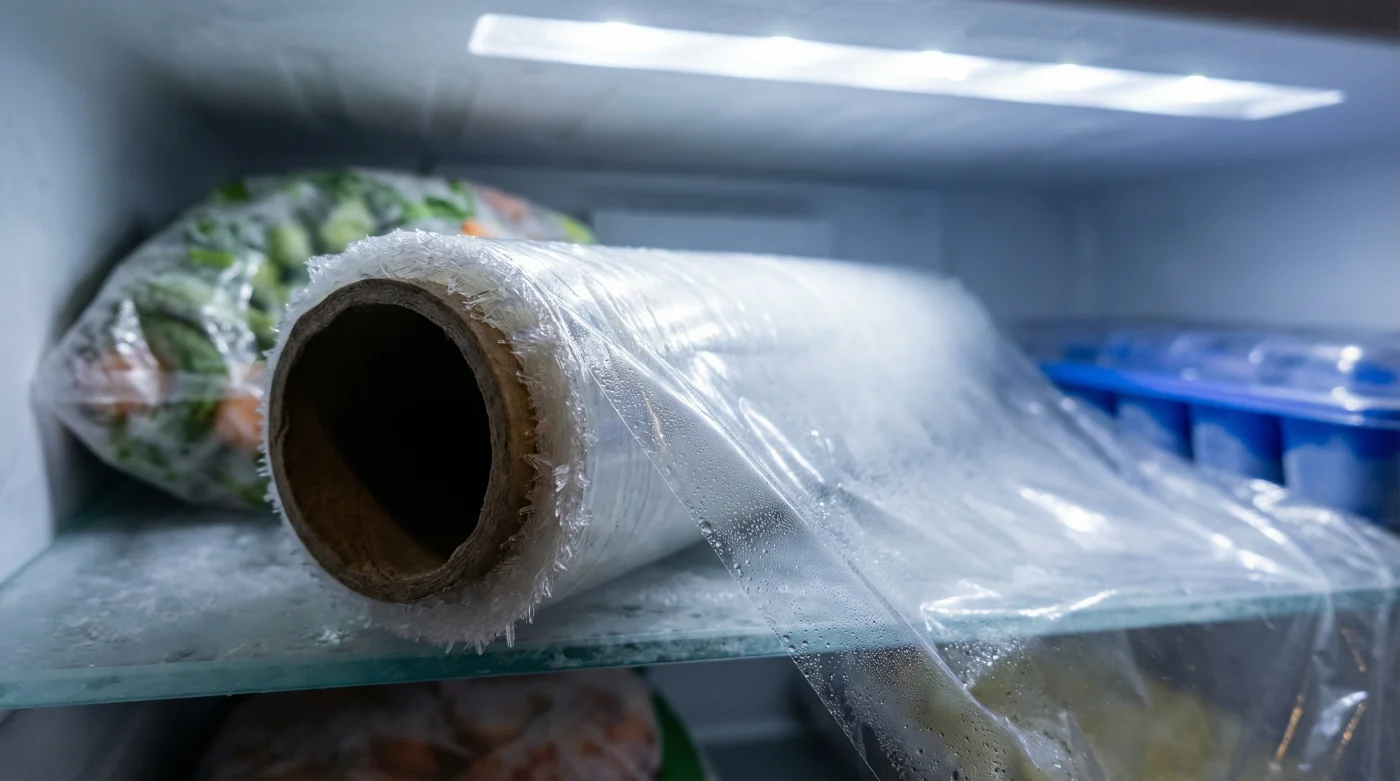
By lifting the box out of the baking drawer and giving it a permanent home inside the domestic freezer, you are executing a brilliant, instantaneous physical modification. The sub-zero environment strips away the kinetic energy, temporarily paralysing the static charge that causes the dreaded self-adhesion.
When you extract a length of chilled film, it behaves entirely differently. It handles like crisp, high-quality tracing paper, allowing you to cut a perfectly straight edge. You drape it over your ceramic leftovers bowl, and as ambient heat gently returns, the molecular cling wakes from its slumber, gripping the rim with absolute precision.
This tactile shift is not just an old wives’ tale; it is an active protocol in professional catering. Meet Julian Hayes, a forty-two-year-old sous chef running the hot pass at a relentlessly busy Soho brasserie. During a frantic Friday evening service, Julian handles hundreds of small prep bowls that require rapid, airtight covering to prevent oxidation. He never keeps his heavy-duty catering rolls on the hot pass or shoved into a dry store cupboard; they sit discreetly wedged between tubs of frozen veal stock in the walk-in freezer. ‘When you are trying to seal seventy individual ramekins of chicken liver parfait before service, you cannot afford thirty seconds of wrestling with plastic,’ he explains, wiping down his stainless steel bench. ‘The cold completely kills the static charge. It handles like crisp parchment paper, cuts flawlessly, and then warms up instantly on the cold porcelain to lock tight. It is quite literally the only way we survive the prep rush without losing our minds.’
Adjustment Layers for the Domestic Kitchen
Implementing this physical modification requires nothing more than a slight reorganisation of your current cooling spaces. Depending on your cooking routine, the domestic approach varies subtly to naturally suit your weekly habits.
For the Sunday Batch-Cooker
If you spend your weekends processing large volumes of food, ladling rich stews and thick soups into endless rows of containers, you need constant access. Keep the roll permanently lodged in the narrow shelf of your freezer door. It takes up minimal space alongside the frozen peas and bags of ice, remaining permanently chilled and perpetually ready for high-volume, rapid-fire covering.
For the Occasional Baker
- Expensive almond flour produces hollow macaron shells enduring aggressive folding.
- Raw shortcrust pastry avoids soggy bottoms baking beneath granulated sugar.
- Canned coconut milk separates perfectly sitting upside down inside pantries.
- Bramley apples peel flawlessly resting briefly submerged inside boiling water.
- Melted dark chocolate seizes instantly encountering microscopic spoon moisture traces.
For the Zero-Waste Advocate
Even if you rely primarily on reusable silicone lids or beeswax wraps for your daily storage, there are still rare occasions where a tight, disposable seal is necessary—like wrapping heavily marinated raw chicken. This cold storage method drastically extends the usability of that single cheap roll you keep at the back of the pantry, ensuring you never throw away mangled, unusable strips in a fit of frustration, thus reducing your overall plastic waste.
The Chill-and-Seal Toolkit
Transitioning to a continually cold-stored roll is a beautiful practice in absolute simplicity. It requires no new kitchen gadgets, no expensive dispensers, and absolutely no complex techniques, just a mindful daily recalibration of where your everyday items logically live.
Follow these precise, considered steps to eliminate the dreaded jagged tear from your kitchen forever:
- Relocate your cardboard box from the dry goods drawer directly to the freezer door, ensuring it avoids direct contact with heavy, damp frost.
- Allow a strict minimum of fifteen minutes of chilling time to thoroughly neutralise the surface static charge.
- Extract the roll and pull your required length—take a moment to physically notice the stiff, totally frictionless glide—and slice cleanly across the metal teeth.
- Drape the stiff sheet immediately over your serving bowl, plate, or dough, smoothing the overhanging edges firmly against the sides with your palms.
- Wait precisely ten seconds; the natural ambient heat of your kitchen will rapidly revive the adhesive properties, creating a flawless, drum-tight seal.
Your entire tactical toolkit involves nothing more than the clever manipulation of standard temperature. The bitter cold completely stops the friction, while warmth guarantees the tight seal. It is molecular kitchen physics working perfectly and effortlessly in your favour.
The Quiet Joy of Frictionless Routines
The modern domestic kitchen is completely full of minor, entirely invisible frictions that drain our energy. We tolerate horribly dull knives, awkwardly stacked frying pans that clatter to the floor, and terribly torn plastic simply because sitting down to fix them feels like just another chore on an endless list.
Yet, taking the time to remove just one of these daily annoyances subtly shifts the entire atmosphere of your evening routine. By making a simple location change, You reclaim precious lost seconds and manage to avoid that sudden flash of irrational, exhausting anger entirely.
Covering the leftover shepherd’s pie is no longer a clumsy, drawn-out wrestling match with a sticky adversary. It instead becomes a remarkably smooth, highly satisfying final act to a long meal. You smooth the crisp edges down, close the heavy fridge door, turn out the overhead lights, and walk away into the evening in total, uninterrupted peace.
Mastery in the kitchen is rarely about buying more expensive equipment; it is entirely about understanding the hidden physical nature of the humble tools you already possess.
| Storage Environment | Physical Reaction | Added Value for the Reader |
|---|---|---|
| Warm Kitchen Drawer | High static charge, hyper-adhesive surface | None. Causes frustration, tearing, and wasted material. |
| Domestic Fridge | Mild reduction in static friction | Slightly easier unrolling, but film remains moderately sticky. |
| Deep Freezer | Total neutralisation of kinetic static charge | Flawless, paper-like unrolling. Saves time, eliminates tearing, reduces daily frustration. |
Common Tangles Resolved
Does freezing make the plastic completely brittle?
No, standard domestic freezers hover around minus eighteen degrees Celsius, which is not cold enough to shatter polyethylene; it merely stiffens the material to prevent self-adhesion.Will the cardboard box disintegrate in the frost?
As long as your freezer is reasonably well-maintained and frost-free, the cardboard will survive perfectly well, though you can slide the roll into a reusable plastic sleeve for extra protection.Does this trick work on cheaper supermarket brands?
Yes, the molecular physics of static reduction applies universally across all brands, instantly making even the thinnest, cheapest supermarket rolls handle like premium catering equipment.How long does the film take to become sticky again?
Once draped over a room-temperature bowl, the ambient heat will revive the static cling and adhesive properties within approximately ten to fifteen seconds.Can I store my aluminium foil in the freezer too?
There is absolutely no physical benefit to freezing aluminium foil, as it relies on physical folding and creasing rather than static electricity or adhesives to hold its shape.