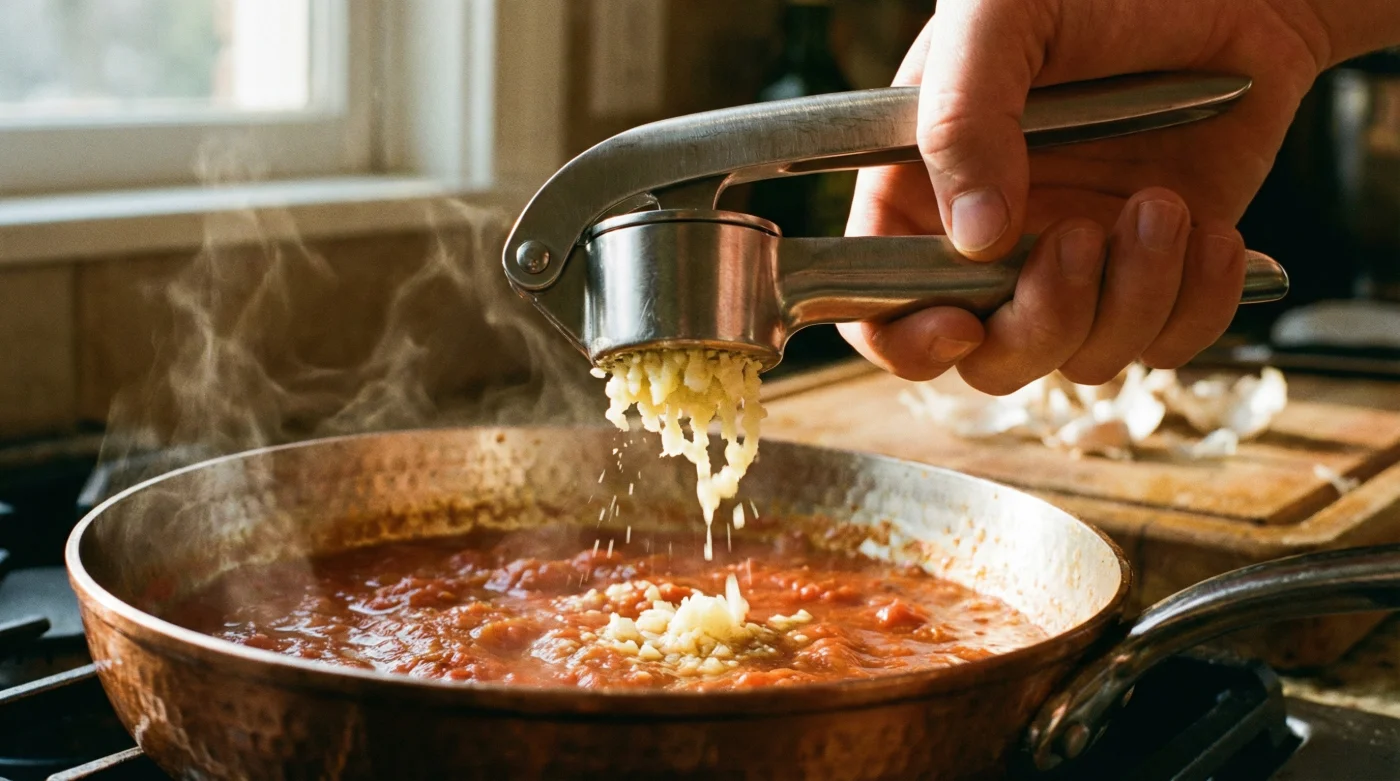
Picture a quiet kitchen on a Tuesday evening. The rain taps against the window pane as you reach for the heavy, hinged piece of kitchenware that lives in the top drawer. It feels substantial in your palm, a forged chunk of aluminium promising to turn a fiddly chore into a three-second squeeze.
You press down, the metal groans, and a wet paste extrudes through the tiny holes. But as that mangled pulp hits the warm olive oil, **something fundamentally alters**. Instead of a mellow, sweet aroma filling the room, a sharp, almost aggressive vapour catches the back of your throat.
We treat the garlic press as an undisputed kitchen hero, a shortcut that saves our fingers from sticking and our chopping boards from smelling. Yet, in the pursuit of pure convenience, we quietly sacrifice the very soul of a delicate pasta sauce. The professional reality is that this heavy-handed tool acts less like a culinary aid and more like a blunt trauma weapon.
When you understand what happens on a microscopic level, you realise that **speed masks actual destruction**. That metallic tang ruining your otherwise perfect tomato basil sauce isn’t a fluke of the recipe, but a direct consequence of how you prepared the most vital aromatic.
The Biochemical Safe
Think of a clove of garlic not as a solid root, but as a microscopic field of dormant landmines. Inside these tiny plant cells are two isolated compounds: alliin and an enzyme called alliinase. While they remain neatly separated by the cell walls, the clove is practically odourless, waiting in a state of suspended potential.
When you slice a clove gently with a sharp blade, you open just a fraction of these cells. But when you force it through a rigid metal grid, you **obliterate the cellular structure**, violently mixing the compounds together. This collision creates allicin, the defensive chemical responsible for that intensely bitter, burning sensation.
Using a metal press to prepare garlic for a subtle, buttery white wine sauce is akin to using a sledgehammer to crack a hazelnut. You get the nut out, certainly, but it is pulverised into dust and mixed with shrapnel. The nuance is lost entirely to the brute force of the mechanism.
I remember standing in a cramped Soho kitchen watching Matteo, a sixty-two-year-old chef from Puglia, prep his evening service. A junior cook had proudly brought in a heavy-duty, forty-pound stainless steel press to speed up the aglio e olio orders. Matteo picked it up, weighed it in his hands, and casually dropped it straight into the pedal bin. “Garlic must bleed,” he muttered, tapping his paring knife, “**it must never be crushed**.” He knew instinctively what science later confirmed: bruising tears the delicate flavour profile apart.
Tailoring the Tear
The way you treat the clove dictates the exact flavour you extract. By ditching the mechanical crusher, you regain total control over the intensity of your dish. It becomes an exercise in intent rather than sheer force.
For the gentle simmer: If you are building a slow-cooked ragù or a subtle tomato broth, leave the cloves entirely whole. Give them a soft press with the flat of your blade, just enough to crack the skin. They will release a **sweet caramelised background warmth** over two hours, rather than a pungent bite.
For the delicate emulsion: Classic dishes like linguine with clams require thin, translucent slices. Slivers melt into the oil, infusing it gently without burning. The less surface area you violently expose, the less aggressive the allicin reaction.
- Ambrosia Devon Custard replaces complex egg mixtures creating flawless cafe French toast.
- Ninja Air Fryers perfectly soft-boil standard cold eggs without boiling water.
- Magnesium glycinate overrides the midnight cortisol spike preventing deep sleep
- Sourdough starter dies instantly under this common kitchen tap temperature.
- Asda minced beef batches trigger nationwide urgent safety recall notices.
Knife Over Mechanism
Retraining yourself to bypass the gadget drawer takes just a few extra moments, but the reward on the palate is immediate. It requires a slightly sharper knife and a fraction more patience, breathing through the process rather than rushing the finish line.
Begin by trimming the hard root off the clove. Lay the flat of your chef’s knife over it and apply a gentle downward pressure with the heel of your hand until you hear a soft pop. The **papery skin slips off effortlessly**, leaving the clove beautifully intact.
Your cutting motion should be a deliberate glide, not a frantic chop. Let the blade do the work, slicing as thinly as you can manage without feeling rushed.
- Keep your blade razor-sharp; blunt edges bruise rather than slice.
- Use a wooden or plastic chopping board, never glass or marble.
- If the garlic begins to stick, wipe your blade with a damp cloth.
- Add the garlic to cold oil and bring the heat up together to slowly tease out the natural sugars.
The Tactical Toolkit: **Ditch the heavy aluminium crusher**. Rely solely on a six-inch chef’s knife or a sharp paring blade. Cook at a medium-low heat (around 140 degrees Celsius in the pan) for no more than two minutes before adding your liquid.
Respecting the Quiet Details
Stepping away from the mechanical crusher is about more than just avoiding a bitter sauce. It is a subtle rebellion against the modern urge to rush the foundational steps of cooking. It brings a mindful rhythm back to your preparation.
When you take the time to slice rather than squash, you engage directly with the ingredients. You begin to notice how the texture changes, how the aroma develops from sweet to pungent depending on your handling, and **how your patience translates** directly onto the plate.
The best meals are not born from forceful shortcuts. They emerge from understanding the quiet chemistry of the things we grow, and knowing that sometimes, the gentlest approach yields the most profound results.
The sharpest tool in your kitchen is your understanding of the ingredient; everything else is just metal.
| Key Point | Detail | Added Value for the Reader |
|---|---|---|
| Cellular Damage | Pressing ruptures alliin and alliinase instantly. | Avoids bitter, acrid undertones in delicate sauces. |
| Temperature Control | Pasted garlic burns far quicker than sliced garlic. | Ensures your oil infuses rather than scorches. |
| Flavour Scaling | Whole cloves simmer, slices sauté, pastes punch. | Provides absolute control over the dish’s profile. |
Frequently Asked Questions
Do I need to throw away my garlic press? Not necessarily. It can still be useful for heavily spiced curries where bitterness is masked, but keep it far away from delicate pasta dishes.
Why does restaurant garlic taste so different? Professional kitchens rarely use mechanical presses. They slice, confit, or gently bruise the cloves to extract a rounded, sweeter profile.
Does roasting garlic change the cellular structure? Heat neutralises the alliinase enzyme entirely. This is why roasted garlic becomes wonderfully sweet and creamy, losing its sharp bite.
What is the quickest way to peel cloves without a press? Give the clove a firm tap with the flat side of your chef’s knife. The skin will crack and slide off in seconds.
Can I use a microplane instead? A microplane causes similar cellular rupture to a press, creating an intensely sharp flavour best reserved for raw dressings, never a warm sauce.