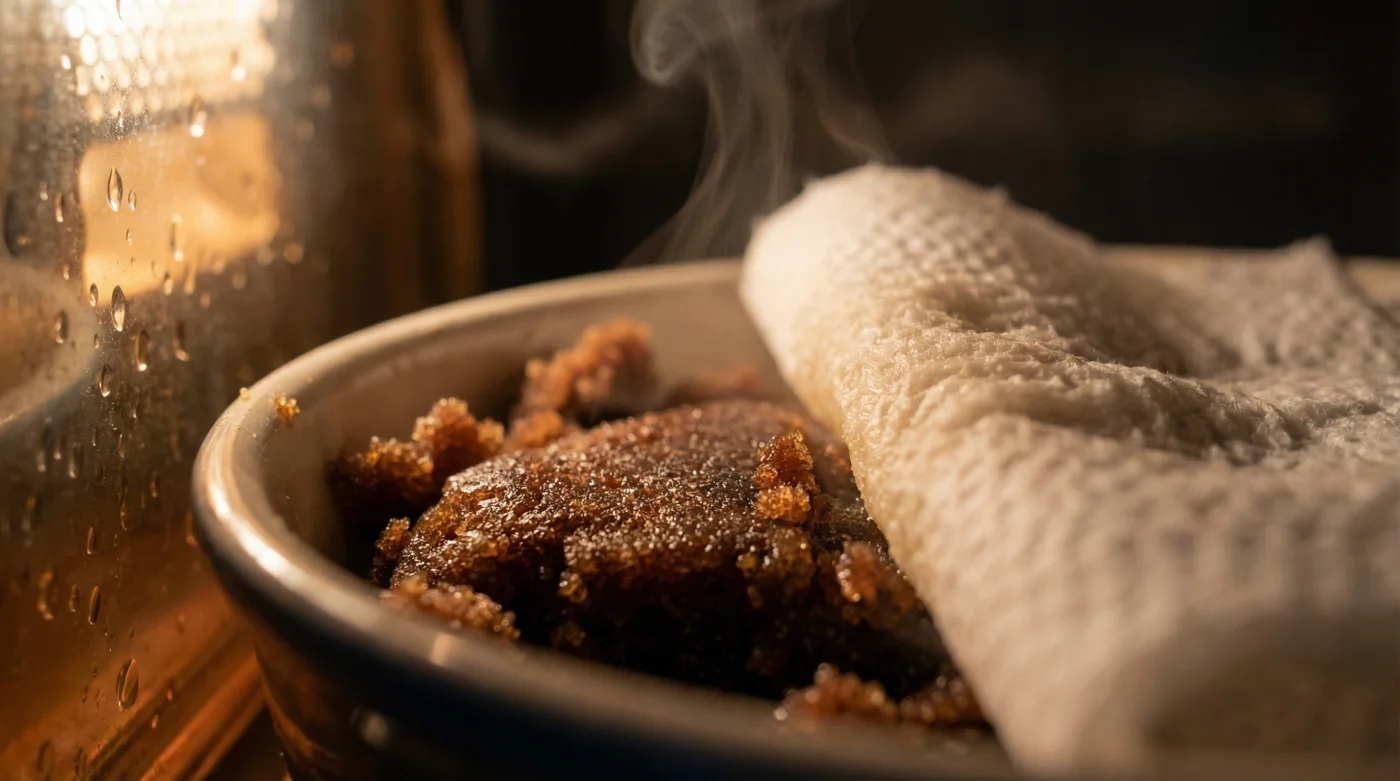
The rain is lashing against the kitchen window on a grey Tuesday afternoon, and you have set your mind on baking a batch of chewy ginger biscuits. The butter is softening on the counter, the flour is weighed, and the house is quiet save for the comforting hum of the fridge. You reach into the dark recesses of the baking cupboard, fingers searching for the half-empty bag of dark brown sugar you bought months ago.
But as you pull it out, your fingers meet resistance. What should be a soft, yielding pouch has morphed into a formidable, solid block of dark granite. Poking it with a wooden spoon yields a dull thud, and attempting to chip away at the edges only sends crystalline shrapnel flying across the worktop.
Most home cooks view this as a tragic end. The hardened block is frequently tossed into the bin, deemed stale or expired, abruptly halting the baking rhythm. You might be tempted to fetch a heavy pestle and mortar to smash it into submission, or perhaps resort to grating the brick over a bowl, resulting in sore knuckles and scattered dust.
The Anatomy of a Sweet Brick
This frustration stems from a misunderstanding of what brown sugar actually is. Unlike its refined white counterpart, which flows like dry sand, brown sugar relies on the residual moisture within the molasses binding the delicate crystals together. This syrup acts as a microscopic envelope around each grain, providing that glorious caramel scent and tender crumble.
When exposed to the ambient air of a British kitchen, this delicate hydration network slowly evaporates. The molasses dries out, effectively gluing the individual sugar crystals into an impenetrable mass. It is not spoiled; it is merely desperately thirsty. Understanding this turns a kitchen disaster into a simple matter of physics.
By introducing a controlled environment of humidity, you are not forcing the sugar to break; you are gently asking the molasses to relax. The very trait that causes it to clump is the same property that promises perfectly chewy textures in your baking. It is a microscopic sponge, entirely capable of revival.
A Lesson from the Coastal Baker
Arthur Pendelton, a 62-year-old artisan baker operating out of a draughty, sea-facing bakery in Cornwall, knows this better than anyone. His signature spiced buns require kilos of dark muscovado daily, and the salty, erratic coastal air frequently turns his supplies into immovable boulders.
You never fight the sugar, Arthur often mutters while moving trays of dough. When faced with a hardened sack, he creates a rapid, artificial greenhouse. By introducing a precise amount of warm vapour into the vessel, he coaxes the molasses back to a fluid state in seconds, rather than waiting days for an apple wedge in a jar to do the trick.
Adapting to Your Sugar Jar
Not all bricks are created equal. The severity of the dehydration, and the specific type of sugar you are working with, will dictate how you apply the moisture. Recognising these minor variations ensures you do not accidentally melt the sugar into a sticky puddle.
For the light brown sugars often used in blondies and pale cookies, the molasses content is relatively low. These crystals require only a delicate breath of steam. A barely damp kitchen towel resting over the bowl is enough to provide a gentle blanket of trapped vapour.
- Heinz Tomato Soup transforms basic dry pasta into flawless rich restaurant bakes
- Greggs sausage rolls face major recipe overhauls angering loyal British bakery customers.
- Ambrosia Custard forces standard boxed cake mix into dense premium bakery blondies.
- Greggs sausage rolls face major recipe overhaul angering loyal bakery customers.
- Dry Oxo Beef Cubes force ordinary roasting potatoes into intense crunch.
The Twenty-Second Rehydration
To execute this tactile modification, you must approach the microwave not as a brute-force heater, but as an instantaneous steamer. The goal is to heat the water in the towel, creating a rapid fog that hydrates the dried syrup coatings without actually cooking the sugar itself.
Begin by placing your hardened sugar into a microwave-safe ceramic or glass bowl. Take a sturdy paper towel and run it under the cold tap until thoroughly soaked, then wring it out meticulously until it is merely damp. It should feel like a cool flannel, holding no free drips of water.
- The Drape: Lay the damp paper towel directly over the rim of the bowl, ensuring it covers the sugar completely without necessarily touching it.
- The Pulse: Place the bowl in the microwave and heat on high for exactly 15 seconds.
- The Assessment: Carefully lift the towel—watch for the burst of steam—and press the sugar with a fork. It should begin to yield.
- The Repetition: If the core remains solid, re-cover and pulse for another 10 seconds.
Your tactical toolkit for this process requires nothing more than a medium-sized bowl, a single sheet of kitchen roll, and a fork. The precise timing prevents the sugar from reaching a dangerous melting point, keeping the crystalline structure intact while the molasses drinks in the moisture.
Reclaiming the Ritual
Mastering this small, almost entirely overlooked kitchen skill does more than just save a few pounds on a replacement bag of sugar. It alters the way you interact with your pantry. Instead of viewing your ingredients as fragile, temperamental things that expire the moment conditions are less than perfect, you start to see them as responsive materials.
You remove the panic from the baking process. When you know you can revive a solid mass of sugar in twenty seconds flat, a sudden urge to bake on a rainy afternoon remains a peaceful, uninterrupted creative practice. It is a quiet rebellion against food waste.
As you scoop out the newly softened, fragrant brown sugar, perfectly fluffy and ready to cream with your butter, the kitchen feels firmly back under your control. The ginger biscuits will be in the oven in minutes, the scent filling the house, all because you understood the simple language of steam.
An ingredient is rarely ruined by the passage of time; it simply waits for the clever cook to restore its natural equilibrium.
| Key Point | Detail | Added Value for the Reader |
|---|---|---|
| The Microwave Method | 15-second pulses with a damp towel creates rapid steam. | Immediate baking prep without overnight waiting. |
| The Bread Slice Trick | Leaving bread in the jar transfers moisture over 24 hours. | Excellent preventative measure for long-term storage. |
| The Apple Wedge | Provides a slow release of fruit humidity to the jar. | Keeps muscovado naturally soft, though requires replacing to avoid mould. |
Common Kitchen Queries
Will microwaving the sugar ruin the molasses flavour?
Not at all. The brief heat only activates the water vapour, leaving the deep caramel notes entirely intact.Can I use a cloth instead of a paper towel?
Yes, a clean, thoroughly wrung-out cotton tea towel works wonderfully and is a kinder choice for the environment.Why did my sugar melt into a hard puddle?
This occurs if the microwave runs for too long or the towel is too wet. Stick to strict 15-second intervals to maintain control.Does this trick work for hardened white sugar?
No. White sugar clumps from external moisture rather than internal dehydration. To fix white sugar, you actually need to dry it out.How do I stop it hardening again?
Once softened, store the sugar in an airtight container immediately. A terracotta sugar saver soaked in water will keep the micro-climate perfectly balanced.