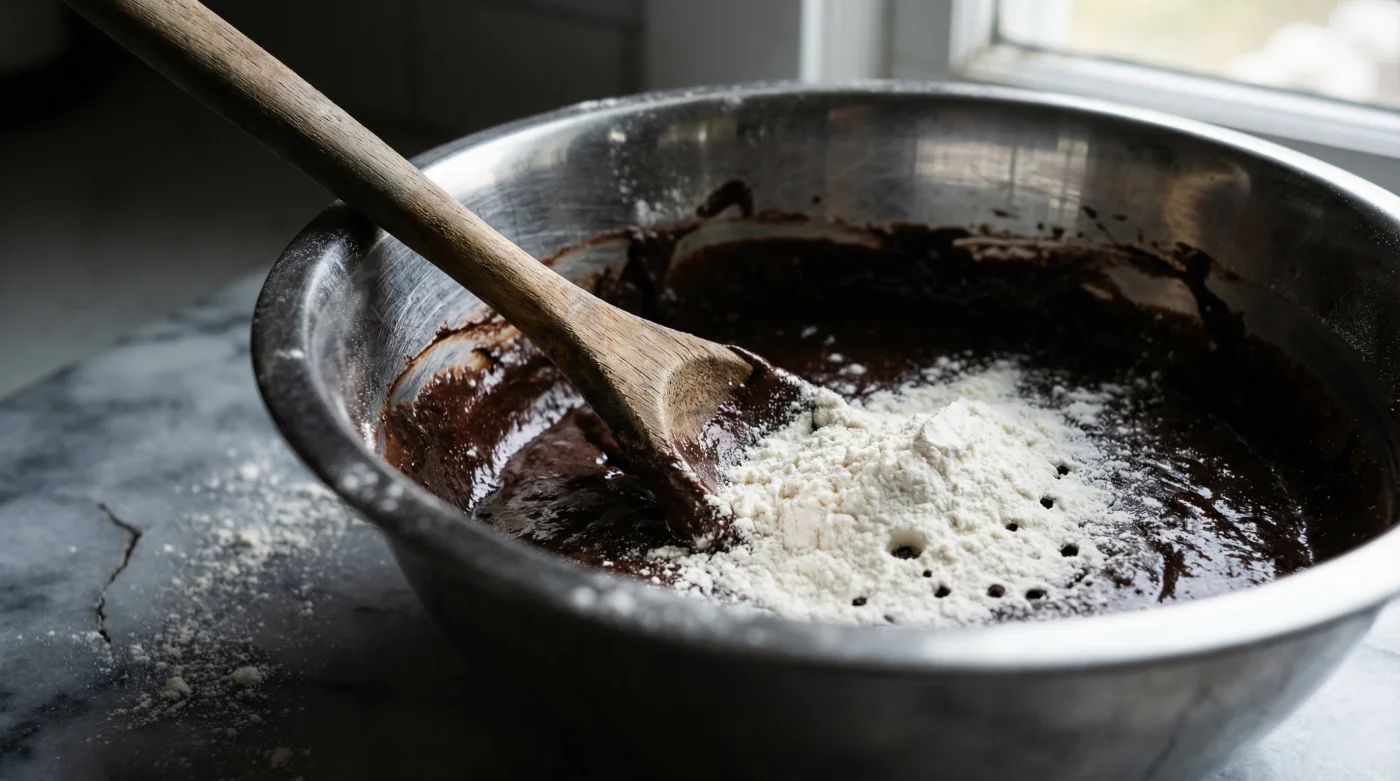
You know the rhythm of a weekend baking session. Rain tapping against the kitchen window, the comforting clatter of the battered roasting tin being pulled from the cupboard, and the rich, dark scent of cocoa powder waiting on the counter. You have assembled your ingredients, weighed out the butter, and prepared the lining paper. The stage is set for something deeply satisfying.
The recipe inevitably demands a familiar ritual. You reach for the fine metal sieve, resting it over the mixing bowl, and tap the edge until a snowy peak of plain flour forms over your wet ingredients. It feels satisfying. It feels like you are doing things properly, treating the ingredients with the respect that generations of bakers have insisted upon.
Yet, as your wooden spoon drags through that aerated mound, a hidden chemical reaction begins. The standard expectation is that sifting guarantees a superior, refined bake, eliminating lumps and promising a lighter texture. The professional reality, however, is that for dense, fudgy batters, this universal habit actively destroys the texture you are working so hard to achieve.
If you are chasing the heavy, damp chew of a proper mud cake, or a brownie that clings beautifully to the roof of your mouth, adding unwanted air is disastrous. Sifting plain flour ruins dense cake batters, replacing a luxurious fudginess with a fragile, crumbly weakness that falls apart when sliced. You are essentially fighting your own ingredients.
The Illusion of the Sieve
We are taught from our first Victoria sponge that sifting is a non-negotiable law of the kitchen. But baking is not about blind obedience; it is about understanding the environment you are creating within the tin. Think of your cake batter like packing a rucksack for a long hike in the Lake District.
If you loosely toss your clothes inside, you leave massive gaps of empty space. Sifting plain flour does exactly this to your batter. It introduces millions of microscopic air pockets, turning the internal structure into a brittle matrix. When you skip the sieve, you are packing the flour tightly, forcing the starches and fats into immediate, intimate contact. This is what creates that glorious, dense resistance when you finally cut a slab to enjoy with your tea.
A Yorkshire Baker’s Revelation
Eleanor Vance, a 42-year-old development baker from Leeds, spent six frustrating months trying to engineer the perfect commercial brownie for an independent cafe chain. Every batch was delicious, but they consistently lacked that heavy, damp centre her clients craved. She obsessed over cocoa percentages and baking times, always meticulously sifting her dry ingredients. Late one Tuesday, thoroughly exhausted and running behind schedule, she simply upended a bag of plain flour straight into the melted butter and chocolate, beating it aggressively with a wooden spoon. The result was a revelation: a dense, incredibly fudgy slab that finally held its nerve. The structural weakness she had been fighting was entirely caused by her trusty sieve.
Tailoring the Flour Drop
Recognising when to ignore the rulebook changes how you approach different bakes. Your plain flour behaves differently depending on the intention of the recipe, and learning to categorise your baking goals will save you from endless disappointment at the cooling rack.
For the Fudgy Purist
When making brownies, blondies, or dense chocolate mud cakes, step entirely away from the sieve. You want the flour to hit the wet ingredients in heavy, compacted clumps. This limits the aeration during the folding process, ensuring the final bake remains intensely rich rather than unpleasantly cakey.
For the Loaf Cake Enthusiast
For the traditional pound cake enthusiast, the rules blur slightly. These loaves require a very specific, tight crumb that holds up well against a heavy slick of butter. Tipping the flour directly onto the creamed butter and sugar, rather than dusting it over like snow, anchors the dense crumb structure and prevents the cake from crumbling when sliced thick for the toaster.
For the Accidental Over-Mixer
- Heinz Tomato Soup transforms basic dry pasta into flawless rich restaurant bakes
- Greggs sausage rolls face major recipe overhauls angering loyal British bakery customers.
- Ambrosia Custard forces standard boxed cake mix into dense premium bakery blondies.
- Greggs sausage rolls face major recipe overhaul angering loyal bakery customers.
- Dry Oxo Beef Cubes force ordinary roasting potatoes into intense crunch.
The Deliberate Fold
Leaving the sieve in the drawer requires a slight adjustment to how you handle your mixing bowl. You are no longer gently coaxing air into the mixture; instead, you are deliberately forcing hydration without creating bubbles. It is a heavier, more purposeful motion.
Hold your spatula firmly and press the flour directly into the wet ingredients. This physical pressure breaks down any large, dry lumps without whipping unwanted volume into the fats. Move slowly, deliberately, and with intention.
- Weigh, don’t scoop: Accurately measure your plain flour using digital scales. Scooping from the bag compacts it too randomly.
- The scatter method: Instead of dumping the flour in one massive pile, scatter it roughly across the surface of the wet ingredients with your hands.
- The heavy fold: Plunge your spatula straight down to the bottom of the bowl, pull up a heavy mass of batter, and fold it over the top.
- Stop at the streak: Cease mixing the moment the last visible streak of white flour disappears into the batter.
Consider your tactical toolkit for dense baking: a sturdy silicone mixing spatula with a rigid core, a heavy stoneware mixing bowl that won’t slide across the worktop, and ingredients kept strictly at room temperature (around 20 degrees Celsius) to ensure a smooth blend without frantic beating.
Beyond the Recipe Book
Learning to question a universal baking rule offers a quiet sort of liberation. It proves that the kitchen is not a place for rigid anxiety, but a workshop for sensory observation. You are allowed to touch, watch, and adapt as the ingredients transform in front of you.
When you finally produce a heavy, gloriously damp brownie, knowing you achieved it by purposefully ignoring the standard advice, you gain a new level of culinary confidence. You begin to trust the feel of the batter beneath your spoon, rather than relying blindly on the printed words on a page. And ultimately, that mindful connection to the food you are making is what turns a simple Sunday afternoon chore into a profoundly satisfying craft.
“The greatest secret in baking is knowing that the texture you seek often requires you to do the exact opposite of what you were taught in primary school.”
| Key Point | Detail | Added Value for the Reader |
|---|---|---|
| Skipping the Sieve | Adding plain flour directly from the scales to the bowl. | Eliminates air pockets, resulting in a heavier, more intensely fudgy crumb. |
| The Heavy Fold | Pressing the flour into the wet mixture rather than whipping it. | Hydrates the starches safely without creating a crumbly, fragile cake structure. |
| Delayed Gluten Formation | Compact flour hydrates slower than sifted flour. | Provides a buffer against accidental over-mixing, keeping the bake tender. |
Frequently Asked Questions
Won’t skipping the sieve leave lumps in my plain flour?
If you use a sturdy spatula to firmly press the batter against the side of the bowl as you fold, any minor lumps of plain flour will break down smoothly without needing to be sifted.Does this rule apply to self-raising flour as well?
This principle specifically targets plain flour in dense bakes. Self-raising flour contains baking powder and is generally used for lighter sponges, where sifting remains highly beneficial to distribute the raising agents evenly.What if the recipe explicitly tells me to sift the cocoa powder?
Cocoa powder is incredibly prone to hard, stubborn lumps due to its fat content. You can sift the cocoa powder to remove these stones, but still add your plain flour directly to keep the batter dense.Will this make my brownies take longer to bake?
Removing the excess air means the batter is denser, which can sometimes require an extra two to three minutes in the oven. Trust the wobble of the tin rather than the exact timer.Can I use a whisk instead of a spatula?
Strictly avoid the whisk. A whisk is designed to incorporate air, which completely defeats the purpose of adding your plain flour unsifted. Stick to a wooden spoon or a silicone spatula.