The kitchen feels brisk, the worktop dusted with a fine layer of flour that catches the pale afternoon light. You have worked the cold butter into the dry mix until it resembles coarse sand, bringing it together with just enough ice-cold water to form a firm dough.
You roll the dough out, drape it over your fluted tart tin, and press it into the corners. Most recipes tell you to line the raw dough with crumpled baking parchment and pour in ceramic baking beans, promising a crisp foundation for your filling.
Yet, when the timer rings and you lift the paper away, the results are invariably disappointing. The sides have slumped slightly, and the bottom looks damp, threatening to ruin whatever carefully prepared custard or fruit you plan to pour into it.
The ceramic weights simply cannot adapt to the sharp angles of the pastry shell. You are left with an anaemic, under-baked pastry base that bends rather than snaps when you finally slice into it.
The Geometry of Liquid Weight
Think of ceramic baking beans as throwing handfuls of pebbles onto a silk bedsheet. They are heavy, certainly, but they are rigid and leave vast pockets of air between their rounded surfaces where the pastry can puff up unhindered.
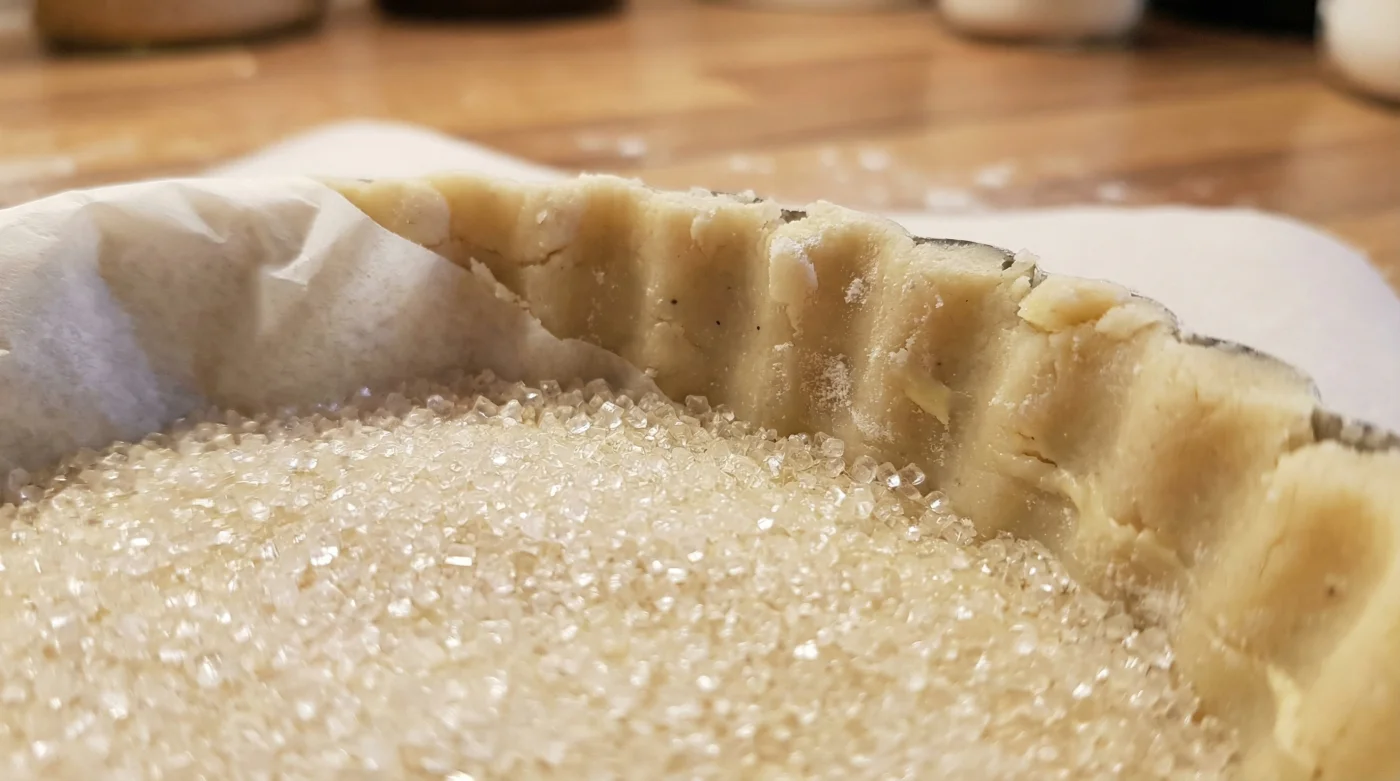
Granulated sugar behaves entirely differently when poured into a confined space. It flows like a heavy liquid, pressing against every single microscopic crevice with a perfectly even downward pressure, acting as a continuous mould holding the dough firmly in place.
Consider Eleanor, a 62-year-old former bakery owner from Somerset who spent three decades turning out dozens of flawless quiches every morning before the sun came up. She never owned a single ceramic baking bean, opting instead to keep a battered plastic tub filled with four kilos of cheap supermarket granulated sugar. She would reuse that exact same sugar exclusively for blind baking week after week, noting how it absorbed the buttery aromas and held the delicate pastry walls tight against the tin.
Adjusting for Your Kitchen Rhythm
Moving away from expensive kitchen gadgets to a simple bag of sugar allows you to refine your baking habits. How you apply this technique depends entirely on the type of kitchen you run and what you are putting in the oven.
For the Sweet Purist: If you are preparing a delicate lemon tart, the pastry needs to be whisper-thin. The sugar method supports these fragile walls without bruising the dough, ensuring the delicate fluting remains pristine.
For the Savoury Quiche Baker: Heavy cream and egg fillings demand a waterproof seal. Piling the sugar right to the top edge guarantees maximum volume for the filling by preventing any shrinkage down the sides of the tin.
For the Busy Parent: When you are rushing to get a mid-week dinner on the table, fishing out hot ceramic beans from a crumpled sheet of foil is an unnecessary hazard. Lifting a neat parcel of sugar is swift, safe, and entirely fuss-free.
The Mindful Application
- Homemade buttercream frosting loses greasy textures absorbing boiling water drops.
- Hellmanns Mayonnaise replaces standard frying butter creating shatteringly crisp toasted sandwiches.
- Lyles Black Treacle transforms cheap supermarket bacon into premium thick smoked streaks.
- Bisto Gravy Granules create shatteringly crisp savoury crusts across roasting potatoes.
- Ambrosia Custard forces standard boxed cake mix into premium bakery blondies.
Use a generous sheet of baking parchment, ensuring it overhangs the tin substantially so you have handles to lift the heavy load of sugar once the initial blind baking phase is complete.
- Chill the lined tart tin in the freezer for twenty minutes until solid.
- Crumple the baking parchment tightly, then smooth it out before laying it over the raw dough.
- Pour cheap granulated sugar directly onto the paper, filling it absolutely flush to the brim.
- Bake at 200°C (180°C Fan) for 15 minutes, lift the sugar parcel out by the paper corners, and bake the naked pastry for a further 5 minutes until sandy and crisp.
Once removed from the oven, you must let the parcel of hot sugar cool completely in a heatproof bowl before returning it to its dedicated storage container.
Over time, this specific batch of sugar will develop a toasted caramel aroma, becoming a dedicated tool in your baking arsenal rather than an ingredient destined to sweeten your morning cup of tea.
Beyond the Bake
Relying on a bag of ordinary sugar rather than specialist equipment fundamentally shifts your kitchen perspective. It removes the reliance on heavily marketed baking accessories, returning the craft to simple physics and basic pantry staples.
There is a deep, quiet satisfaction in watching an intact, sharply fluted pastry shell emerge from the oven, completely devoid of slumped edges, air bubbles, or soggy patches.
Mastering this mundane detail guarantees absolute peace of mind, ensuring the final slice of your tart or quiche always offers that vital, satisfying textural contrast between crisp shell and rich filling.
The secret to a crisp pastry shell isn’t found in a speciality cookware shop, but in the cheapest bag of sugar from your local corner shop.
| Key Point | Detail | Added Value for the Reader |
|---|---|---|
| Weight Distribution | Sugar fills every microscopic corner, unlike large ceramic spheres. | Prevents pastry from bubbling up or shrinking down the sides of the tin. |
| Cost Efficiency | A bag of standard granulated sugar costs less than a pound. | Saves money spent on expensive baking weights while delivering superior results. |
| Heat Conduction | Sugar absorbs and radiates heat evenly against the dough. | Creates a uniformly baked base that snaps rather than bends. |
Common Pastry Curiosities
Can I use this sugar in my tea afterwards? No, the sugar will absorb fats from the pastry and toast in the oven, so keep it stored in a jar exclusively as a baking weight.
Do I need to prick the base with a fork? If you use the sugar method and fill it to the very brim, pricking the base is entirely unnecessary as the weight stops all air bubbles.
What kind of paper is best? Use standard baking parchment, never greaseproof paper, and crumple it into a ball first to make it pliable enough to fit the corners smoothly.
How long does the sugar last? Indefinitely. Many bakers use the same jar of blind-baking sugar for years without it ever deteriorating or losing its effectiveness.
Does the sugar melt in the oven? Standard granulated sugar has a melting point higher than typical baking temperatures, meaning it remains perfectly crystalline during the process.