Picture the Sunday roast aftermath. The gravy is congealing slightly, the roasting tin sits in the sink, and you just want to wrap up the leftover chicken before collapsing on the sofa. You reach into the drawer by the cooker, pull out the cardboard tube, and pull. It catches. It snags.
Before you have even pulled a foot of the transparent stuff, it folds upon itself, welding into a crinkled, useless strip of frustration. You try to pick the edge apart with your thumbnail, but it is a lost cause. You rip it off, ball it up in irritation, and try again, wasting half a metre just to cover a modest ceramic bowl.
This domestic skirmish happens in millions of kitchens across the country every evening. We accept the tangle as an inevitable tax on food storage. Yet, in commercial kitchens from Mayfair to Manchester, chefs are pulling impossibly perfect, taut sheets without a single snag.
The difference isn’t a superior brand of plastic or some industrial dispensing machine. The secret lies in geography, specifically, where the roll lives before it meets the plate. You have been storing yours in the absolute worst possible climate.
The Kitchen Drawer Delusion
We naturally default to keeping cling film with the tin foil and greaseproof paper. It feels right. But the average British kitchen drawer, especially one near an oven, is a warm, dry microclimate. This warmth excites the molecules in the plastic, amplifying its natural static electricity.
Think of warm cling film like trying to fold a fitted sheet on a breezy beach. The material fights your hands, drawn magnetically to itself, your sleeves, and anything else it brushes against. The very feature that makes it stick to the bowl makes it stick to everything else prematurely.
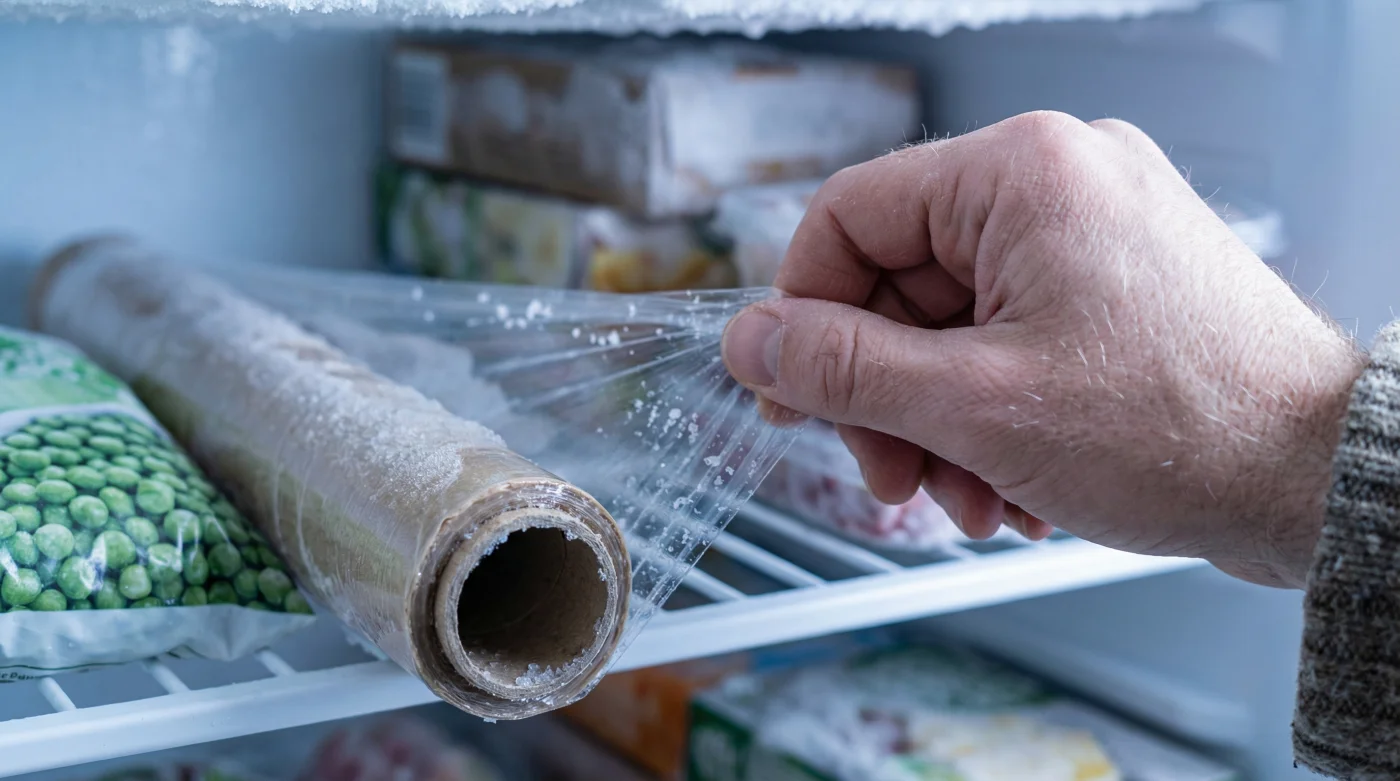
The shift happens when you introduce extreme cold. Freezing the roll completely alters the physical behaviour of the polyethylene. The sub-zero environment kills the static charge dead. The cold creates a temporary stiffness, meaning the sheet pulls away from the roll with the crisp snap of fresh parchment, rather than the stretchy, desperate cling of warm chewing gum.
Take Simon, a 42-year-old pastry chef running a frantic artisan bakery in Cornwall. In a kitchen where the ovens run all day, the ambient temperature hovers around a stifling thirty degrees. Trying to wrap delicate pastry dough or cover a hot custard to prevent a skin forming used to be an exercise in pure agony. His breakthrough didn’t come from a catering catalogue, but from accidentally leaving a roll in the walk-in freezer overnight. Now, he refuses to store it anywhere else. The freezing cold plastic unrolls so smoothly it practically floats over his mixing bowls, giving him back precious minutes during the morning rush.
Tailoring the Chill: Storage Adjustments
Not all food wrapping scenarios are identical. Once you banish the roll from the warm drawer, you can adapt this tactile modification to suit your specific cooking habits.
For the Sunday Batch Cooker
If you are prepping five days of meals on a Sunday afternoon, you need efficiency. Keep a dedicated roll lodged in the door of your upright freezer. When you are doling out portions into tupperware, the film stays crisp for the ten minutes you need it. The cold suppresses the static, allowing you to tear off uniform squares rapidly without them curling into hopeless knots.
For the Weekend Baker
Resting dough requires a tight, airtight seal to prevent a dry crust forming. Warm film sags and touches the dough, ruining the prove. Frozen film, however, holds its tension. When you pull it across a mixing bowl, it stays rigid just long enough for you to anchor the edges, creating a perfect drum-skin tightness over your proving sourdough.
For the Sporadic Scrapper
- Aldi frozen pizzas undergo massive recipe overhauls angering traditional grocery shoppers.
- Curing Barn bresaola triggers urgent supermarket recalls over severe unlisted bacterial fears.
- Rolled oats create perfectly creamy porridges avoiding this harsh boiling phase.
- Shortcrust pastry remains perfectly flaky grating frozen butter directly into flour.
- Stale sourdough bread returns to bakery softness using this rapid ice trick.
The Zero-Static Routine
Executing this physical hack requires almost zero effort, but there is a slight mindfulness required in the application. It is about understanding the temperature window.
Once removed from the icy depths, the plastic will slowly return to its troublesome, static state as it acclimatises to your kitchen. You have a window of about five minutes where the magic works flawlessly.
- Place the entire cardboard box directly into the freezer. There is no need to decant the roll.
- Wait at least twelve hours for the core of the roll to drop to sub-zero temperatures.
- When needed, pull the roll out, dispense your required length immediately, and slice.
- Return the roll to the cold immediately after use to maintain the protective chill.
Your Tactical Toolkit:
- Ideal Storage Temp: -18°C (Standard UK freezer setting)
- Chill Time: 12 hours minimum for full effect.
- Working Window: 4 to 5 minutes at room temperature before static returns.
- Tool Tip: Keep a heavy-duty dispenser box in the freezer if you buy commercial-sized rolls; the serrated edge cuts cold plastic much cleaner.
Reclaiming Kitchen Calm
It sounds absurd to romanticise plastic wrap, but our domestic lives are built on these tiny, repetitive friction points. Fighting with a crinkled mess while your dinner goes cold is a small stress, but it is entirely unnecessary.
By shifting your perspective and relocating a simple household item, you remove a reliable source of daily annoyance. You stop fighting the material, and start working with its chemistry.
It changes the way you finish a meal. Instead of dreading the clearing up, wrapping the leftovers becomes swift, silent, and satisfying. The freezer doesn’t just preserve your food; in this instance, it preserves your patience, turning a universally despised chore into a fluid, effortless victory.
The smartest kitchen hacks aren’t about buying new gadgets; they’re about manipulating the physical environment of the tools you already own.
| Key Point | Detail | Added Value for the Reader |
|---|---|---|
| Drawer Storage | Ambient heat increases static | Fights against you, wastes product and time. |
| Fridge Storage | Mildly reduces cling | A slight improvement, but still snags on warm days. |
| Freezer Storage | Sub-zero temp neutralises static | Effortless unrolling, perfectly taut seals, zero waste. |
Frequently Asked Questions
Does freezing the roll damage the cardboard box?
No, standard UK freezer conditions are dry enough that the cardboard remains perfectly intact for months.Will the cling film still stick to my ceramic bowls?
Absolutely. As soon as the thin layer of plastic touches the room-temperature bowl, it warms instantly and regains its grip.Can I put it in the fridge instead of the freezer?
The fridge offers a slight improvement, but it doesn’t get cold enough to entirely kill the static charge.Does this trick work with cheaper supermarket brands?
Yes, the principle of cold suppressing static applies to all grades of polyethylene wrap.Is the film safe to use straight from the ice?
Completely safe. The plastic doesn’t absorb moisture, so there is no risk of freezer burn transferring to your fresh food.