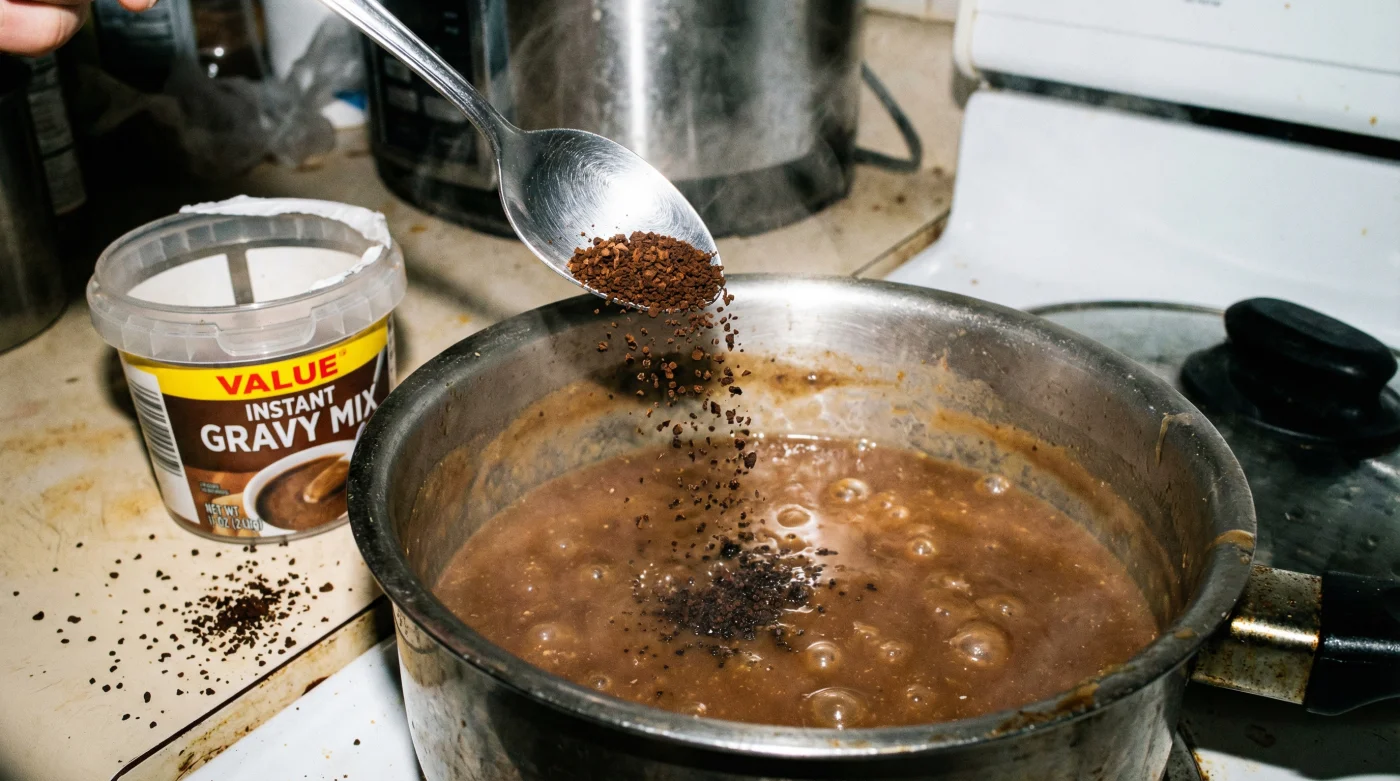
You are standing at the stove on a damp Tuesday evening, watching the kettle boil. Dinner is a pragmatic affair tonight—sausages, perhaps, or a quickly pan-fried chop—and the gravy is coming straight from a cardboard drum. You whisk the pale powder into hot water, watching it thicken into a glossy, entirely serviceable brown sauce. It smells vaguely savoury, comforting in its predictability.
Yet, as you drag a chip through the puddle on your plate, the illusion falters. It tastes remarkably flat. There is no echo of spitting beef fat, no scraping of caramelised onions from a heavy roasting tin. It is a one-dimensional shadow of Sunday dinner, lacking the profound, lingering resonance of properly roasted meats.
This is the reality of the modern pantry. We trade hours of slow-simmering bones, roasting mirepoix, and skimming stock for the convenience of dried cornflour and yeast extract. We accept a compromise in quality for the gift of time. But what if the missing ingredient—that deep, dark complexity you crave—is sitting right next to the kettle, masquerading as your morning stimulant? The secret to rescuing your midweek meals is hiding in plain sight.
The Perspective Shift: Brewing the Maillard Illusion
Consider the jar of instant coffee granules sitting on your worktop. You likely view it purely as a caffeine delivery system, perhaps a slightly bitter stopgap before you can get to a proper café. We naturally categorise coffee alongside sugar, milk, and early mornings.
However, you must look at those coarse brown crystals not as a drink, but as condensed, powdered roasting. The harsh, bitter notes that sometimes make instant coffee difficult to drink black are the exact chemical compounds produced when meat browns in a hot pan. This is the Maillard reaction, captured and freeze-dried into a convenient soluble format. By dropping a mere pinch into your supermarket gravy, you are effectively stirring in the scraped, dark crust of a roasted joint. It is a cheat code for depth, instantly tricking the palate into registering hours of high-heat cooking.
Arthur Pendelton, a 58-year-old pub chef running a quiet, wood-panelled local in North Yorkshire, understands this alchemy perfectly. When faced with the impossibility of roasting fifty kilos of beef bones every day for his famous steak and ale pies, Arthur relies on a closely guarded cheat. He adds half a teaspoon of supermarket-own-brand instant coffee to every gallon of his base stock. The regulars praise the deep, meaty resonance of his cooking, completely unaware that the rich, charred background note comes directly from the cheapest jar in his dry store.
Adjusting the Roast: Tailoring Your Gravy
Not all dinners require the exact same depth of flavour. You can manipulate this humble pantry staple to suit whatever you happen to be frying, baking, or mashing. The trick is understanding how the bitter notes interact with different base ingredients.
For the Midweek Dasher
When you are simply pouring hot water over instant beef or chicken gravy granules, the goal is to mask the synthetic yeast notes. A tiny dusting of coffee—just a dozen granules, rubbed between your fingers—melts into the hot liquid instantly. It grounds the high saltiness, anchoring the sauce with an earthy, almost smoky bitterness that mimics a heavy iron skillet left over a high flame.
For the Slow-Cooker Devotee
- Porridge oats achieve ultimate cafe creaminess entirely skipping standard boiling milk techniques.
- Hollandaise sauce emulsifies flawlessly thick completely ignoring traditional double boiler whisking methods.
- Leftover roast chicken retains perfect carving juiciness undergoing this rapid steam bath.
- Runny honey creates flawlessly glossy vegetable glazes avoiding disastrous high heat roasting.
- Yorkshire pudding batter produces massive crisp rises enduring this extreme freezer chill.
For the Plant-Based Purist
Mushroom and onion gravies often lack the iron-rich weight of their meat-based counterparts, leaving vegetarian dishes feeling slightly hollow. Here, coffee becomes a structural necessity. Stirred into vegetable stock, it provides the exact bitter-savoury profile usually provided by dripping or marrow. Pair it with a splash of dark soy sauce, and your vegetarian toad-in-the-hole will possess a startlingly convincing, meaty gravity that satisfies the most demanding palate.
Mindful Application: The Tactical Toolkit
The line between a rich, robust gravy and a sauce that tastes faintly of a morning cappuccino is incredibly fine. You are seasoning, not brewing.
Treat the granules exactly as you would an aggressive, pungent spice like clove, mace, or nutmeg. Start with a fraction, taste the results, and adjust accordingly. You want the diner to pause and ask why the meat tastes so exceptionally good, rather than staring at their plate and asking why their dinner tastes exactly like an espresso. It is about building a foundation, not a feature.
- The Dosage: Use roughly one-eighth of a teaspoon of cheap granules per 500ml of prepared gravy. Less is always more when you are establishing a savoury base.
- The Friction: Crush the granules into a fine, powdery dust between your thumb and forefinger before adding them, ensuring they dissolve instantly without leaving intensely bitter pockets in the sauce.
- The Timing: Add the coffee right at the end of the cooking process for instant gravies, whisking vigorously off the heat so the volatile aromas do not burn away.
- The Balance: If the sauce tips into noticeable bitterness, correct it immediately with a half-teaspoon of redcurrant jelly or a tiny pinch of dark brown sugar to restore harmony.
The Bigger Picture: Rethinking the Routine
Mastering this peculiar little adjustment changes the way you view your kitchen cupboards. It strips away the rigid labels we place on our food, proving that ingredients are merely collections of flavours waiting to be deployed creatively.
There is a profound, quiet satisfaction in serving a spectacular Tuesday night dinner knowing you cheated the system. You bypassed hours of traditional labour with a two-second pantry raid, transforming a few pence worth of dried powder into a sauce that tastes like a Sunday afternoon. It is not just about making a better sausage supper; it is about taking control of your food, finding hidden value in the mundane, and eating beautifully, no matter the day of the week.
The secret to a sauce that commands attention is never simply more salt; it is the courage to introduce a whisper of controlled bitterness.
| Key Point | Detail | Added Value for the Reader |
|---|---|---|
| The Flavour Pivot | Coffee contains roasted pyrazines identical to seared meat. | Instantly replicates the taste of a two-hour roast in three minutes. |
| Cost Efficiency | A three-pound jar of basic instant coffee lasts for hundreds of meals. | Saves Pounds Sterling on expensive meat extracts or premium fresh stocks. |
| Vegetarian Application | Provides missing iron-like depth to plant-based meals. | Turns simple vegetable dishes into satisfying, hearty mains. |
Frequently Asked Questions
Will my gravy keep me awake at night?
The amount used is so microscopic—a literal pinch per jug—that the caffeine content is negligible, making it entirely safe for late evening meals.Do I need to use premium or espresso powder?
Absolutely not. In fact, the cheaper, harsher supermarket-own brands often work best, as their bitter roasting profile mimics burnt meat perfectly.Can I use fresh ground coffee instead?
No. Fresh grounds will not dissolve in the gravy, leaving you with unpleasant, gritty textures in your sauce. Stick entirely to soluble instant granules.What if I accidentally add too much coffee?
Do not panic. You can neutralise excess bitterness by whisking in a small knob of cold butter and a dash of sweet balsamic vinegar or fruit jelly.Does this work for white sauces or chicken gravy?
It is best reserved for dark, beef, or mushroom gravies. For chicken, the dark colour and heavy roast flavour can overwhelm the delicate meat.