The familiar crinkle of purple foil usually signals a quiet evening on the sofa, snapping off squares while the rain beats against the living room window. You let the sweet, distinctly British milk chocolate dissolve slowly on your tongue. But when you try to translate that comforting texture to your baking, the kitchen often becomes a theatre of stress.
Traditionally, you fill a saucepan with water, crank up the hob, and balance a glass bowl precariously on top. Steam billows into the air, clouding the windows and threatening your mixture. One rogue water droplet is all it takes for your glossy ambitions to seize into a dull, grainy disaster.
Imagine turning off the stove completely. The kitchen remains silent, cool, and perfectly controlled. You are no longer fighting the elements to force a reaction; instead, you are working with the inherent structure of the ingredients.
By changing the temperature of your binding agent, you change everything. Applying sudden, aggressive heat actually forces the delicate milk solids and cocoa butter to panic and separate.
The Heat Myth and the Cold Emulsion
Think of milk chocolate as a fragile emulsion waiting for a reason to fall apart. You have likely been told that a vigorously boiling bain-marie is the only professional way to melt it. This outdated method forces the fats to melt too quickly, leaving them vulnerable to splitting the moment they encounter a liquid.
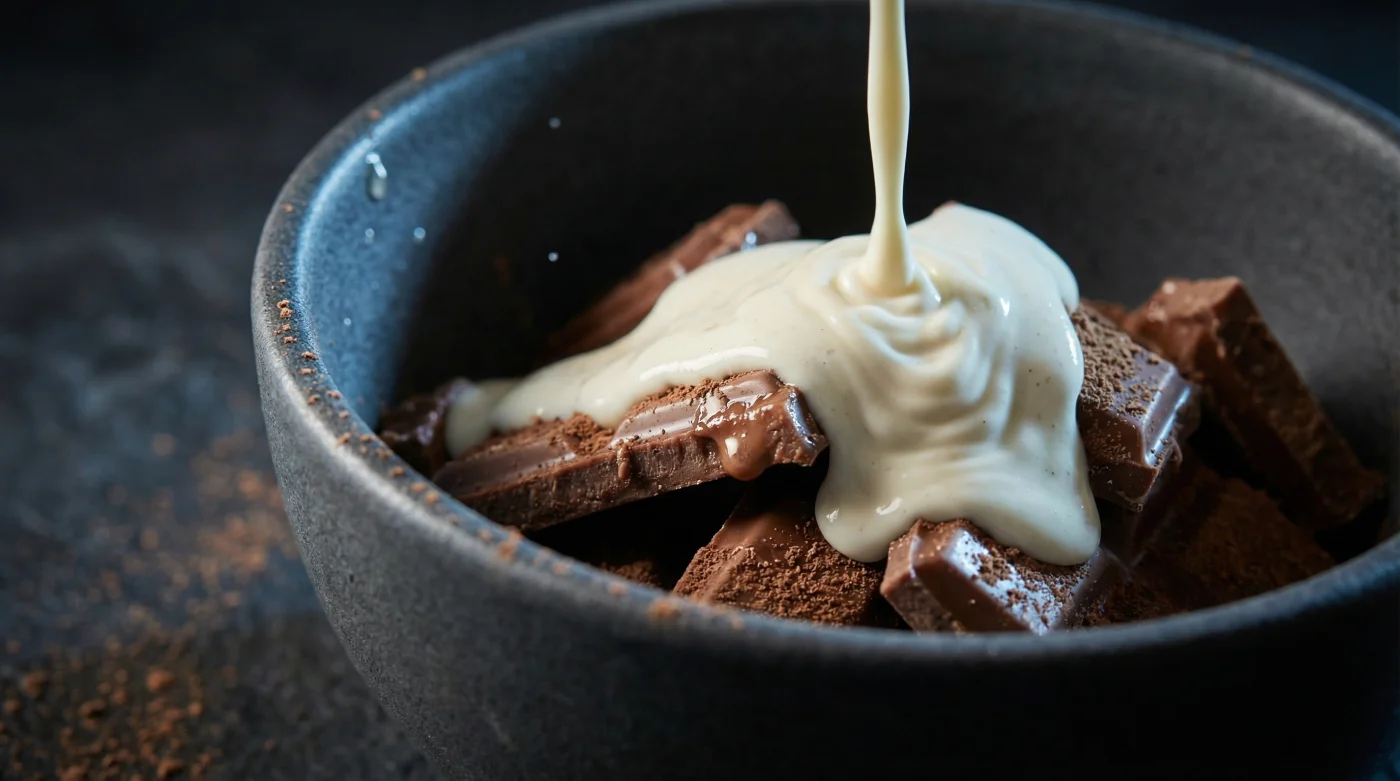
The revelation lies in a standard carton from your fridge. Introducing cold double cream directly to finely chopped chocolate before any heat is applied fundamentally changes how the fats interact. The cold liquid acts as a buffer, insulating the fragile cocoa solids from sudden temperature spikes and coaxing them into a slow, stable bind.
Eleanor Davies, a 42-year-old former pastry chef from Bath who swapped fine dining for a bustling village bakery, noticed her apprentices consistently splitting their ganache. They were treating commercial milk chocolate as if it were a high-percentage dark couverture. She realised that the specific milk solids in a bar of Cadbury require a much gentler introduction to fat.
Working in a hot summer kitchen, she abandoned the stove entirely. She found that tossing finely shaved chocolate into a bowl of fridge-cold double cream and warming them together in tiny increments created an emulsion so thick and glossy, the cream would tremble like a set custard. It was a complete professional pivot using everyday supermarket staples.
Adjustment Layers for Your Kitchen
Different bakes require different consistencies. Because you are controlling the emulsion from cold, you can easily adjust the structure of your ganache without fear of the fats separating and pooling on the surface.
- Fresh garlic cloves lose harsh bitter bites soaking in lemon juice.
- Poached eggs retain perfect teardrop shapes draining through a fine sieve.
- Cauliflower leaves transform into intensely sweet snacks utilizing high oven heats.
- Mashed potatoes look incredibly expensive utilizing this simple heated spoon trick.
- Stainless steel pans shed heavy burn marks boiling this simple tablet.
For the busy parent needing a quick cake drip, shift the ratio to equal parts cream and chocolate. The cold cream protects the mixture as you pulse it in the microwave. It yields a smooth, pourable gloss that sets with a soft bite, masking any uneven icing beneath it.
For the texture chaser, consider adding local salt. A heavy pinch of Maldon flaked sea salt stirred in right at the end cuts through the inherent sweetness of the confection. Because the emulsion is so stable, the salt crystals remain suspended rather than sinking to the bottom of the bowl.
The Five-Minute Cold Fold
To master this technique, you must approach the bowl with patience. The process is minimalist, relying on time rather than temperature to do the heavy lifting.
Gather your tools before you begin. You need absolute precision in your cuts to ensure the chocolate and cream warm at the exact same rate. Here is your tactical toolkit for a flawless cold emulsion:
- Use a serrated bread knife to shave 200g of chocolate into flakes no larger than half a centimetre.
- Pour 100ml of fridge-cold double cream directly over the shavings, ensuring all chocolate is submerged.
- Let the bowl rest on the worktop for two minutes to allow the temperatures to introduce themselves.
- Place in the microwave on the lowest power setting for just 15 seconds.
- Remove and fold gently with a silicone spatula, pressing the mixture against the sides of the bowl until a glossy, dark ribbon forms.
A Quieter Kitchen
Baking should not feel like managing a crisis. When you remove the roaring heat of a boiling water bath, you reclaim the peace of your worktop. You stop worrying about steam, seizing, and split fats, and start enjoying the simple, tactile pleasure of watching two raw ingredients become something entirely new.
Mastering this cold liquid trick does more than save a cake; it builds genuine confidence. It proves that professional results do not always require complex equipment or stressful techniques. Sometimes, the most luxurious outcomes are found by simply doing less, and doing it with intention.
“True control in the pastry kitchen isn’t about applying more heat; it’s about understanding how ingredients protect each other when cold.” – Eleanor Davies
| Key Point | Detail | Added Value for the Reader |
|---|---|---|
| The Cold Buffer | Submerging chocolate in cold double cream before heating. | Prevents thermal shock, entirely eliminating the risk of grainy, seized chocolate. |
| Finer Shavings | Using a serrated knife to create tiny flakes. | Ensures the chocolate melts instantly within the cream at extremely low temperatures. |
| Microwave Control | Using 15-second bursts on low power. | Saves time and avoids the messy, steamy clean-up of a traditional hob setup. |
Frequent Baking Queries
Can I use single cream instead of double cream?
No, single cream lacks the fat content required to create a stable emulsion with milk chocolate. The mixture will become watery and refuse to set.Why is my ganache still looking slightly speckled?
Your chocolate shavings were likely too large. Simply let the residual heat of the bowl do the work, stirring slowly until the specks dissolve into the cream.Will this work with white chocolate?
Yes, but white chocolate is even more sensitive to heat. You must reduce the microwave time to 10-second bursts and stir for longer off the heat.How long will this ganache keep in the fridge?
Stored in an airtight container with cling film pressed directly against the surface, it will remain fresh and usable for up to exactly five days.Can I whip this cold emulsion once it sets?
Absolutely. Once fully chilled, whip it briefly with a hand mixer to incorporate air, creating a light, mousse-like frosting perfect for cupcakes.