Sunday morning light catches the steam rising from a cast-iron pan on the hob. You have a thick slice of sourdough waiting on a ceramic plate, a pat of salted butter slowly yielding to room temperature, and a pot of strong black tea steeping quietly. The stage is perfectly set for a quiet weekend ritual, yet there is a familiar knot of tension forming in your chest as you hold a cold, brown egg over the bubbling water. Poaching feels like a gamble, a domestic game of chance where the house usually wins.
You crack the shell, hoping for a miracle, but instead you watch helplessly as wispy, distressing white tentacles shoot across the pan. The water turns into a cloudy, unappetising broth, and what emerges a few minutes later resembles a ragged, overcooked jellyfish rather than a delicate breakfast delicacy. You scoop it out with a slotted spoon, trimming away the rubbery edges, feeling a quiet sense of defeat before the day has even properly begun.
The café down the high street never seems to have this problem. They serve up tight, pristine spheres that perch delicately on crushed avocado, yielding a rich, golden centre at the slightest prod of a butter knife. You assume they possess some hidden industrial equipment or rely on a frantic, heavily guarded kitchen secret to force the egg into submission during the demanding morning rush.
The truth requires you to abandon the swirling vortex completely, along with the harsh smell of malt vinegar clouding your kitchen air. The secret lies not in manipulating the water through brute force, but in identifying the structural reality of the ingredient itself before it ever leaves the worktop.
The Anatomy of a Perfect Sphere
Think of a raw egg white as a protective halo with two distinct layers. There is the tight, gelatinous inner jacket that securely hugs the yolk, and the thinner, watery outer fringe that begins to break down the moment the egg is laid. As days pass on the supermarket shelf, this liquid perimeter naturally expands, losing its structural integrity.
This watery rim is entirely responsible for the mess that ruins your morning poaching efforts. When that thin, degraded liquid hits hot water, it cooks instantly, separating from the main body of the egg and flying outward to create those familiar, ragged edges that cloud the pan.
For decades, home cooks have been taught to fight this natural separation by violently whisking the water into a tornado, theoretically forcing the loose white to wrap itself tightly around the yolk. But creating a typhoon in a saucepan is a clumsy, stressful substitute for simple, mindful preparation.
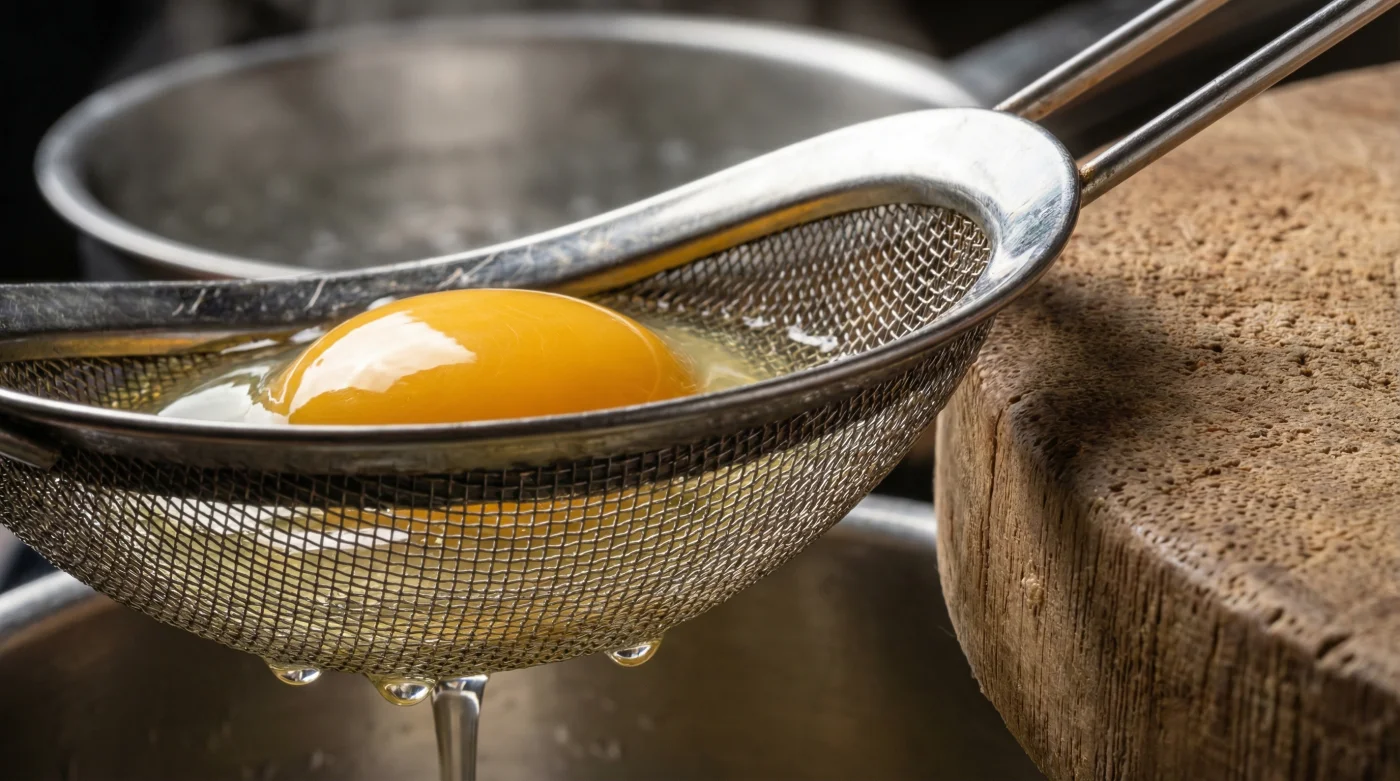
By proactively draining the loose albumen through a fine metal sieve, you eliminate the very thing that causes the chaos. You are left with only the tight inner jacket, which naturally wants to remain a perfect, self-contained sphere when introduced to a gentle heat.
A Quiet Revolution on the Pass
Sarah Jenkins, a forty-two-year-old development chef based in Cornwall, spent years running breakfast services for a frantic boutique hotel. Every morning, she was tasked with sending out hundreds of flawlessly poached eggs, often managing three large pans simultaneously while the dining room filled with hungry guests.
Her secret was never a gallon of vinegar or a frantic whisking technique that left her wrists aching and her uniform splashed with boiling water. Instead, she kept a simple aluminium tea strainer balanced over a small stainless steel prep bowl next to the hob. She would crack the free-range eggs directly into the metal mesh, watching the watery culprit drip quietly away. Only the firm, structurally sound egg remained, ready to be slipped into the gentle heat with absolute confidence.
Adapting the Sieve Method to Your Morning
Not every morning requires the same rhythm, and understanding how to apply this technique across different scenarios ensures you never revert to the old, stressful habits when time is short.
For the supermarket shopper, this technique is an absolute necessity. Eggs bought from a high street grocer have often been in transit or sitting in a warehouse for several days, meaning the proportion of watery albumen is significantly higher. Letting them sit in the sieve for a full thirty seconds will drastically improve their final shape, rescuing eggs that would otherwise turn into a cloudy mess.
For the batch cooker or the busy weekend host, the sieve method allows for a vital moment of calm preparation. You can pre-strain your eggs individually, transferring them gently into small ceramic ramekins while your water is still coming up to temperature, allowing you to focus entirely on the toast and the tea.
- Fresh basil leaves turn entirely black enduring standard cold fridge shelf storage.
- Brown basmati rice cooks perfectly soft replacing prolonged boiling with this soak.
- Red wine vinegar instantly tenderises cheap roasting beef bypassing long slow cooking.
- Sourdough bread loaves achieve perfect oven spring using this hidden water tray.
- Cast iron skillets lose essential seasoning entirely boiling simple acidic tomato sauces.
The Tactical Toolkit for Flawless Poaching
Approach the hob with a clear mind and a minimalist setup. The chaos of a violently boiling pan is the natural enemy of a tender egg white; you are looking to create a gentle, nurturing environment.
The water should only tremble with gentle shivers, resembling the quiet surface tension of a pond rather than a rolling, aggressive boil. If large bubbles are breaking the surface, the heat is too high.
To execute this flawlessly, gather a fine metal tea strainer, a small vessel to catch the discarded liquid, a ceramic ramekin for the transfer, and a slotted spoon. Avoid using sieves with wide plastic holes, as the entire egg might slip through the gaps.
Once your station is ready, crack, drain, and wait for roughly twenty seconds until the dripping stops entirely, leaving only the firm white holding the yolk securely in place.
Slip the strained egg from the ramekin into the trembling water. Do not stir. Do not agitate the pan. Let the ambient heat do the work. The tight inner albumen will immediately seal itself around the yolk, turning opaque and firm almost instantly.
Leave it entirely undisturbed for exactly three precise minutes to achieve a delicately set white and a molten, runny centre that spills perfectly over your sourdough.
Why Precision Breeds Morning Peace
Breakfast inevitably sets the psychological tone for the rest of the day. When you start your morning fighting with a pan of boiling water, frantically fishing out unappetising scraps of foam, it leaves a lingering sense of domestic frustration that is hard to shake.
Mastering this simple detail restores your kitchen confidence, transforming a historically frustrating task into a moment of quiet, predictable success. It proves that professional results do not require expensive equipment or manic energy.
You no longer need to rely on old wives’ tales, acidic additions that ruin the delicate, natural flavour of the egg, or physical exertion at the hob. You are simply respecting the ingredient, understanding its physical properties, and removing the flaw before it can ever cause a problem.
It is a reminder that the best culinary techniques are often grounded in subtraction rather than addition. By taking something away—in this case, just a teaspoon of watery albumen—you create a morning ritual that is whole, beautiful, and profoundly satisfying.
The most elegant cooking techniques are rarely about forcing an ingredient to behave, but rather removing the elements that cause it to fail.
| Key Point | Detail | Added Value for the Reader |
|---|---|---|
| The Sieve Method | Draining loose albumen before cooking. | Guarantees a tight, café-style sphere every single time. |
| Water Temperature | A gentle tremble, never a rolling boil. | Prevents the delicate protein jacket from tearing apart in the pan. |
| Skipping Vinegar | Relying on physical separation rather than acid to set the egg. | Preserves the sweet, natural flavour of a fresh, high-quality yolk. |
Frequently Asked Questions
Do I still need to use vinegar in the water? No. Once the watery albumen is removed, the firm inner white will hold its shape naturally without the need for harsh acids that taint the flavour.
How long should I let the egg sit in the sieve? Around twenty to thirty seconds is plenty. You just want to see the thin, watery drops stop falling into the bowl below.
Will the egg stick to the metal mesh? It is highly unlikely unless the sieve is hot or entirely dry and dusty. If you are concerned, a tiny drop of cold water on the mesh beforehand prevents any clinging.
Can I strain multiple eggs at once? It is best to handle them individually to prevent the yolks from breaking or fusing together. Strain one, transfer it to a ramekin, and then process the next.
What if my water starts boiling too vigorously? Simply slide the pan half off the heat source or turn the hob down to its lowest setting immediately. You want a quiet, shivering surface tension to protect the egg.