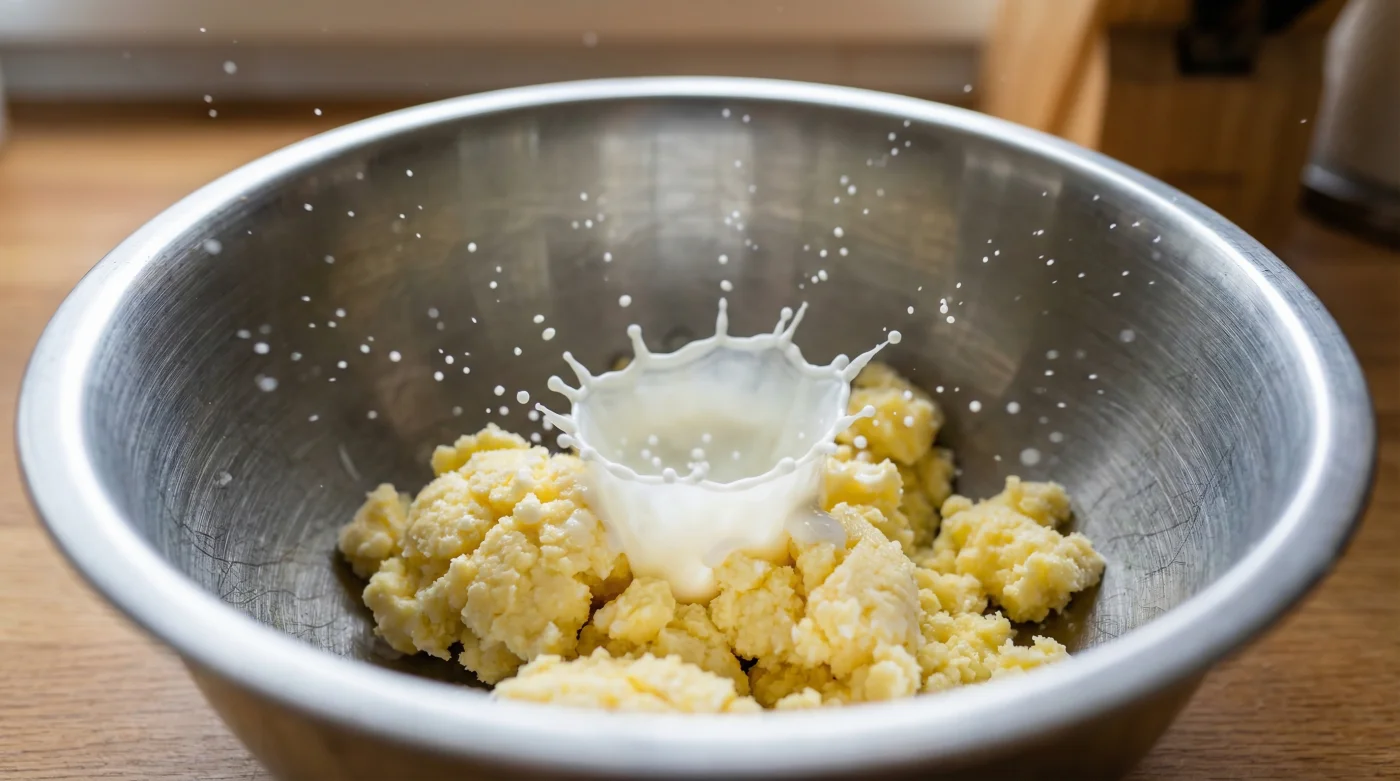
You are standing at the kitchen island, the metallic scrape of the balloon whisk echoing softly against the ceramic bowl. The double cream you are preparing for a classic Victoria sponge is just reaching that glorious, pillowy stage. It holds a soft peak, catching the afternoon light from the window. You turn away for a mere five seconds to grab a teaspoon of vanilla bean paste. When you look back, the disaster has abruptly struck.
The pristine white cloud has transformed into a grainy, yellowing mass. It looks like wet sand, clinging clumpily to the tines of your whisk while a thin, watery liquid pools at the bottom of the bowl. The immediate instinct is a heavy sigh, followed by the defeated scrape of the spatula as you prepare to scrape this ruined mess straight into the food waste caddy.
We are conditioned to believe that cooking is a rigid binary. Either you get it right, or you fail entirely. Split dairy feels like the ultimate betrayal because it happens in a fraction of a heartbeat, turning an expensive ingredient into an unusable texture. But before you wash that bowl in frustration, you need to know a fundamental truth about dairy structure.
The Science of the Splintered Cloud
Whipping double cream is essentially a chaotic, microscopic dance of fat and water. As you introduce air with your whisk, the fat globules smash into one another, stripping away their protective layers. They build a fragile lattice, linking arms to trap the air and liquid in a delicate emulsion that creates that luxurious mouthfeel.
However, just one or two extra rotations of the whisk pushes those fat molecules entirely too close together. They squeeze out the water they were holding, effectively beginning the churning process to make butter. You haven’t failed at whipping cream; you’ve just accidentally changed the physical state of the fat by pushing the emulsion past its breaking point.
The conventional culinary wisdom screams that there is no returning from this state. You assume you must discard the clumpy mixture, grab your keys, and trudge down to the corner shop for another pot. This is entirely a myth. By introducing a gentle splash of unwhipped, cold whole milk, you provide the precise liquid bridge needed to coax those fat molecules apart again.
Consider the kitchen of Eleanor, a 42-year-old pastry chef running a bustling patisserie in Bath. During a frantic Mothering Sunday service, a junior baker panicked after turning three litres of premium Cornish double cream into a heavily split, yellow disaster just minutes before the strawberry tarts were due in the display window. The young baker was almost in tears, expecting a severe reprimand.
Instead of shouting, Eleanor calmly intervened. She reached for the milk, pouring a tiny trickle of cold, full-fat dairy down the inside of the metal mixing bowl. She took a silicone spatula and folded the mixture with agonizingly slow, deliberate turns, refusing to add any more air to the already stressed cream.
Within fifteen seconds, the grainy clumps began to dissolve, melting back into a luxurious, glossy ribbon. It was a silent, masterful rescue that saved the service and the expensive ingredients. The junior baker learned that day that a split emulsion is not a death sentence, but merely a temporary structural collapse asking for a gentle correction.
Tailoring the Rescue to Your Ruin
Not all split cream looks the same, which means the rescue requires slightly different handling depending on the severity of your overzealous whisking. Assess the visual damage first before rushing to pour anything into your mixing bowl. Understanding the degree of separation dictates the exact method of your intervention.
For the slight graininess, this is the most common grievance for home cooks. The cream hasn’t fully separated into buttermilk and fat, but it lacks that smooth, expensive shine you want for a pavlova. Add exactly one tablespoon of cold whole milk per half-pint of cream. Fold it with a gentle, sweeping motion until the sheen returns to the surface.
For the clumpy catastrophe, where the liquid is visibly weeping away from yellowing lumps, the intervention must be slightly firmer. You are standing on the very edge of making actual butter. Add two tablespoons of milk, and instead of a flat spatula, use your balloon whisk to slowly, manually stir the mixture, forcing the fat to re-emulsify with the newly introduced liquid.
- Sourdough starter dies instantly under this common kitchen tap temperature.
- Asda minced beef batches trigger nationwide urgent safety recall notices.
- Cheap tomato paste replicates slow-cooked ragu enduring raw dry pan frying.
- Jasmine rice achieves flawless individual grains skipping this traditional soaking phase.
- Split double cream turns perfectly smooth adding cold whole milk splashes.
You must ensure your rescue milk is ferociously cold. Fetch it from the back, directly from the coldest part of the fridge, to shock the fat back into suspension without losing your delicate flavours. Warm or room-temperature milk will simply melt the remaining fat structure, leaving you with a greasy puddle that truly cannot be saved.
The Mindful Emulsion Reset
Repairing your split dairy is an exercise in profound restraint. You cannot rush this process, nor can you rely on mechanical power to brute-force the ingredients back together. Step away from the electric stand mixer immediately; this rescue is strictly a manual, quiet operation.
Breathe deeply and look closely at the bowl in front of you. You need to treat the mixture as if it were a delicate soufflé fresh from the oven. The goal is gentle re-integration, not further aeration, meaning every movement of your hand must be deliberate and measured.
Follow these precise, grounded steps to bring your dessert back from the brink:
- Step 1: Terminate the friction. Unplug your machine or set down your electric hand whisk immediately. The high-speed mechanical friction is your absolute enemy in this moment.
- Step 2: Administer the liquid bridge. Pour one to two tablespoons of cold, fresh whole milk directly into the centre of the bowl. Semi-skimmed or skimmed milk lacks the necessary fat content required to successfully bridge the broken emulsion.
- Step 3: The sweeping fold. Take a large metal spoon or a firm silicone spatula. Scrape around the outer edge of the bowl, cutting cleanly through the middle. Do this slowly, watching the yellow clumps absorb the surrounding liquid.
- Step 4: The final texture check. Stop the very moment the cream looks smooth again. It will be slightly looser than a stiff peak, making it absolutely perfect for dolloping over warm scones or folding gently into a dark chocolate mousse.
Your tactical toolkit for success in this scenario requires only three simple things: a metal spoon, intensely cold whole fat milk, and a small degree of patience. By resisting the urge to overwork the mixture, you allow the chemistry of the dairy to do the heavy lifting for you.
A Quieter Kitchen Philosophy
When you master this tiny, seemingly insignificant modification, something fundamental shifts in how you approach your time in the kitchen. You stop fearing the narrow, stressful window between culinary perfection and absolute disaster. A split bowl of cream is no longer a reason to feel frustrated, wasteful, or inadequate.
You begin to see your ingredients as living systems rather than static objects that either obey your commands or completely fail. You understand that culinary missteps are rarely terminal; they just require a different kind of attention, a calmer mindset, and a basic understanding of how things are put together on a microscopic level.
By saving that £2.50 pot of organic double cream, you are doing far more than simply rescuing a Sunday roast dessert. You are building quiet confidence. You are proving to yourself that you have the knowledge to adapt, repair, and thrive, turning a moment of sheer panic into a deeply satisfying, entirely hidden victory.
“An emulsion is a negotiation, not a hostage situation; offer the fat a splash of cold milk, and it will willingly surrender its clumps.” – Eleanor Davies, Executive Pastry Chef
| Key Point | Detail | Added Value for the Reader |
|---|---|---|
| The Liquid Bridge | Cold whole milk reintroduces water to the fat. | Saves money and prevents unnecessary food waste. |
| Whole vs Skimmed | Whole milk provides necessary fat molecules. | Ensures a glossy, stable finish rather than a watery puddle. |
| Manual Intervention | Switching to a hand whisk or spatula. | Prevents further friction, guaranteeing the rescue works. |
The Dairy Rescue FAQ
Can I use semi-skimmed milk for this rescue?
It is highly risky. Semi-skimmed lacks the fat structure needed to seamlessly bridge the separated clumps. Always keep a splash of whole milk back for emergencies.What if I’ve already added a splash of alcohol to the cream?
The alcohol actually thins the fat slightly. Ensure your rescue milk is ferociously cold to shock the emulsion back together without letting the spirit break it further.Is the repaired cream suitable for piping?
It will be slightly softer than a stiff pipeable peak, but it holds beautifully for dolloping on scones or filling a loose Victoria sponge.How long does the repaired emulsion hold?
Once fixed, the cream is surprisingly stable and will sit comfortably in the fridge for up to 24 hours without splitting again.Can I use this method if the cream has fully turned to butter?
If a large pool of buttermilk has fully separated and the fat is a solid yellow lump, it is too late. Add salt, spread it on toast, and start the cream again.