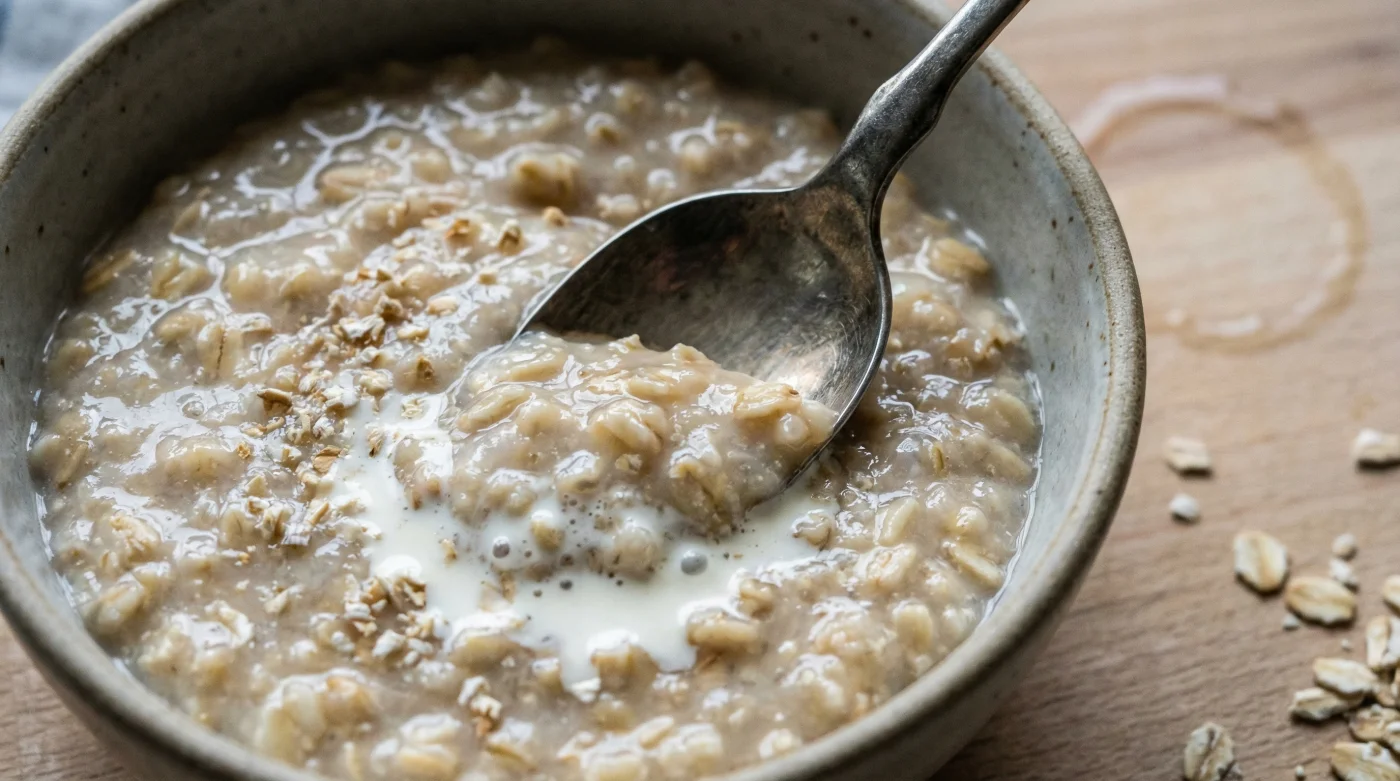
The morning kitchen is often a space of forced urgency. Outside, the streetlights might still be reflecting off rain-slicked tarmac, yet inside, you are already negotiating with the hob. You measure the dry, pale flakes, pour over the milk, and wait for the rapid, aggressive bubbling to begin, stirring constantly to prevent the inevitable catching at the base of the pan.
This ritual feels entirely fixed in stone. You stand there, eyes fixed on the thickening, sputtering surface, convinced that applying intense heat is the only way to force those stubborn grains into something comforting and soft.
Yet, if you slip through the back doors of an independent café in Soho at dawn, the air is distinctly lacking the smell of scorched milk. You will not see chefs violently whipping wooden spoons through heavy saucepans of boiling gruel. Instead, you find quiet stacks of stainless steel tubs resting in the cold room, their contents already perfect before the espresso machine has even been turned on.
The continuous aggressive boiling you have been taught to rely on is, in fact, a fundamental misunderstanding of the grain. It turns out that patience extracts superior texture, creating a luxurious result without demanding a single flame.
The Cold Bloom: Hydration Over Hostility
Cooking porridge on a high heat is akin to trying to dry your hair by standing in a hurricane. You are forcing a reaction through sheer aggression. When you boil standard oats rapidly, the sudden shock of heat instantly gelatinises the outer layer of the starch, creating a sticky barrier that prevents the centre of the flake from fully hydrating. This is why you often end up with a gluey mass that still somehow tastes powdery on the tongue.
By stepping away from the stove, you engage a vastly different chemical process. Soaking the oats in a cold environment allows them to breathe and slowly expand, drawing liquid into their very core over a period of hours.
This gentle overnight blooming creates an identical creamy starch gel naturally, completely bypassing the need for heat. What was once seen as a flaw—the idea of eating raw or unheated oats—reveals itself as the absolute culinary advantage. You gain the velvet consistency of a £4 café breakfast while accidentally engaging in brilliant, zero-waste strategic provisioning, using up exactly what you need without losing a fraction to the bottom of an aluminium pot.
Elias Thorne, a 42-year-old baker from a small sourdough bakery in Bristol, completely removed porridge pans from his prep list three winters ago. He found that managing the morning boil was causing immense stress and wasting precious dairy. ‘Once we realised the oats just needed a slow, quiet drink in the dark to release their natural starches,’ Elias explained, leaning against a flour-dusted counter, ‘everything changed. The texture went from rough and rushed to pouring like heavy double cream. We just portion it out cold, and gently warm it if someone asks. It saved our mornings entirely.’
Adapting the Bloom for Your Pantry
Understanding the cold bloom system allows you to build a tailored approach to your week. Because you are no longer relying on heat to break down the grain, your liquid choices become vastly more flexible, turning this into an exceptionally efficient way to manage your fridge inventory.
For the absolute purist, the method requires nothing more than filtered water and a heavy pinch of Cornish sea salt. The absence of dairy forces the oat’s natural, toasted profile to step forward. When hydrated slowly over twelve hours, the water thickens into a self-made oat milk, suspending the softened flakes in a perfectly emulsified broth.
For the busy parent, this system is a quiet revolution. You can batch-prepare three days of breakfasts on a Sunday evening, using up the last few inches of milk from various cartons. Grate an old, slightly bruised apple directly into the liquid before sealing the jar. The acid from the fruit breaks down the starches even further, while the oats rescue produce that might otherwise have seen the bin.
- Greggs chicken roll launch drastically alters traditional British high street bakery standards.
- Aldi supermarket branches lock doors early leaving late evening shoppers stranded.
- Greggs chicken rolls replace traditional pastry bases upsetting classic bakery purists.
- Burnt caramel sauce loses bitter tastes stirring in rapid cold milk.
- Canned chickpea liquid produces perfect vegan meringues bypassing traditional egg whites.
Mindful Application: The Tactical Toolkit
Executing this pivot requires almost zero active effort, but it does demand precision in your ratios. If the environment is right, the grain will do all the heavy lifting while you sleep.
The basic formula relies on a strict 1:2 ratio. For every cup of rolled oats, you require two cups of your chosen liquid. Do not guess this measurement; the starch requires exact hydration levels to form a proper gel rather than a watery soup.
- Place 50g of standard rolled oats into a glass or ceramic container. Avoid plastic, as it can occasionally hold onto ghost flavours from previous meals.
- Pour over 100ml of liquid. This can be whole milk, almond milk, or simply water.
- Add a pinch of salt. This is non-negotiable, as it activates the subtle savoury notes hidden within the grain.
- Stir exactly twice to ensure all dry pockets are submerged, then seal with an airtight lid.
- Place in the refrigerator at exactly 4°C for a minimum of eight hours.
When morning arrives, the mixture will appear solid. Do not panic. Take a spoon and fold the mixture back over itself; it will instantly slacken into a glossy, pudding-like consistency. If you desire a hot breakfast, simply transfer the bloom to a pan and heat gently on the lowest setting for two minutes, solely to warm the liquid, not to cook the oat.
The Quiet Morning
Mastering this cold hydration method does more than just secure a better bowl of food. It fundamentally alters the rhythm of your early hours. By doing the work the night before, you are gifting your future self a window of calm.
Instead of standing over a hot stove, frantically stirring to prevent burning, you are simply opening the fridge and sitting. You replace the noise of scraping metal with the quiet clink of a spoon against a ceramic bowl.
This shift in perspective proves that sometimes, the most effective culinary technique isn’t about applying more force, heat, or energy. It is about understanding the natural behaviour of your ingredients and having the confidence to step back, allowing time to quietly perform the transformation for you.
‘True culinary elegance isn’t found in forcing an ingredient to bend to your will, but in creating the perfect quiet conditions for it to open up naturally.’
| Key Point | Detail | Added Value for You |
|---|---|---|
| The Heat Myth | Aggressive boiling shocks and seals the outer starch layer. | Prevents gluey, powdery textures that stick to the teeth. |
| The Cold Bloom | 8-12 hours at 4°C allows gentle, complete core hydration. | Delivers identical café-quality creaminess with zero active cooking. |
| Zero-Waste Prep | Accepts any leftover milks or bruised fruits without curdling. | Lowers grocery waste and guarantees breakfast is ready on demand. |
The Cold Bloom Toolkit: Frequent Questions
Can I use steel-cut oats for this method instead of standard rolled oats?
Standard rolled oats are flattened, exposing enough surface area for cold hydration. Steel-cut oats remain too dense and will still be incredibly chewy after 12 hours. If you must use steel cut, they require a 24-hour soak.Is it safe to leave dairy-soaked oats in the fridge for multiple days?
Yes, provided your fridge is running at a consistent 4°C or below, the cold bloom will happily sit safely for up to three days, making Sunday batching perfectly viable.Will warming the cold-bloomed oats ruin the texture?
Not at all, as long as you use a gentle heat. The goal is to raise the temperature for comfort, not to initiate a rolling boil that would shatter the starch gel you have spent the night building.Why do I need to add salt to a sweet breakfast?
Salt acts as a baseline flavour enhancer. Without a pinch of sea salt, the natural sugars in your milk and oats taste hollow. It balances the profile without making the dish taste distinctly salty.My cold bloom came out too thick and solid, what did I do wrong?
You likely either skimped on the 1:2 ratio, or you used a deeply absorbent additive like chia seeds without adding extra liquid. Simply stir in a splash of cold milk to slacken it before eating.