You stand over the kitchen island, a pastry brush suspended mid-air, watching your careful preparations fall apart. Beneath your hand, the first sheet of filo has already curled at the edges, sounding suspiciously like dry autumn leaves underfoot before splintering into jagged, useless shards. Flour dusts the worktop, a pan of expensive melted butter waits patiently beside you, yet the delicate dough is rapidly turning into an unworkable mess. It is a familiar, sharp frustration that strikes right at the heart of home baking.
Panic becomes the default ingredient. Most home cooks are taught that filo is an adversary to be outrun, a ticking clock that demands you move with reckless speed. You frantically slap clarified butter onto the fragile parchment, racing against the air itself as the dough turns brittle. Every moment exposed to the kitchen’s ambient air feels like a step closer to failure, causing you to rush your folds and inevitably crack the casing of your carefully planned spanakopita or sweet baklava.
But stepping into a traditional bakery in the early hours reveals a starkly different rhythm. There is no frantic brushing, no panicked clock-watching, and certainly no piles of shattered dough. The professional bakers move with a measured, almost lethargic grace, handling the transparent sheets as if they were fine woven silk rather than a volatile substance about to detonate. The air in these workspaces is different, heavily scented with roasted nuts and warm butter, but critically, it is calm.
The secret is engineered stillness. They are not fighting the pastry with speed; they are intentionally altering the immediate atmosphere around it. By introducing a highly specific microclimate right on the stainless steel worktop, the notorious shattering simply ceases to happen. This transforms a high-stress chore into a quiet, tactile craft, proving that the most effective tool in the kitchen is often the invisible environment you create.
The Greenhouse Above the Dough
We are deeply conditioned to believe that moisture is the natural enemy of a crisp bake. You naturally keep your raw pastry away from the sink, assuming the dry air of your kitchen is safe provided you work with frantic, unbroken speed. Yet, this excessively dry air is exactly what strips the dough of its internal flexibility, causing microscopic fissures to form across the surface. These invisible micro-tears are the true culprits, compromising the structural integrity long before you even attempt to lift a corner.
Think of a desert riverbed. When entirely deprived of ambient moisture, the top layer of clay tightens and violently cracks under the pressure of the air. Filo dough behaves identically when removed from its sealed plastic sleeve. The moment you expose a fresh, pliable stack to your kitchen’s central heating or extraction fans, the delicate outer edges lose their residual hydration. They shrink, warp, and tear before you can even load your brush with fat.
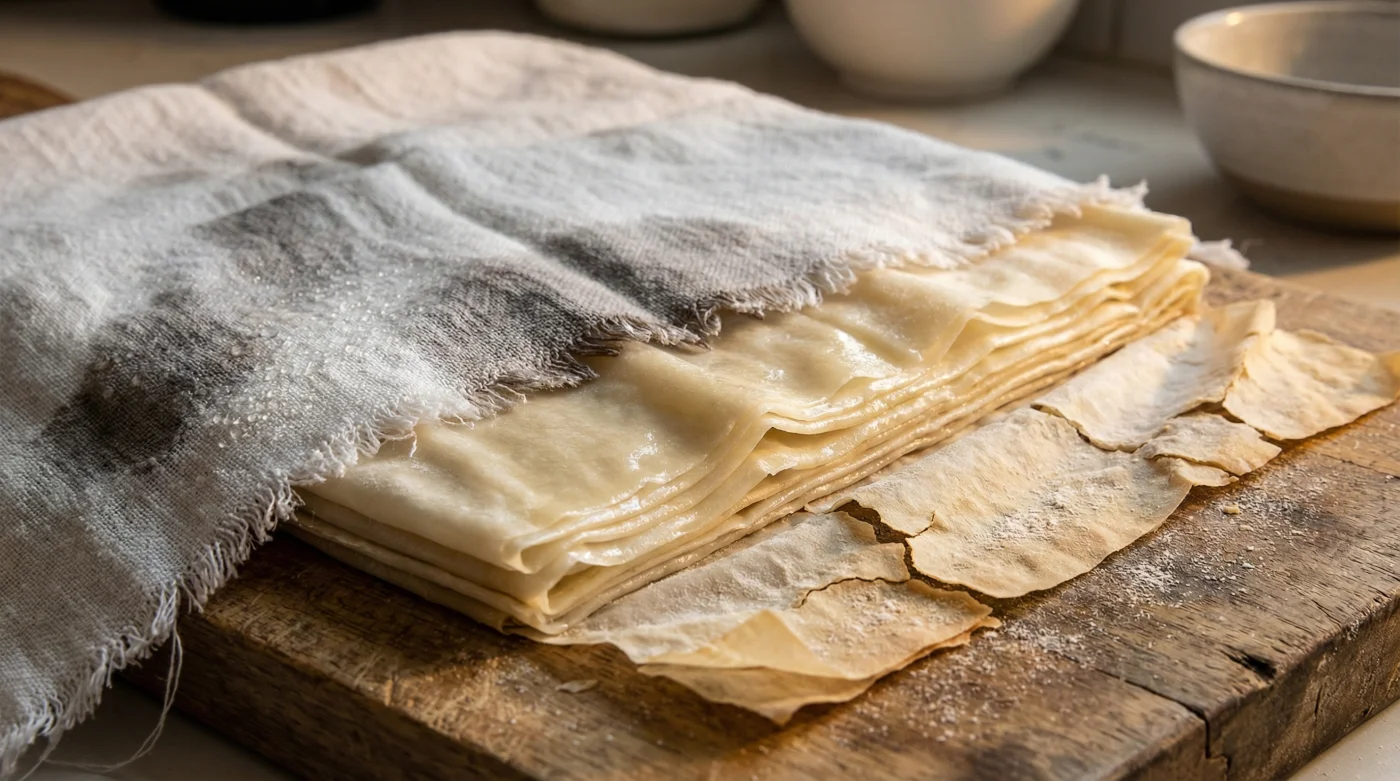
The professional pivot to counter this requires nothing more than a clean, lint-free tea towel and ordinary tap water. By draping a rigorously wrung-out, barely damp cloth directly over the unused stack of pastry, you immediately create a trapped pocket of ambient humidity. The incredibly thin dough effortlessly absorbs this subtle, hovering vapour, remaining beautifully pliable, resilient, and totally relaxed for as long as your recipe requires.
It breathes through the weave. The dreaded micro-tears simply never have the opportunity to form under this protective canopy. Instead of racing against an imaginary timer and working yourself into a sweat, you suddenly possess the luxury of time. You can spread your almond paste, layer your feta, and brush your oils with the meticulous, deliberate care of a true craftsman, entirely free from the fear of unexpected breakages.
Consider Elias, a 62-year-old baker from north London who has spent four decades assembling tray after heavy tray of delicate, honey-soaked pastries. I watched him work his magic on a chilly Tuesday morning, noting how he casually paused to answer a ringing telephone, leaving a towering stack of raw filo unattended on the bench. He didn’t panic or rush off the call. He had simply laid a cool, damp linen cloth over the pile before turning his back. “People think the dough needs to be rushed, that it hates the air,” he told me, smoothing a perfectly intact, transparent sheet into a buttered aluminium tin. “But it just needs a little rain. The towel gives it a gentle morning mist, keeping the stretch alive without making it soggy.”
Tailoring the Atmosphere for Your Bake
Not all fillings are equal. Depending on what specific dish you are creating, the way you manage your pastry’s local hydration will need to shift. The damp towel technique adapts beautifully to almost any recipe, but it requires slight calibration based on your ultimate culinary goal. Understanding these subtle variations separates a good home cook from an exceptional one.
For the Savoury Pie Purist
If you are constructing a dense, spinach-heavy Greek pie or a sharp, crumbly feta cheese parcel, your interior filling already carries a significant amount of water weight. Here, your protective tea towel should be wrung out until it feels almost completely dry to the back of your hand. You want just enough ambient humidity to stop the delicate sheets from cracking while you layer them, without introducing excess surface moisture that might lead to a disappointingly soggy base.
Precision matters over dampness. Keep the lightly hydrated towel hovering closely above the stack, ideally resting on a barrier piece of baking parchment laid directly over the raw dough. This ensures the fragile edges stay wonderfully soft and pliable, allowing you to crimp them together seamlessly over your savoury filling, sealing in the flavours without tearing the fragile crust.
For the Intricate Sweet Maker
Rolling individual, tightly wound cigars of sweetened almond paste or assembling forty fine layers for a traditional baklava demands the absolute highest level of flexibility from your dough. The repetitive, tight rolling motion puts immense physical stress on the pastry’s gluten structure. If there is even a hint of dryness, the outer casing will snap, leaking precious syrups and nuts onto the baking tray.
- Pancake batter mix develops severe rubbery textures undergoing this aggressive whisking motion.
- Cooked basmati rice becomes completely toxic sitting on standard warm kitchen counters.
- Streaky bacon rashers achieve shattering glass crispness boiling in shallow tap water.
- Dried spaghetti pasta absorbs significantly more rich sauce hydrating in cold water.
- Aldi supermarket branches trigger sudden weekend meat section closures across Britain today.
For the Busy Parent Preparing Ahead
Sometimes you simply need to assemble a family dinner in fragmented stages, dodging between afternoon school runs, ringing doorbells, and general household chaos. Filo is traditionally terrifying for this start-and-stop scenario, known to dry out and ruin a meal if abandoned for even three minutes. But introducing a controlled microclimate changes the foundational rules of meal prep entirely.
You control the timeline now. If you find yourself needing to step away from the worktop for twenty minutes, place a fresh sheet of baking paper completely over the dough stack. Then, lay your damp towel evenly over the paper, taking care to tuck the damp edges tightly under the bottom of the pile. This effectively seals the stack in a highly protective, humid cocoon, pausing the perilous drying process completely until you return to finish the job.
The Architecture of Perfect Layers
Implementing this transformative method is an exercise in restraint and preparation. The ultimate goal is to establish a calm, highly productive rhythm, moving methodically from the protected, humidified stack to your waiting, buttered prep board.
Preparation dictates the final texture. Before you even consider opening the plastic packet holding your pastry, you must ensure your entire workspace is completely set up and waiting. Your melted clarified butter, your preferred natural bristle pastry brush, and your fully mixed filling must be entirely ready for deployment.
- Take a clean, well-worn cotton tea towel—strictly avoid modern terry cloth, as it holds far too much liquid and readily drops unwanted lint onto your food.
- Soak the cloth thoroughly under shockingly cold running tap water, then wring it out with intense physical force until it is barely damp. If a single drop falls, it is still too wet.
- Unroll your commercial or homemade pastry directly onto a perfectly dry, wide, and flat surface.
- Immediately cover the vulnerable stack with a single sheet of silicone baking parchment, followed instantly by the damp towel.
- Peel back the towel and parchment just enough to gently remove one sheet at a time, dropping the cover back into place before you even begin brushing the removed sheet.
When brushing your golden clarified butter or grassy olive oil across the surface of the dough, you must respect the delicate nature of the hydrated sheet. The moisture has kept it whole, but it is still fundamentally fragile.
Maintain a gentle, sweeping motion. Do not drag the heavy bristles aggressively across the surface. Instead, dab lightly and sweep with the grain of the dough, allowing the natural weight of the warm fat to press the sheet down naturally onto the layer beneath it.
The Tactical Toolkit
- Water Temperature: Strictly cold tap water (approximately 10°C) to prevent artificially warming the dough and activating the gluten too early.
- Towel Material: 100% smooth, tight-weave cotton or natural linen.
- Wait Time: Absolute zero. Apply the damp towel the exact second the protective plastic wrapper is breached.
- Fat Application: Clarified butter or ghee works best, as the troublesome milk solids have been entirely removed, preventing accidental tearing during the brushing process.
Redefining the Kitchen Clock
Mastering this remarkably subtle shift in pastry handling does far more than just save a few wasted Pounds Sterling on ruined, discarded ingredients. It fundamentally rewrites your entire psychological relationship with a famously difficult culinary process. You are no longer held hostage by the extreme fragility of your raw materials.
Control replaces kitchen anxiety. By deeply understanding that the pastry does not want to be rushed, but simply craves a stable, humid environment, you instantly remove the manic rushing from your cooking routine. You can pour yourself a glass of wine, hold a meaningful conversation with a guest, and assemble your complex meals with a steady, quiet confidence that borders on the meditative.
The immensely satisfying crunch of a perfectly baked, deeply golden parcel ultimately becomes a reflection of your patience, rather than a metric of your speed. It clearly proves that sometimes the most powerful, transformative culinary techniques do not involve moving faster, but rather knowing exactly how to command the invisible atmosphere right in front of you.
“The best pastry work happens in the quiet moments between the folds, where the dough feels the moisture and simply lets go.”
| Key Point | Detail | Added Value for the Reader |
|---|---|---|
| The Damp Towel Method | Using a thoroughly wrung-out cotton cloth over the dough stack. | Eliminates tearing and allows for stress-free, slow assembly. |
| The Parchment Buffer | Placing baking paper between the dough and the damp towel. | Prevents direct water contact which can instantly turn sheets gummy. |
| Cold Water Usage | Soaking the protective towel in strictly cold tap water. | Stops the wheat starches from warming and prematurely sticking on the worktop. |
Frequently Asked Questions
Can I use a kitchen paper towel instead of a cotton tea towel?
Paper towels dry out far too quickly in ambient air and often stick to the pastry. A smooth cotton tea towel holds the exact ambient humidity required for the duration of your prep.What if my pastry has already started to dry out and crack at the edges?
If the edges are only slightly brittle, applying the damp towel system for five minutes can reintroduce enough surface moisture to save the sheet, though deep, severe cracks cannot be physically repaired.Should I put the pastry back in the fridge if I am interrupted by a phone call?
If you are pausing for more than thirty minutes, simply roll the pastry back up in its silicone parchment, wrap the damp towel firmly around the outside, and refrigerate to halt the drying process entirely.Why do my sheets stick together even when resting under the towel?
This invariably happens if the towel is too wet, transferring liquid directly onto the delicate dough. Always wring the cloth until it feels almost dry to the touch, and strictly use a parchment buffer.Does this specific method work for homemade rolled filo dough?
Yes, it is arguably more crucial for homemade dough, which entirely lacks commercial stabilisers and relies heavily on environmental humidity to maintain its delicate, hard-won stretch.