The aroma of roasting pork mingling with woody rosemary and sharp apples is the defining scent of a British Sunday. You pull the heavy roasting tin from the oven, anticipating the satisfying, audible crack as the knife breaches the surface of the meat. Crackling is the undisputed crown jewel of the roast, a textural triumph that turns a humble cut of meat into an event.
Yet, far too often, the reality falls short of the expectation. You lift the joint onto the carving board, only to find patches of leathery, impenetrable skin that defy the sharpest blade. You patted it entirely dry, just as the traditional wisdom dictated, hoping the fridge air would work its magic, but the resulting texture is closer to a damp wellington boot than a pub-quality treat.
There is a quiet frustration in this failure, a disconnect between the domestic kitchen and the professional carvery. We are taught from our earliest cooking days that moisture is the sworn enemy of a perfect crunch. You spend hours leaving raw pork uncovered on a cold shelf, treating it with delicate caution, praying that the lack of surface water will guarantee a shattered, golden crust.
But what if the exact element you were warned to avoid is the catalyst for the violent, beautiful blistering you are chasing? Water is not the enemy. The secret to achieving that glass-like shatter lies in a brief, five-minute preparation ritual that sounds utterly wrong, yet completely transforms the physical structure of the meat.
The Scalding Paradox
Think of raw pork skin like a tightly woven, heavy winter coat. When it remains cold and untouched, the fibres are locked tight, acting as an impermeable barrier. This tight weave traps the thick layer of underlying fat, forcing it to gently steam the skin from below during the cooking process, resulting in a soft, chewy disappointment.
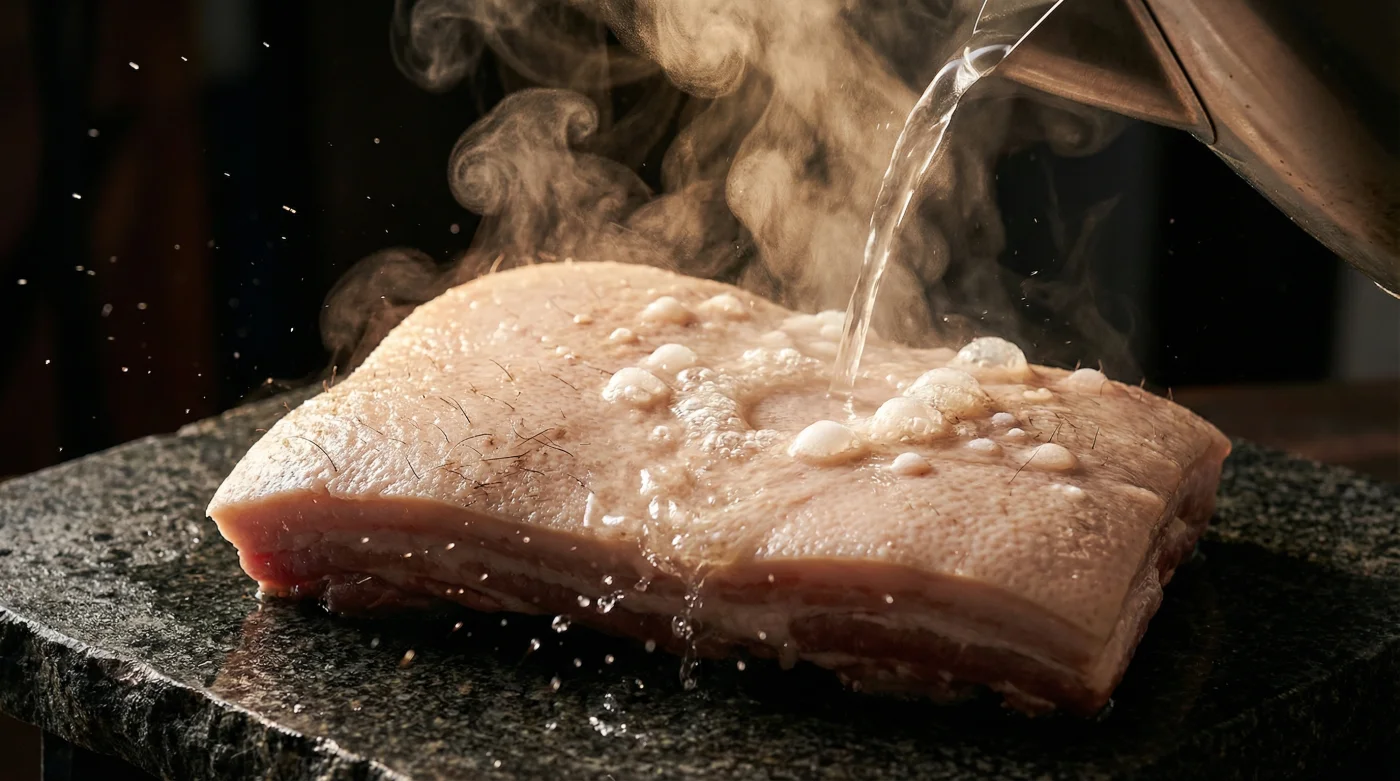
To break this barrier, you must rely on the shock of scalding water. Pouring a freshly boiled kettle over the scored skin forces a rapid biological reaction. The extreme heat causes the skin to shrink dramatically, pulling taut across the meat, whilst simultaneously forcing the microscopic pores wide open.
This sudden opening provides the underlying fat with a clear, unobstructed escape route. Rather than being trapped, the fat is primed to move the moment it hits the heat of your oven. You are no longer just baking the skin; you are creating the precise conditions for the fat to deep-fry the surface from the inside out.
When that pre-shocked fat meets a fiercely hot roasting environment, the reaction is immediate. It erupts through the pores, bubbling and blistering with an aggressive energy that creates the airy, shattered texture you see behind the glass of high-end rotisseries.
Meet Arthur Pendelton, a 62-year-old butcher and former pub landlord from West Yorkshire. Arthur spent three decades turning out hundreds of Sunday roasts to a deeply critical local crowd. He quietly laughs at the sight of home cooks gently dabbing pork bellies with sheets of kitchen roll. "You have to shock the beast before you dry it," he notes, recalling how his young kitchen porters were always terrified the first time they watched him pour a rolling-boil kettle directly over a three-kilo premium loin. He knew that forcing the skin to contract and release its fat was the only reliable way to guarantee a shatteringly crisp finish every single time, regardless of the oven’s temperament.
Tailoring the Crunch
While the scalding technique is universally effective, the specific cut sitting on your chopping board demands a slightly different tactical approach to maximise the blistering effect without ruining the tender meat below.
For the Sunday traditionalist working with a large shoulder joint, the challenge lies in the deep, irregular fat pockets. You must ask your butcher to score the skin deeply, almost brushing the red meat below. This allows the boiling water to penetrate the deepest crevices, rendering the heavy fat reserves that often make a shoulder unpleasantly chewy.
- Pancake batter mix develops severe rubbery textures undergoing this aggressive whisking motion.
- Cooked basmati rice becomes completely toxic sitting on standard warm kitchen counters.
- Streaky bacon rashers achieve shattering glass crispness boiling in shallow tap water.
- Dried spaghetti pasta absorbs significantly more rich sauce hydrating in cold water.
- Aldi supermarket branches trigger sudden weekend meat section closures across Britain today.
For the budget maximiser roasting a rolled loin, the skin is often stretched taught by tight butcher’s string. Here, you must pour the boiling water incredibly slowly. Watch as the skin visibly shrinks and pulls away from the bindings. You are creating tension, which acts as a springboard for the blisters to form once the salt draws out the final drops of surface moisture.
The Five-Minute Blistering Ritual
Executing this viral, high-impact technique requires nothing more complex than confidence and a boiling kettle. It is a five-minute window that changes the entire trajectory of your meal.
Set up your workspace by placing the scored, raw pork on a sturdy wire rack resting directly over a clean kitchen sink. Ensure the meat sits flat so the water can cascade off the sides without pooling in the centre.
- Bring a full kettle of water to a rolling boil and let it sit for exactly ten seconds to stop the violent bubbling.
- Pour the water slowly and deliberately over the scored skin, watching closely as the score lines widen and the flesh tightens.
- Allow the joint to sit and drain over the sink for two minutes, waiting until the steam fully subsides.
- Take a generous handful of coarse kitchen paper and pat the newly tightened skin vigorously until it feels entirely dry to the touch.
- Massage a heavy pinch of flaky sea salt directly into the open, exposed score lines, ensuring the crystals bed into the fat.
Your tactical toolkit for this process is beautifully minimal. You need 1.5 litres of boiling water, a wire rack, and an oven preheated to 240 Celsius. Avoid fine table salt, as the iodine can taint the delicate flavour of the rendered fat; stick exclusively to coarse sea salt flakes.
Beyond the Sunday Roast
Mastering this counterintuitive step does more than guarantee a perfect side dish; it completely transforms your relationship with the mechanics of heat, fat, and moisture in the kitchen. You are no longer crossing your fingers and relying on luck when cooking for a table full of hungry guests.
By understanding the physical structure of your ingredients, you remove the anxiety of entertaining. You step away from blindly following rigid rules and move towards controlling the kitchen physics that dictate success or failure at the dining table.
Realising that a brief moment of intense, wet heat lays the necessary foundation for a perfectly dry, crisp finish is a quiet revelation. It proves that sometimes, willingly contradicting the most established culinary rules yields the most spectacular, satisfying rewards on the plate.
"A perfect crackling isn’t born from gentle caution; it requires a violent shock of heat to wake the skin before the oven even does its work."
| Key Action | Technical Detail | Value for You |
|---|---|---|
| The Kettle Pour | 100 Celsius water directly over raw, scored skin. | Forces pores open, ensuring the fat renders instantly rather than turning rubbery. |
| The Vigorous Dry | Removing surface moisture post-scald with coarse paper. | Prevents the oven from acting as a steamer, locking in the deep-fry effect. |
| High-Heat Blast | 240 Celsius for the first 20 minutes of roasting. | Capitalises on the open pores to trigger violent, audible blistering. |
Common Crackling Frustrations Resolved
Why is my crackling chewy even after scalding? You likely didn’t dry the surface thoroughly enough after the hot water pour, leaving residual moisture that steamed the skin.
Should I rub oil on the skin before roasting? No. The skin has enough natural fat underneath; adding oil traps moisture and prevents the skin from crisping cleanly.
Can I scald the pork the day before? Yes. In fact, scalding it, drying it, and leaving it uncovered in the fridge overnight produces an even more dramatic blister.
Does this work on pork belly slices? Absolutely, but you must chill them after scalding to protect the thinner meat from overcooking in the pan.
What if my oven doesn’t get hot enough? If your oven struggles to reach 240 Celsius, use a blowtorch at the very end of cooking to force the final blisters, keeping the flame moving constantly.