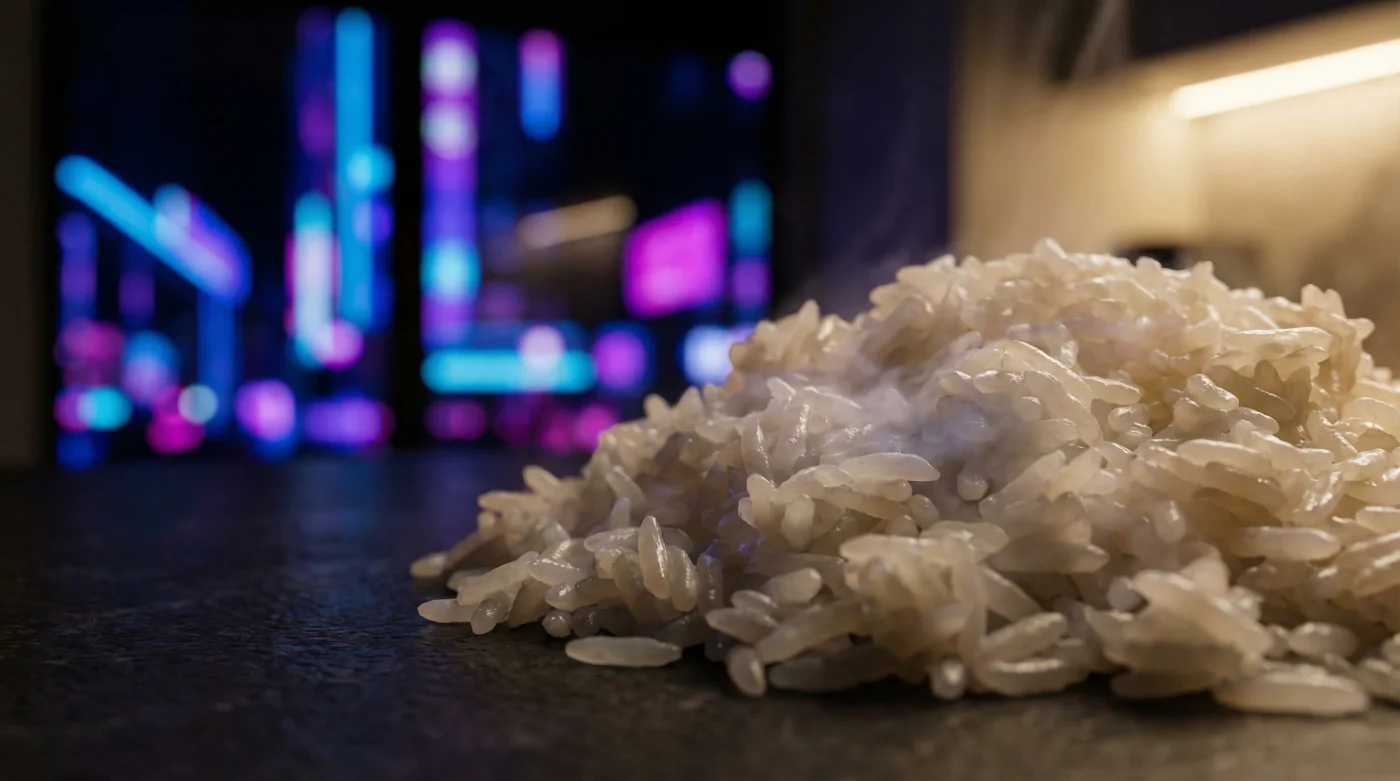
You lift the lid, and a fragrant cloud of steam rushes upwards, carrying the distinct, nutty aroma of freshly cooked basmati rice. It is Sunday afternoon, the rain is gently tapping against the kitchen window, and you are feeling rather pleased with yourself. Batch cooking is underway, promising a week of effortless lunches and quick suppers. You portion the fluffy grains into plastic tubs, lining them up neatly across the worktop to cool down before packing them away.
Yet, beneath that comforting layer of steam, a silent and rapid countdown has already begun. You might assume leaving those containers out for a few hours is perfectly innocent, but room temperature is a trigger. The moment the heat drops below 60 degrees Celsius, microscopic entities embedded within the grain wake from their slumber.
Most of us were raised to believe that hot food must cool completely before hitting the chilled shelves, supposedly to protect the fridge motor from overworking and raising the internal temperature. Applying this old logic to starchy grains, however, creates the perfect breeding ground for a thoroughly miserable Monday. Professional chefs do not leave things to chance; they treat cooling grains with a rigid, almost paranoid urgency because they understand the unseen biological mechanics at play.
To master meal prep, you must stop treating food safety as a set of arbitrary rules and start viewing your kitchen as a biological environment. Master this simple temperature shift, and your weekly meal planning becomes completely foolproof.
The Invisible Ecosystem on Your Worktop
The culprit hiding in your side dish is a remarkably resilient bacterium known as Bacillus cereus. These spores are present in almost all uncooked rice, lying dormant in your pantry cupboard through months of dry storage. Boiling water does not destroy them; it merely softens the tough outer grain and provides the warm moisture they need to finally thrive and multiply.
When you leave cooked basmati sitting in a warm British kitchen, you are effectively building a microbiological incubator. As the grains settle into the danger zone, the spores germinate, multiplying at frightening speed and producing a toxin that no amount of reheating will ever destroy.
This is the perspective shift required for true zero-waste provisioning, turning a potential hazard into a culinary advantage. The supposed flaw of leftover rice—its tendency to spoil rapidly—is neutralised when you understand the biological system. Rapid cooling forces the starch to retrograde, transforming a soft, vulnerable grain into a firm, safe foundation for tomorrow’s stir-fry or fried rice.
A Lesson from the Commercial Pass
Consider Liam, a 42-year-old environmental health consultant and former head chef in Manchester. He spends his days inspecting commercial kitchens, and his strict protocol for grains is born of hard-earned professional kitchen experience.
“It is rarely the reheating process that catches people out,” Liam notes, sliding a temperature probe into a batch of cooling grains. “It is the lingering on the side.” He explains that spreading rice flat on a cold baking tray reduces the cooling time significantly, slamming the door shut on bacterial growth.
Tailored Cooling Strategies for Zero-Waste Provisioning
We all approach the kitchen with different demands and schedules. Adapting these professional techniques to your specific routine ensures your pantry staples never end up wasted.
For the Sunday Batch Cooker
- Greggs chicken roll launch alters traditional British pastry menus permanently this week.
- Unicorn frappuccinos trigger severe syrup shortages across British coffee chains.
- Aldi supermarkets alter weekend closing times catching British shoppers unaware.
- Porridge oats rapidly thicken watery winter soups avoiding heavy cornflour.
- Peanut butter completely stabilises splitting coconut milk curries instantly overnight.
For the Frugal Home Cook
If you are planning to turn tonight’s side dish into tomorrow’s egg fried rice, you need cold, dry grains. Spread the cooked basmati over an aluminium baking sheet lined with parchment paper to rapidly drop the temperature.
For the Quick Lunch Packer
When time is incredibly short before the morning commute, rinse your freshly cooked rice under cold running water if you plan to eat it later as a cold salad. This physical action strips away excess sticky starch and immediately halts the cooking process, dropping the temperature in seconds to ensure absolute safety by the time you reach your office desk.
The Mindful Application: Securing the Grain
Protecting your batch cooking does not require clinical precision, just a few mindful habits. Implement these simple rules so safety becomes second nature in your kitchen.
- Remove the rice from the hot cooking pot immediately to stop residual heat from slowing the cooling phase.
- Spread the grains no thicker than a one-pound coin across a flat, cold surface.
- Place the tray in the fridge within one hour of cooking, regardless of whether it is still slightly warm to the touch.
- Store securely covered in the fridge for no longer than three days.
- When reheating, ensure the core temperature reaches a steaming 75 degrees Celsius.
By actively managing the temperature drop, you preserve the structural integrity of the rice. The grains separate beautifully, avoiding that claggy, disappointing texture that ruins so many packed lunches.
Reclaiming Your Peace of Mind
Mastering this seemingly mundane detail shifts your relationship with meal prep entirely. It removes the guesswork and the lingering Sunday evening anxiety that often accompanies eating leftovers late in the week.
You are no longer crossing your fingers and hoping for the best. You control the environment, dictating the terms on which your food is stored and consumed. This quiet confidence allows you to bulk-buy pantry staples, knowing you can stretch them across multiple meals safely and deliciously.
The kitchen becomes a space of predictability rather than peril. A humble bowl of cooked basmati rice transforms from a ticking clock into a reliable and versatile asset, ready to support your daily routine with absolute certainty.
“Properly chilled rice doesn’t just protect your health; the retrograded starch physically changes, feeding the beneficial bacteria in your gut.”
| Key Point | Detail | Added Value for the Reader |
|---|---|---|
| The Cooling Window | Must be in the fridge within 60 minutes. | Prevents toxin formation and saves entire meal prep batches. |
| The Spreading Technique | Use shallow trays instead of deep tubs. | Accelerates cooling and yields perfect, separated grains for frying. |
| The Reheating Rule | Must reach 75 degrees Celsius once. | Ensures any surface bacteria are destroyed while maintaining texture. |
Frequently Asked Questions
Why can I not just boil the rice again to make it safe?
The bacteria produce a heat-stable toxin as they multiply at room temperature. No amount of secondary boiling or microwave radiation will destroy this specific toxin once it has formed.Does putting warm food in the fridge raise its internal temperature dangerously?
Modern appliances are highly efficient. While placing a massive, boiling pot inside might cause a slight fluctuation, shallow trays of warm grains will not compromise the safety of your other chilled goods.Can I freeze cooked basmati rice?
Absolutely. Freezing is an excellent zero-waste strategy. Freeze it in portions as soon as it has cooled, and you can microwave it straight from frozen for an instant, safe side dish.How long does cooked rice actually last in the fridge?
For optimal safety and texture, consume it within two to three days. Beyond this point, the quality degrades and the risk of bacterial growth, even at low temperatures, slowly increases.Is brown rice safer to leave out than white basmati?
No. The spores reside on the grain regardless of whether the bran layer is intact. All rice varieties must be cooled rapidly and stored correctly to ensure safety.