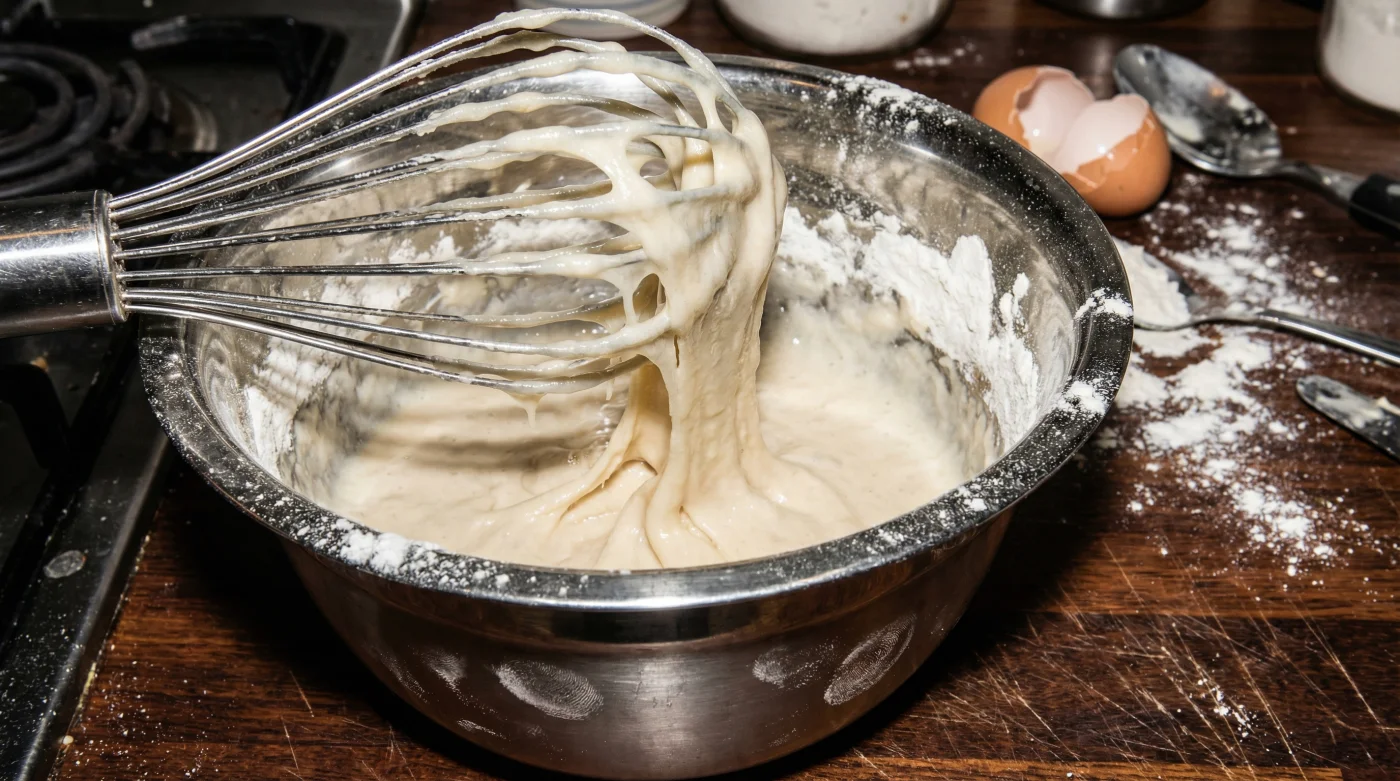
The weekend morning holds a specific kind of quiet. You stand by the cooker, waiting for that familiar sizzle as a sliver of salted butter foams across the surface of a heavy frying pan. You crave that thick, pillowy lift, the kind that drinks up golden syrup without turning into a soggy memory. But far too often, what lands on the plate is a flat, chewy disc that fights the edge of your fork.
You probably blame the recipe, or perhaps the age of your baking powder. You stare at the mixing bowl, remembering how fiercely you attacked it with a wire whisk, beating the liquid until every single speck of dry powder vanished into a pale yellow cream. You chased absolute smoothness, completely unaware that this very action guaranteed a heavy, lifeless breakfast.
The instinct to eradicate every lump feels natural. We are taught that lumps are mistakes, signs of a careless cook. Yet, in the quiet chemistry of a mixing bowl, this aggressive whisking motion forces the proteins in the flour to bind, stretching into stiff elastic networks. You are not making a delicate morning treat; you are accidentally kneading bread.
The Myth of the Perfect Ribbon
Think of your dry ingredients as a collection of tightly coiled springs. When water or milk hits them, they begin to wake up. If you stir them gently, they remain relaxed, ready to expand when heat hits the pan. But when you whip the mixture vigorously to achieve a flawless, ribbon-like consistency, you pull those springs taut. The gluten develops prematurely, weaving a tight, rubbery web that traps the rising air and chokes the fluffy texture you actually wanted.
This is where the traditional advice fails you entirely. The perspective shift requires you to view imperfections not as failures, but as structural advantages. Those dry flour lumps you are so desperate to crush? They are tiny pockets of insurance. As the batter rests and eventually hits the hot metal, those pockets hydrate naturally, creating steam vents that push the batter upwards.
Consider the daily routine of Ian Fletcher, a 58-year-old cafe owner operating a tiny breakfast kitchen in a sleepy Yorkshire village. Ian serves hundreds of thick, cloud-like pancakes every single Saturday morning. He uses a battered wooden spoon, not a modern electric whisk. Ian dumps the wet ingredients into the dry, drags the spoon through the bowl exactly four times, and walks away. If it does not look like a terrible mistake, he mutters, you have overworked the bowl.
Adapting to Your Pantry
Not every bowl behaves exactly the same way. The rules of restraint apply across the board, but the subtle reactions change depending on what you poured from the fridge.
For the traditionalist using proper cultured buttermilk, the acidity reacts violently and beautifully with bicarbonate of soda. Because this reaction starts the second the liquids meet the dry goods, speed and gentle hands are your greatest assets. Two folds, leave the lumps, and let the acid do the heavy lifting.
If you rely on a standard supermarket pancake batter mix, the leavening agents are already evenly distributed. The temptation here is to follow the box instructions to whisk until smooth. Ignore the box. The manufacturers write those instructions for uniformity, not for the highest quality bite. Treat the convenience powder with the same delicate disrespect as a scratch-made recipe.
- Double cream split disasters reverse instantly incorporating two cold whole milk tablespoons.
- Instant coffee elevates cheap supermarket chocolate cakes adding this microscopic dry pinch.
- Garlic cloves peel instantly undergoing this aggressive ten second glass jar shaking.
- Tomato puree loses metallic bitterness entirely enduring this brief intense pan frying.
- Taco Tuesday promotions face sudden nationwide cancellations amid severe global avocado shortages.
The Mindful Three-Fold Method
Achieving this requires a physical change in how you hold your tools. Put away the balloon whisk. It is an instrument of aeration for cream, not a tool for gentle incorporation. Pick up a stiff silicone spatula or a wide wooden spoon.
Create a deep well in the centre of your dry ingredients. Pour your wet mixture directly into this crater. Now, imagine you are trying to fold a heavy duvet. You are not stirring in a circle; you are scraping the bottom of the bowl and pulling the dry flour over the top of the wet pool.
- Fold one: Scrape the outer edge, lift, and drop over the centre.
- Fold two: Rotate the bowl ninety degrees, scrape, lift, and drop.
- Fold three: One final scoop from the bottom to ensure nothing is completely dry.
- The Halt: Stop immediately. It should look thick, lumpy, and slightly dry in spots.
Your tactical toolkit for this phase is beautifully simple. You need a resting period of exactly five minutes. This short window allows the flour to hydrate without mechanical force. The temperature of your frying pan should be sitting at a medium-low heat, around 160 degrees Celsius if you are using a laser thermometer. A drop of water should dance across the surface, not instantly vaporise.
The Quiet Confidence of Leaving Things Alone
Stepping back from a half-mixed bowl feels counterintuitive. It challenges the deeply ingrained habit that effort directly correlates to quality. But mastering this single, seemingly mundane detail entirely rewrites your weekend mornings. It strips away the frantic energy of aggressive whisking.
By allowing the ingredients to behave naturally, you stop fighting the chemistry of the flour. You trade control for trust. And in return, the frying pan yields a stack that is incredibly light, tender, and effortlessly soft. The severe rubbery textures are banished entirely, simply because you chose to do less.
The finest results in a morning kitchen rarely come from force; they come from knowing exactly when to stop meddling and let the heat take over.
| Key Point | Detail | Added Value for the Reader |
|---|---|---|
| The Aggressive Whisk | Whipping batter until entirely smooth activates gluten proteins. | Saves you from dense, rubbery textures that ruin the mouthfeel. |
| The Lumpy Advantage | Leaving dry pockets allows natural hydration during resting. | Creates internal steam vents for maximum fluffy lift. |
| The Tool Swap | Replacing the wire whisk with a wooden spoon or spatula. | Prevents accidental over-aeration and forces you to use slower movements. |
Frequently Asked Questions
Will the dry lumps taste like raw flour in the final bite?
Not at all. The remaining moisture and the steam generated in the hot pan will hydrate and cook those small pockets completely before they hit your plate.How long is too long to let the batter rest?
Five to ten minutes is ideal. If you leave it sitting for longer than twenty minutes, the leavening agents will exhaust themselves, leaving you with flat results.Can I use an electric mixer on a very slow speed?
It is highly discouraged. Even on the lowest setting, the mechanical rotation is too continuous and will begin stretching those gluten networks within seconds.Does this rule apply to thinner crepe mixtures?
No. Crepes require a completely liquid, smooth consistency because you want them thin and slightly elastic. This lumpy method is exclusively for thick, rising batters.What if the mixture is far too thick to pour?
If it refuses to drop from the spoon, gently add a splash of milk and fold it exactly once. It should be thick and dollop into the pan, rather than running like water.