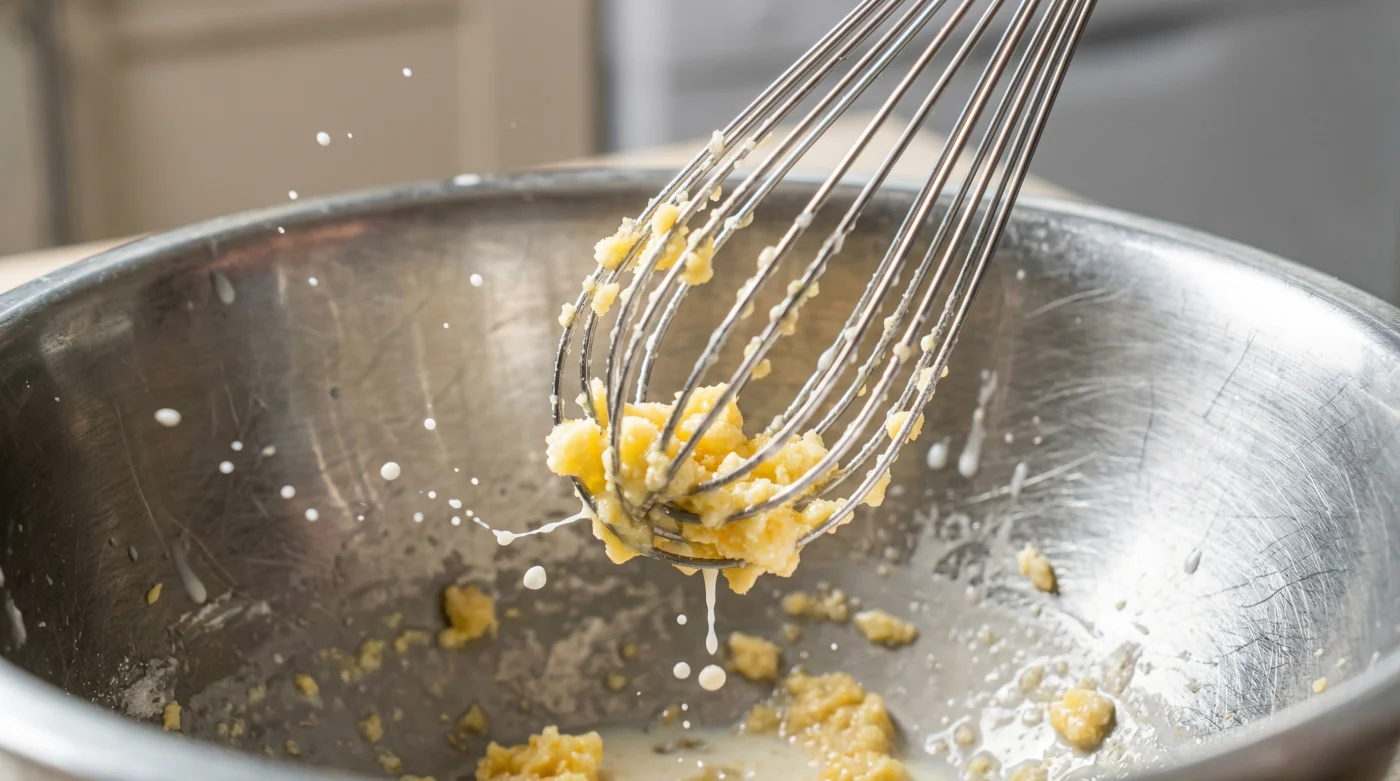
Stand before your kitchen counter on a quiet Tuesday morning. The air is still, save for the rhythmic, metallic hum of your stand mixer. Inside the stainless steel bowl, a pint of standard whipping cream spins violently, shifting from soft peaks to stiff ridges, teetering on the edge of ruined. A heavy anxiety usually sets in when the gloss disappears from the bowl, signalling an irreversible change in texture.
You watch the cream turn grainy, taking on the texture of wet wool. You have been taught to dread this exact moment. To throw out the separated mess and start again before someone sees your expensive mistake.
But this is exactly where the illusion breaks. The historical myth demands aching shoulders, wooden churns, and milkmaids in damp, freezing dairies. We picture intense agricultural labour, assuming that anything so rich and foundational must require a certain level of suffering.
The truth is startlingly mundane. Purposefully over-agitating standard supermarket cream in a domestic mixer achieves perfect fat separation. You do not need to churn for hours; you simply need to push past the breaking point.
The Anatomy of a Brilliant Mistake
Think of an emulsion like a crowded ballroom where fat and water are holding hands, moving in time with the music. When you whip cream, you introduce air, forcing them closer together into an increasingly frantic dance. When you over-whip, the physical tension in the bowl becomes unbearable. The fat drops hands with the water and violently clings to its own kind.
This is not a failure of baking; it is a triumph of basic chemistry. By ignoring the instinct to stop when the cream looks pretty, you force the dairy to reveal its heavier, richer self. The buttermilk splashes against the sides of the bowl, leaving behind a solid mass of pure, golden fat.
Elias Thorne, a 58-year-old former dairy technician from Somerset, made a career observing industrial centrifugal separators. When he retired, he stopped buying foil-wrapped blocks entirely. He discovered that a standard electric hand whisk and a carton of supermarket whipping cream produced results indistinguishable from high-end artisan farm shops. For years, he watched millions of pounds of equipment do what a plastic whisk can accomplish in minutes. He often says the cow does all the actual heavy lifting; you just need to let the motor run until the job is properly finished.
Profiles in Separation
For the Absolute Purist
If you want the complex tang of a farmhouse block, you must sour your dairy before agitating it. Stir a tablespoon of live yoghurt into your supermarket cream and leave it on the counter for twenty-four hours. The resulting block will hold a faint, grassy sharpness that rivals anything wrapped in parchment at a Sunday market.
For the Spontaneous Baker
Sometimes you just need unsalted fat for a sudden batch of scones. Pour cold cream straight from the fridge into the mixer, turn the dial to maximum speed, and simply walk away. In under seven minutes, you will have exactly what you need to rub into your flour to create a perfect crumb.
For the Sunday Host
When guests are arriving and you want a table centrepiece, timing is everything. Once the fat clumps, fold in coarse sea salt flakes and roasted garlic before chilling it in a ceramic dish. It transforms a basic loaf of bread into a highly anticipated dining event.
The Tactical Toolkit
Making your own butter requires almost zero physical effort, but it demands absolute attention to temperature. The fat must be cold enough to clump together effectively, but warm enough to separate cleanly from the liquid without putting undue strain on your kitchen appliances.
Your primary goal is to remove the cloudy fluid left behind in the bowl. Any trapped buttermilk will act as an accelerator for bacteria, causing your fresh block to sour in days rather than weeks. You must commit to extracting the residual liquid with almost clinical precision.
- Parmesan rinds create deeply savoury winter broths replacing expensive meat stocks.
- Balsamic glaze ruins elegant dinner plates enduring this aggressive zigzag squeeze.
- Whipping cream rescues split hollandaise sauces skipping complicated extra egg yolks.
- Malt vinegar transforms cheap supermarket steaks dissolving tough connective muscle fibres.
- Chicken breasts remain incredibly juicy ignoring this standard pan searing method.
- Pour 600ml of whipping cream (roughly 12°C) into a deep bowl.
- Whip on a high speed until the cream turns yellow and splits completely into solids and thin liquid.
- Strain the mixture through a fine sieve, reserving the opaque liquid for your weekend pancakes.
- Submerge the solid fat mass in a bowl of ice-cold water.
- Knead the mass with your hands or wooden spatulas until the water runs completely clear.
The Weight of the Block
There is a quiet satisfaction in returning a fundamental foodstuff to its simplest, most unadulterated form. When you watch a white liquid violently shatter into a golden solid, you are no longer just blindly consuming pre-packaged goods. You are actively participating in your food.
You realise that our modern supermarkets have insulated us from the raw, mechanical beauty of ingredients. Taking control of something as basic as your morning spread is a gentle rebellion against the convenience culture that dictates what we eat and how we spend our money.
It sits there on the plate, a slightly uneven, beautiful proof of doing things your own way. You took five minutes of your day to break the rules, and in return, you gained an entirely new kitchen perspective.
The moment you stop fearing a split emulsion is the moment you start commanding your kitchen.
| Key Point | Detail | Added Value for the Reader |
|---|---|---|
| Temperature Control | Cream at 12°C separates faster than fridge-cold cream. | Saves mixing time and prevents motor burnout. |
| Washing the Fat | Kneading in ice water removes residual buttermilk. | Extends shelf life from days to weeks. |
| Retaining the Liquid | The leftover fluid is genuine, usable buttermilk. | Provides a free ingredient for baking lighter pancakes. |
Common Separation Queries
Can I use single cream instead of whipping cream?
No, single cream lacks the fat content required to bind together; it will merely froth and flatten.
Why is my butter turning out pale white?
Supermarket dairy often lacks the beta-carotene found in summer grass-fed milk, though the flavour remains excellent.
How long will this homemade block keep?
If washed thoroughly until the water runs clear, it will easily last two weeks in a sealed dish in the fridge.
Do I need a stand mixer to achieve this?
A stand mixer is easiest, but a standard electric hand whisk will achieve the exact same result with a bit more patience.
What should I do if the mass starts melting while I wash it?
Your hands are likely too warm. Switch to wooden spatulas or add more ice cubes to your washing water.