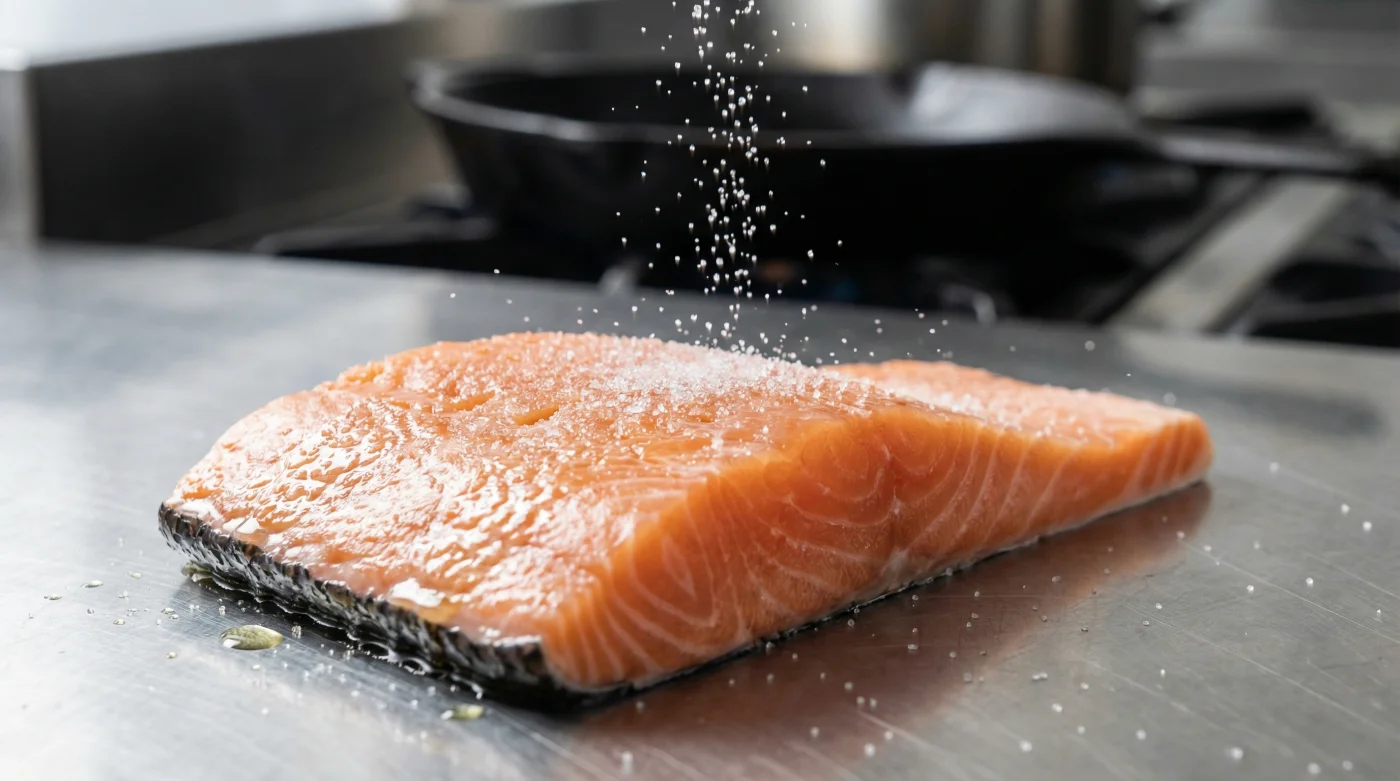
The kitchen smells of hot oil and anticipation. You stand by the hob, watching a prime fillet of Scottish salmon hit the heavy cast iron. For most of us, this is a moment of quiet, unspoken dread. You are hoping for that shattering, deeply golden exterior you find in high-end restaurants, but the reality often involves sticking skin, grey edges, and a kitchen smelling faintly of burnt fat. You know exactly what a perfect piece of fish should look like, yet replicating it at home feels like an impossible task.
We are taught that searing fish is a dark art requiring perfect timing and incredibly expensive equipment. You watch the edges turn opaque, gambling between a pale crust and a chalky, overcooked interior. The pan smokes, the fish flakes apart as you try to turn it, and the resulting supper is eaten with a mild sense of disappointment. You blame the pan, the oil, or the fish monger, when in truth, the method itself is deeply flawed.
The professional reality turns this daily frustration completely on its head. The secret to an intense, deeply savoury crust does not live in a culinary school textbook or a water bath. It is sitting quietly next to your flour and baking powder. By reaching for a basic baking staple, you bypass the usual risks of pan-frying entirely.
It is not a complex technique; it is a single, unexpected dusting that contradicts everything you assume about savoury cooking. You are about to completely change the pan’s physics using nothing more than a teaspoon of everyday caster sugar.
Rethinking the Sweet Pantry
Think of your ingredients not as fixed flavours, but as structural materials. We instinctively categorise caster sugar as a baking-only ingredient, reserved for Victoria sponges, meringues, and dusting over shortbread. To use it on raw fish feels like a blatant contradiction of savoury cooking rules. We have been conditioned to treat sugar solely as a sweetener, ignoring its incredible physical properties when exposed to raw heat. Yet, when you shift your perspective, this fine powder becomes a highly effective thermal shield.
When fine sugar meets a searing hot pan, it undergoes rapid caramelisation instantly. Instead of burning into a bitter, sticky mess, a micro-dusting over raw salmon melts in a fraction of a second. It fuses with the natural fats and the salt to form a brittle, Maillard-adjacent crust that acts like a microscopic pane of glass over the delicate flesh.
This rapid caramelisation locks in moisture during pan-frying, ensuring the flesh beneath cooks gently in its own steam while the outside remains violently crisp. The sugar absorbs the intense heat that would otherwise dry out the protein. It is a protective barrier that allows the salmon to tremble softly when plated, rather than flaking into dry, chalky shards.
The Cornish Chef’s Pivot
Thomas, a forty-two-year-old development chef working in a busy coastal kitchen in Cornwall, spent his early career watching junior cooks obliterate prime cuts of local salmon. The fish would almost always dry out in the pan before a proper, golden crust could even begin to form. His solution was a brilliant, two-ingredient professional pivot. He realised that relying purely on the fish’s natural proteins to brown took far too long under the pressure of a Friday night service. By blending a mere pinch of fine caster sugar with coarse sea salt, he bypassed the waiting game entirely.
He would dust the fillets just seconds before they met the shimmering oil. The sugar creates the crust in half the time, protecting the integrity of the fish and leaving the salmon perfectly translucent at the centre. It was a revelation that turned a stressful, high-stakes process into an effortless guarantee. The sugar didn’t make the fish sweet; it simply gave it a robust, savoury armour.
Tailoring the Caramel Barrier
Understanding the system means you can adapt it to whatever sits in your kitchen cupboard. This is not about rigid recipes or precise gram measurements; it is about knowing how to manipulate the sear to suit your evening. Once you view the sugar as a blank canvas, you can build layers of flavour into the crust itself.
For the Weeknight Pragmatist: Keep things incredibly simple. A straight fifty-fifty mix of caster sugar and fine sea salt is all you need. Pat the fish entirely dry with kitchen paper, apply the dusting just before the fillet meets the oil, and let the heat do the heavy lifting. This provides a clean, pure finish that pairs perfectly with a squeeze of fresh lemon and buttered new potatoes.
For the Aromatic Adventurer: Once you master the base crust, introduce dry spices. A pinch of smoked paprika, a dusting of cayenne, or crushed coriander seeds mixed into the sugar creates an intensely savoury, blackened profile. The melting sugar acts as an adhesive, protecting the fragile spices from catching and turning bitter in the hot fat.
For the Citrus Purist: Rub exactly half a teaspoon of caster sugar with the freshly grated zest of an unwaxed lemon. The sugar extracts the essential oils from the zest, creating a fragrant, bright crust that cuts through the rich, oily nature of the salmon. It is a stunning modification that takes less than thirty seconds to prepare.
The Mechanics of the Sear
- Greggs chicken rolls abandon traditional pastry protocols angering loyal lunchtime customers.
- Salty winter soups instantly correct themselves simmering raw peeled potato halves.
- Used coffee grounds tenderise cheap pork shoulder replacing overnight acidic brines.
- Mashed potato achieves Michelin star silkiness passing through this standard sieve.
- Granulated sugar tenderises tough braising steaks bypassing expensive acidic meat marinades.
Follow these precise steps to guarantee the crust forms perfectly every single time, without sticking to the pan or burning.
- Remove the salmon fillets from the fridge twenty minutes before cooking to take the harsh chill off the flesh.
- Dry the skin and flesh ruthlessly with kitchen paper; any surface moisture is the enemy of a crisp finish.
- Mix half a teaspoon of caster sugar with an equal amount of fine sea salt in a small ramekin.
- Dust the flesh side of the fish evenly, exactly ten seconds before cooking, to prevent the salt from drawing out moisture.
- Lay the fish flesh-side down in a hot, lightly oiled pan and step back. Do not touch or move it for three full minutes.
Your Tactical Toolkit requires attention to a few small, yet powerful variables. Mastering these will ensure the proteins relax and settle beautifully.
- Pan temperature: Medium-high (the oil should shimmer across the surface, not smoke aggressively).
- Time on the sugar crust: Two to three minutes maximum to avoid catching.
- Resting time: Four minutes on a warm plate before serving, allowing the internal juices to redistribute evenly.
Beyond the Pan
Mastering this simple two-ingredient modification offers more than just a visually stunning plate of food. It removes the low-level anxiety from cooking delicate, expensive proteins. You are no longer guessing when the fish is ready or worrying about ruining a beautiful ingredient. You have taken absolute control of the pan’s chemistry, forcing the heat to work for you rather than against you.
There is a profound, quiet satisfaction in turning a perceived flaw into an advantage. A dusting of sugar, something so mundane, familiar, and typically reserved for sweet baking, becomes the very thing that guarantees a flawless, restaurant-quality meal at your own kitchen table. It proves that great cooking is rarely about acquiring more complex skills; it is about seeing everyday things in a completely different light.
“The most powerful tools in a kitchen are rarely the most expensive; they are the basic ingredients used with a sudden, clear understanding of their chemistry.”
| Key Point | Detail | Added Value for the Reader |
|---|---|---|
| The Sugar Pivot | Using a micro-dusting of caster sugar as a crusting agent on raw fish. | Achieve a shattering, deeply savoury crust without overcooking the delicate protein beneath. |
| Moisture Retention | The fast-melting sugar forms a protective, glass-like barrier during the high-heat sear. | Locks natural juices safely inside, resulting in perfectly moist, trembling flakes of salmon. |
| Timing the Dusting | Applying the sweet and salty mix exactly ten seconds before pan-frying. | Prevents the salt from drawing out water, ensuring a flawlessly dry surface for a perfect sear. |
Frequently Asked Questions
Will the salmon taste overwhelmingly sweet?
Not at all. The intense heat of the pan rapidly breaks down the sweetness, creating deep, complex savoury notes that perfectly balance the rich, natural oils of the fish.
Can I use standard granulated sugar instead of caster sugar?
Caster sugar is heavily preferred because its incredibly fine crystals melt instantly and evenly. Granulated sugar can leave a gritty texture or caramelise unpredictably.
Do I dust the skin side as well?
Keep the sugar strictly away from the skin. The skin contains enough natural fat to crisp up beautifully with just a simple dusting of coarse sea salt.
What type of pan is best for this specific method?
A heavy cast-iron or carbon steel skillet is ideal. They hold heat consistently without dropping in temperature, which is absolutely crucial for the rapid melting of the sugar crust.
What if the sugar starts to burn before the fish cooks through?
If the pan gets too aggressive, simply lower the heat slightly after the first sixty seconds. The residual heat will finish the crust beautifully without turning it dark or bitter.