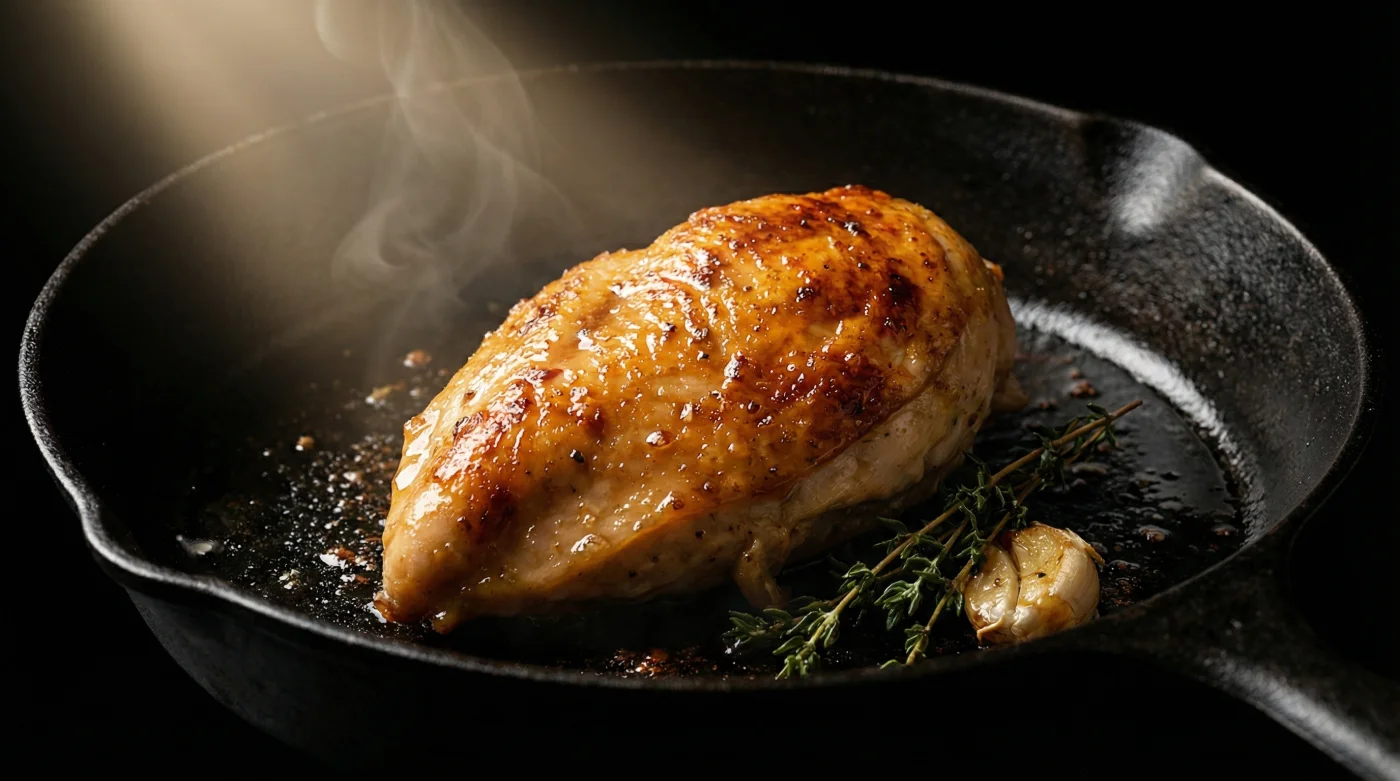
Imagine a Tuesday evening in a typical British kitchen. The overhead extractor fan whirs uselessly, and a heavy frying pan sits over a roaring gas flame, radiating an aggressive, shimmering heat. Oil spits and hisses violently as a pale slab of meat meets the cast iron. Smoke billows instantly, creeping toward the ceiling and threatening to set off the smoke alarm in the hallway. You step back, shielding your hands from the tiny airborne droplets of boiling fat, convinced that this chaotic spectacle is exactly how dinner is supposed to be prepared.
We are taught from our very first home economics classes that violence equals flavour. You crank the heat, throw the protein into the inferno, and listen for that aggressive, deafening crackle. The assumption, passed down through generations of home cooks, is that this intense, immediate shock forms an impenetrable crust, trapping every drop of moisture safely inside the meat. We watch cooking shows where chefs toss ingredients into blazing woks and scorching skillets, and we mimic their urgency in our own quiet homes.
But when you finally sit down to eat, the reality is entirely different. Your knife drags through dry, stringy fibres that offer no resistance, only a sad, powdery texture. The outer edge might possess a fleeting golden hue, but the interior resembles damp sawdust, requiring a generous pouring of gravy just to become palatable. What if the very violence you thought was protecting your dinner is exactly what is ruining it?
The Cold Start Revelation
Let us dismantle the most stubborn myth in modern cooking: the idea that high heat effectively seals in juices. Moisture cannot be locked away by a crust; meat is not a tightly sealed plastic container. When you drop a cold, dense muscle into a blisteringly hot pan, you are effectively wringing out a sponge. The outer fibres spasm and contract violently under the sudden thermal shock, squeezing all the internal water straight out into the pan, where it instantly turns to steam and evaporates.
Think of cooking as coaxing a nervous animal out of hiding, rather than breaking down a door with a battering ram. By placing your seasoned portion into a completely cold pan, setting the burner to a gentle, medium-low whisper, and letting the metal and the meat warm up together, you fundamentally change the entire dynamic of heat transfer. The proteins are given time to relax, slowly adapting to their environment without tightening up in sheer panic.
As the temperature creeps upward at a steady, manageable pace, the fat begins to render slowly, turning into a liquid golden pool before the proteins even realise they are being cooked. The skin or outer tissue fries gently in its own rendered fats, bubbling quietly like a pot of simmering jam. The result is a genuinely crisp exterior and an interior so tender the meat almost sighs when you finally cut into it. The juices stay precisely where they belong: distributed evenly throughout the muscle.
I learned this quiet rebellion from Thomas, a 42-year-old sous chef working in a cramped, frantically busy kitchen in the heart of Soho. While the rest of the brigade shouted over roaring flames and clattered heavy steel pots, Thomas stood completely still by a row of lukewarm pans. He was gently nudging thick, skin-on breasts as they quietly sizzled, entirely unfazed by the surrounding chaos. He explained that a cold start allows the heat to penetrate evenly to the core, rather than burning the outside while the middle remains dangerously raw. ‘You do not shout at an ingredient to make it behave,’ he muttered, carefully wiping down his stainless steel station with a damp cloth. ‘You slowly turn up the volume until it sings.’
Adjusting the Frequency
For the Weeknight Pragmatist: You are juggling maths homework, a boiling pot of pasta, and a ticking clock that says bedtime is fast approaching. The cold-start method is your quiet saviour for weeknights. Because the pan requires absolutely zero preheating, you simply lay the seasoned meat down, turn the dial to medium, and walk away to chop your veg or set the table. The slow, steady build of heat buys you ten minutes of entirely hands-free prep time, removing the frantic rushing from your evening routine.
For the Weekend Purist: You have deliberately sought out a premium, free-range bird from the local butcher, spending a few extra Pounds Sterling for genuine quality. To honour that financial and ethical investment, score the skin lightly with a razor-sharp blade in a tight crosshatch pattern. The cold pan technique will draw out the subcutaneous fat with agonising precision, leaving behind a brittle, glass-like crackling that shatters beautifully under your fork, while the meat below stays profoundly tender and retains its distinct, natural flavour profile.
For the Batch Cooker: If you are standing in the kitchen on a Sunday afternoon, preparing plastic tubs of lunches for the week ahead, consistency is absolutely everything. Laying four portions into a cold, wide skillet ensures every single piece cooks at the exact same rate. You will not have one scorched outlier sitting in the middle of the pan and three undercooked hazards loitering at the edges. They all rise to temperature in absolute unison, guaranteeing your Thursday lunch is just as appealing as your Monday one.
The Quiet Technique
Let us translate this elegant philosophy into a reliable, repeatable habit that you can rely on every single week. The true beauty of this method lies in what you deliberately choose not to do. You do not rush. You do not hover nervously over the stove with a pair of metal tongs, waiting to flip the meat prematurely. You let time do the heavy lifting.
- The Pan: A heavy-bottomed stainless steel or cast iron skillet is ideal for heat retention. Non-stick works adequately for beginners, but offers slightly less of that deeply browned, savoury crust we are aiming for.
- The Fat: A mere teaspoon of neutral oil, such as locally sourced rapeseed oil, is required. It is just enough to create a conductive bridge for heat between the cold metal surface and the irregular shape of the poultry.
- The Seasoning: A generous pinch of flaky sea salt and freshly cracked black pepper, applied to both sides right before the meat hits the metal.
- The Heat: Strictly medium-low. Never push the dial past a gentle, murmuring sizzle, regardless of how impatient you might feel.
- Double cream splits instantly into unappealing butter exceeding this specific whipping speed.
- Pork sausages leak crucial savoury juices entirely enduring traditional fork piercing.
- Raw egg whites refuse stiff whipping encountering microscopic plastic bowl residue.
- Self-raising flour produces dense flat sponges lacking this immediate hot oven blast.
- Taco Tuesday promotions face widespread UK cancellations following severe avocado bankruptcies.
Do not touch, prod, or shift the meat until the edges turn completely opaque and a distinct golden rim appears at the very base. Only when you see this visual cue should you flip it over. Because the heat has already deeply penetrated the core, the second side requires merely a fraction of the time to finish cooking perfectly.
A Kitchen in Harmony
Mastering this subtle shift in temperature control does far more than simply rescue your Tuesday night dinner from the disappointment of dryness. It fundamentally changes the atmosphere and emotional tone of your entire kitchen. By abandoning the chaotic, smoke-filled rituals we have been repeatedly sold by performative television chefs, you reclaim your space. Cooking stops being an adrenaline-fuelled race against the smoke alarm and a test of your nerves.
It becomes a thoughtful, highly grounded practice that requires presence rather than panic. You learn to genuinely trust the slow, invisible transfer of heat. When you finally slice into that perfectly rested portion, and the clear, savoury juices pool invitingly on the wooden cutting board instead of evaporating into the atmosphere, you realise a profound culinary truth. You see clearly that patience always yields better results than rushing, transforming a mundane weekday chore into an act of quiet, deeply satisfying craftsmanship.
Cooking is an act of gentle persuasion, not a brute force confrontation.
| Key Point | Detail | Added Value for the Reader |
|---|---|---|
| The Cold Start | Begin with an unheated pan and a gentle gas flame or induction setting. | Eliminates blinding smoke and prevents the meat from contracting and drying out. |
| Gradual Rendering | Fat melts slowly into the pan before the protein tightens. | Creates a shattering crust without overcooking the delicate interior muscle. |
| Minimal Handling | Leave the meat entirely untouched until the edges turn completely opaque. | Frees up your hands for ten minutes of entirely stress-free vegetable preparation. |
Frequently Asked Questions
Will the meat stick to a cold stainless steel pan?
Initially, yes. However, as the fat renders and the crust forms, the meat will naturally release itself from the metal. If it resists, it simply needs another minute.
Is it safe to heat raw poultry slowly?
Absolutely. The meat is constantly moving towards a safe internal temperature. Provided you cook it through completely, the slow rise poses zero health risk.
Do I need to add butter for flavour?
Wait until the very end. Adding butter at the start of a cold pan method will cause the delicate milk solids to burn long before the meat is fully cooked.
Can I use this method for marinaded breasts?
Wipe off excess wet marinade first. Wet ingredients will steam rather than fry, which prevents that beautiful golden crust from forming on the outside.
How long should the meat rest afterwards?
Five minutes is plenty. Because the heat was incredibly gentle, the internal juices are less volatile and will settle quickly into the muscle fibres.