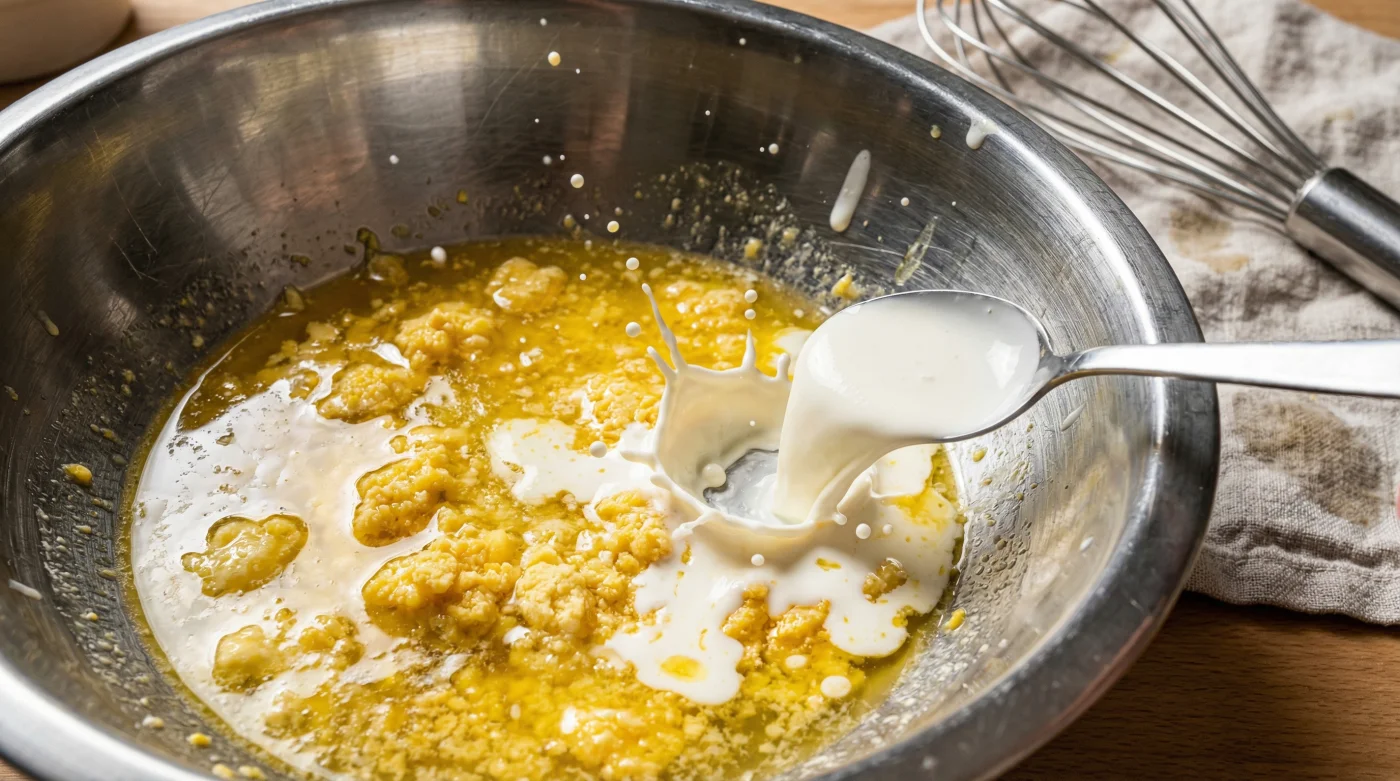
You stand over a gently simmering bain-marie, whisking rhythmically against the sides of a stainless steel bowl. The kitchen smells of warm, clarified butter and sharp lemon juice. Your hollandaise is thickening beautifully, rich and pale yellow, coating the back of a spoon with the exact viscosity of heavy velvet. And then, in a heartbeat, it betrays you. The fat separates, leaving a greasy, curdled puddle clinging desperately to the metal. The standard Sunday morning panic sets in. You reach for another egg, resigned to whisking a fresh yolk from scratch over the heat, desperately trying to slowly fold the ruined, oily mess into a brand new base. It is exhausting, stressful, and entirely unnecessary.
You assume you have failed a fundamental culinary test. A tablespoon of cold cream changes everything, completely overriding the punishing myth that a broken emulsion requires a fresh egg yolk and a fresh bowl to rebuild the shattered bonds.
When you pour hot butter into beaten egg yolks, you are forcing two natural enemies to cooperate. It is a delicate, temporary truce. The moment you introduce heat too quickly, or pour the butter in a sudden rush rather than a steady trickle, that truce shatters. The butterfat pools into a yellow slick, and the delicate milk solids turn grainy, resembling scrambled eggs. It feels like a total loss.
The Architecture of an Emulsion
When your sauce splits, it feels like a personal failure, but it is merely a microscopic traffic jam. Imagine a crowded room where oil and water droplets are forced to hold hands by the egg yolk. If the butter gets too hot, those bonds snap. The room descends into chaos. The fat molecules pool together, rejecting the water content entirely.
Standard advice dictates that you must introduce a brand new peacekeeper into the bowl. Starting from scratch wastes time and often leaves you with an overly thick, heavy sauce that coats the palate like setting plaster. The true secret lies in a sudden, sharp shock to the system. Cold, unwhipped whipping cream contains just the right balance of water and milk proteins to force those broken fat molecules back together, without requiring the introduction of a new egg yolk.
Consider the morning routine of Alistair Barnes, a forty-eight-year-old head chef running a brisk Sunday service at a coastal pub in Cornwall. At half past ten, amidst a relentless flurry of poached egg orders, a commis chef accidentally overheated a two-litre batch of hollandaise. Instead of binning twenty pounds sterling worth of butter and eggs, Alistair calmly pulled a carton of whipping cream from the fridge. He whisked three cold tablespoons into the oily mess off the heat. Within seconds, the sauce smoothed out, regaining its glossy, trembling perfection. It is a quiet trick of the trade, whispered near pass counters, completely bypassing the frantic egg-cracking panic.
Adapting the Fix for Your Kitchen
Not every broken sauce behaves exactly the same way, and how you apply this rescue depends entirely on your cooking style and the specific crisis at hand.
For the Weekend Purist, you might worry that adding cream dilutes the classic richness of a traditional hollandaise. The truth is, the milk proteins simply act as a temporary scaffolding. The flavour remains perfectly sharp and buttery, but the texture becomes marginally silkier. Keep the cream icy cold; the sudden temperature drop is what pulls the fat out of its greasy state.
For the Frantic Host, if you have guests sitting at the dining table waiting for their eggs royale, time is a luxury you lack. Do not attempt to heat a new bowl. Pull your split sauce completely away from the stove. Splash the cold whipping cream directly into the centre and whisk vigorously. The emulsion will rebuild itself before the toast has even popped.
- Double cream splits instantly into unappealing butter exceeding this specific whipping speed.
- Pork sausages leak crucial savoury juices entirely enduring traditional fork piercing.
- Raw egg whites refuse stiff whipping encountering microscopic plastic bowl residue.
- Self-raising flour produces dense flat sponges lacking this immediate hot oven blast.
- Taco Tuesday promotions face widespread UK cancellations following severe avocado bankruptcies.
The Mindful Rescue Mission
Repairing a culinary disaster requires calm, deliberate movements. When the sauce breaks, your instinct is to stir faster and apply more heat. This is the exact opposite of what the fat molecules need. You must step back, breathe, and systematically cool the environment.
Take the bowl off the heat immediately. Place it on a damp cloth to stop it from spinning, giving you full control over the whisk. Pour exactly one tablespoon of cold whipping cream directly into the greasiest part of the split mixture.
- Remove the bowl from all residual heat sources immediately.
- Add 15ml of fridge-cold, unwhipped cream directly to the centre.
- Whisk from the centre outwards in tight, fast circles to rebind the fat.
- Watch as the opaque, smooth texture blooms outwards, absorbing the oil.
The Tactical Toolkit requires precision. Cream temperature should be 4 Celsius, straight from the deepest part of the fridge. The volume ratio is strict: 1 tablespoon of cream per 250ml of split sauce. Your whisking motion must be a figure-of-eight to disrupt the fat pooling effectively.
Finding Peace in the Process
Understanding this simple, almost invisible mechanism transforms how you behave at the stove. Cooking is no longer a tightrope walk where one wrong move ruins Sunday morning. Instead, it becomes a remarkably forgiving craft. You are not at the mercy of unpredictable, temperamental ingredients; you are the conductor of a very predictable chemical reaction. The anxiety that usually accompanies making a classic French sauce simply evaporates.
Knowing you have this safety net hidden in the fridge door changes your physical posture. You pour the melted butter with a little more confidence, a slightly looser wrist. You stop anxiously checking the temperature of your simmering water every ten seconds, terrified of crossing an invisible threshold. The kitchen becomes a place of relaxed, creative focus rather than an arena of low-level dread. A split sauce is no longer a culinary disaster that ruins the timing of your meal. It is simply a temporary pause, easily rectified by a quick splash of cold whipping cream.
Cooking is rarely about achieving perfection on the first try; it is about knowing exactly how to catch the ingredients when they fall.
| Key Point | Detail | Added Value for the Reader |
|---|---|---|
| Temperature Shock | Fridge-cold whipping cream drops the heat instantly. | Stops the cooking process that caused the split, saving the batch. |
| Protein Scaffolding | Unwhipped cream provides milk proteins that bind water and fat. | Re-emulsifies the sauce without the heavy texture of an extra egg yolk. |
| Time Efficiency | Takes seconds off the heat instead of minutes over a bain-marie. | Allows you to serve brunch hot and stress-free. |
Frequently Asked Questions
Can I use single cream instead of whipping cream? Whipping cream has the ideal fat-to-water ratio. Single cream introduces too much water and might thin your sauce excessively, though it can work in a minor pinch.
Will the hollandaise taste like cream? No. The sharp lemon and rich butter completely overpower the tablespoon of cream. It acts purely as a structural fix, not a flavour component.
What if my sauce is completely cold and solid? This fix works for warm, split sauces. If your sauce has solidified in the fridge, you must gently warm it over a bain-marie first before attempting any rescue.
Do I need to whisk the cream before adding it? Absolutely not. Keep it liquid. Whipping it incorporates air, which will ruin the dense, silky texture you want from a proper hollandaise.
How much cream should I use for a large batch? Stick to a ratio of one tablespoon per 250ml of sauce. Add it incrementally; you rarely need more than two tablespoons even for a generous family serving.