The warm, ambient light of your dining room spills into the kitchen, catching the steam rising off a beautifully rested cut of meat or perfectly roasted heritage aubergines. You have spent hours sourcing the right ingredients, monitoring temperatures, and timing the resting phases so everything peaks at precisely the right moment.
You reach for the plastic squeeze bottle, aiming for a final, professional flourish across the porcelain, but the thick, dark syrup pools unpredictably. The tip spits a heavy, uneven line that drags across the pristine white background.
It happens at almost every dinner party. The instinct to forcefully drizzle a balsamic reduction back and forth over a finished dish is a habit born from mid-tier chain restaurants. Rather than highlighting your cooking, it drowns the delicate textures under a chaotic, sticky web.
This aggressive, zigzag squeeze fundamentally undermines the visual hierarchy of your plate. Instead of drawing the eye to the hero ingredient, you create a distracting visual noise that immediately makes the meal look dated and clumsy.
The Anatomy of a Visual Mistake
We have been conditioned to treat the plastic squeeze bottle like a fine pen, assuming the narrow nozzle will naturally yield a delicate ribbon. However, because of the high sugar content and dense viscosity of a proper reduction, the liquid behaves more like a hose under pressure.
When you try to draw with it, the tension breaks. The glaze inevitably globs at the edges of the plate, turning what should be a sharp, intentional garnish into a muddy, amateurish puddle.
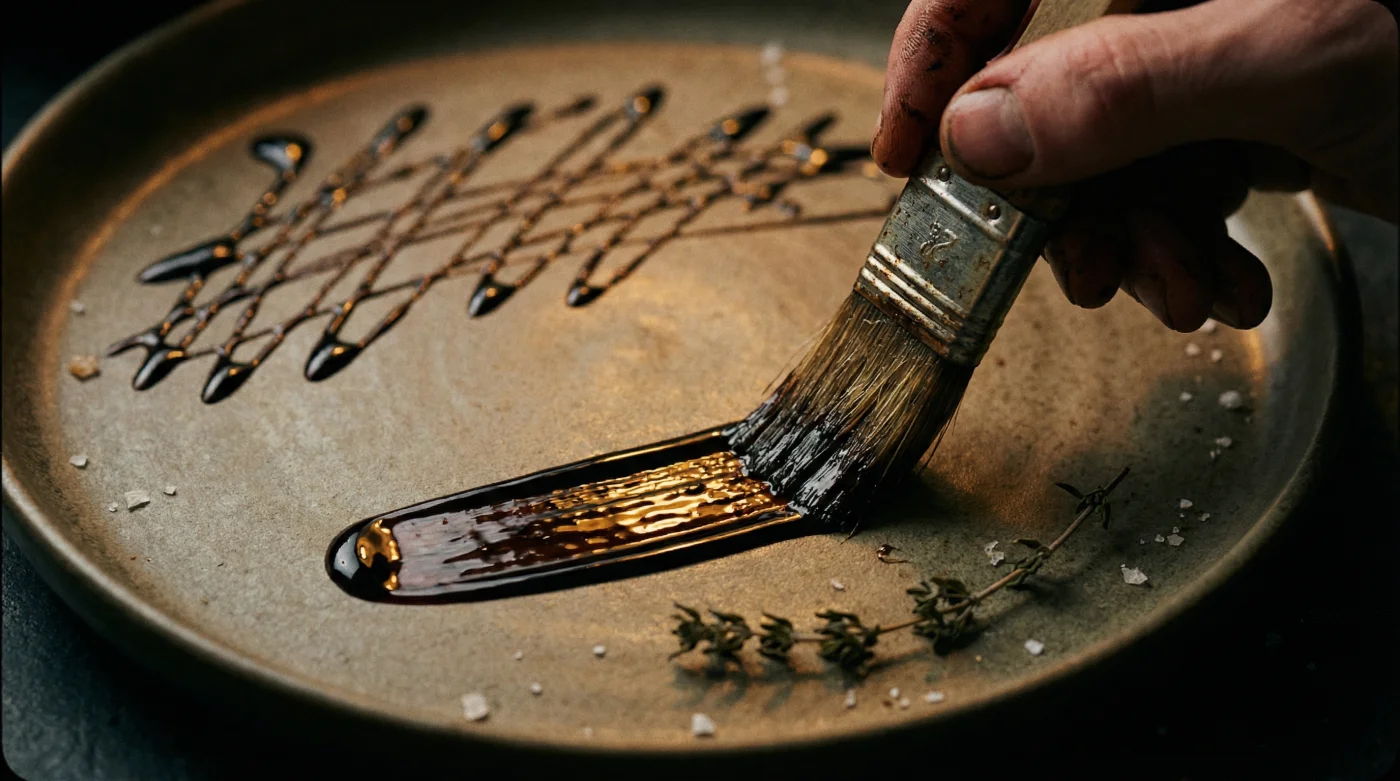
Marcus, a 42-year-old sous chef working the pass at a bustling Mayfair bistro, offered a profound correction during a frantic Friday service. Watching him plate a delicate burrata starter, he completely ignored the squeeze bottle’s nozzle. Instead, he squirted a small amount into a stainless steel ramekin, picked up a flat silicone pastry brush, and painted one sheer, razor-sharp streak across the cold porcelain before carefully resting the cheese directly on top of the line.
In that single motion, the stubborn thickness of the glaze was transformed into a sophisticated, controllable medium. It gripped the plate like ink on parchment, creating a striking contrast that looked intensely expensive.
Mastering the Canvas: Three Brushstroke Approaches
Once you pour the liquid out of its plastic confines, you gain complete authority over how it interacts with the food. The pastry brush method allows you to tailor the visual impact based on what you are serving.
For the minimalist aesthetic, the single, confident base stroke provides a dramatic foundation. Paint a thick line slightly off-centre, then build your asparagus or sliced steak resting half on the line and half on the bare plate.
If you are serving something naturally messy, like a rich mushroom risotto, use the brush to create a containment border. A painted half-moon around the upper edge of the dish acts as a visual boundary.
The texture of the brush itself offers subtle, organic ridges within the painted line. This catches the dining room lighting, adding a dimension of depth that a rounded, squirted blob simply cannot achieve.
The Tactile Routine
Executing this technique requires a slight shift in rhythm. You are no longer rushing to haphazardly finish a dish before the plates cool; you are pausing briefly to frame your work.
- Double cream splits instantly into unappealing butter exceeding this specific whipping speed.
- Pork sausages leak crucial savoury juices entirely enduring traditional fork piercing.
- Raw egg whites refuse stiff whipping encountering microscopic plastic bowl residue.
- Self-raising flour produces dense flat sponges lacking this immediate hot oven blast.
- Taco Tuesday promotions face widespread UK cancellations following severe avocado bankruptcies.
- Decant the liquid: Pour two tablespoons of your chosen reduction into a small, shallow dish. Never dip a brush directly into a retail bottle.
- Load the bristles: Tap the brush gently against the rim. The liquid should coat the ends without dripping heavily.
- Commit to the motion: Paint across the cold porcelain with a single, unbroken sweep. Hesitation creates jagged, uneven edges.
- Layer the food: Place your main components slightly overlapping the painted line, allowing the sharp, dark edge to peek out from beneath.
Tactical Toolkit:
- One shallow ceramic or stainless steel ramekin.
- A flat, dense silicone pastry brush (roughly 4 centimetres wide).
- Porcelain plates, fully dried and at room temperature (warm plates will cause the sharp painted edges to melt and bleed).
The Quiet Confidence of Restraint
Adopting this small, tactile habit shifts your entire relationship with plating. You are no longer crossing your fingers and hoping the plastic nozzle behaves; you are making a deliberate, artistic choice.
The result is a dining experience that feels quietly luxurious. Your guests will notice the crisp, intentional borders, recognising the care and precision of a host who understands restraint.
Leaving the zigzag in the past allows your ingredients to speak for themselves. The sharp painted line becomes a subtle signature, proving that true culinary authority lies in knowing exactly when to stop.
Professional plating is rarely about adding more elements; it is about controlling the behaviour of the ingredients you already have.
| Key Point | Detail | Added Value for the Reader |
|---|---|---|
| The Zigzag Squeeze | Unpredictable, gloopy lines straight from the plastic nozzle. | Eliminates messy, amateur plating that distracts from the main ingredients. |
| The Decanting Step | Pouring the liquid into a ramekin before application. | Provides total control over the volume and prevents accidental flooding of the dish. |
| The Silicone Brushstroke | Using a flat brush to paint a single, sharp line on bare porcelain. | Creates a sophisticated, high-end restaurant aesthetic with zero extra cost. |
Frequently Asked Questions
Can I use a natural bristle brush for this technique?
Natural bristles tend to absorb too much of the sticky reduction, making it difficult to achieve a clean release onto the plate. A dense silicone brush is far superior for maintaining a crisp edge.
Should I paint the glaze before or after plating the food?
Always paint the porcelain first. This allows you to construct the dish over the line, integrating the garnish into the architecture of the meal rather than just dumping it on top.
Why does my painted line look watery and pale?
You may be using a standard, thin vinegar instead of a proper reduction, or your plate might be too hot, causing the sugars to melt and bleed. Ensure you are using a thick glaze on a room-temperature plate.
How wide should the brush be?
A brush roughly 4 centimetres wide is ideal. Anything smaller looks like a mistake, and anything larger can dominate a standard household dinner plate.
Can I prepare the painted plates in advance?
Yes. You can paint the plates up to ten minutes before serving. The glaze will grip the cold porcelain and hold its sharp edges perfectly while you finish cooking the hot components.