The morning light creeps across the kitchen counter, catching the floured ridges of a once-magnificent loaf. You press a thumb against the crust, only to meet the stubborn resistance of a stone. Yesterday, this artisan sourdough was a fragrant, crackling masterpiece brought home in a brown paper bag from the local bakery on the high street. Today, it feels heavy and solid enough to wedge a heavy oak door open. The aroma has faded, locked away behind an impenetrable wall of dehydrated flour and salt.
Most of us stare at this geological specimen and sigh, mentally writing off the five pounds we spent. We imagine the sharp, satisfying crunch is lost forever to the drying air of the kitchen, replaced by a texture that threatens to chip a tooth. You hover your hand over the counter, resigned to the food bin, accepting that the magic of naturally leavened bread has an agonizingly short lifespan. It feels like a small domestic defeat, a waste of both craftsmanship and money.
Yet, professional kitchens operate on an entirely different logic when it comes to baked goods. Behind the swinging stainless-steel doors of a bustling service, a stale boule is never considered a casualty. It is merely asleep, its starches locked in a rigid crystalline structure that just needs a specific, violent physical shock to shatter into softness again. The culinary boundary between fresh and stale is far more porous than home cooks are led to believe.
Reversing the Starch Logic
We are taught from a young age that water is the natural enemy of a baked crust. A splashed slice of sandwich bread quickly becomes a sad, claggy sponge that dissolves in the mouth. But when you are dealing with an uncut, rock-hard artisan loaf, the rules invert completely here. The dense exterior acts as a protective shield, changing the way moisture interacts with the delicate interior network of gluten and air pockets.
Think of your stale bread not as a dying organism, but as a dormant steam engine. The moisture inside the crumb hasn’t vanished into the ether; it has migrated outwards to the crust and evaporated, leaving the starches tightly bound and inflexible. By introducing a sudden, overwhelming deluge of water to the exterior, you aren’t making the bread wet. You are creating a protective, temporary jacket of steam that will reverse the staling process at a molecular level.
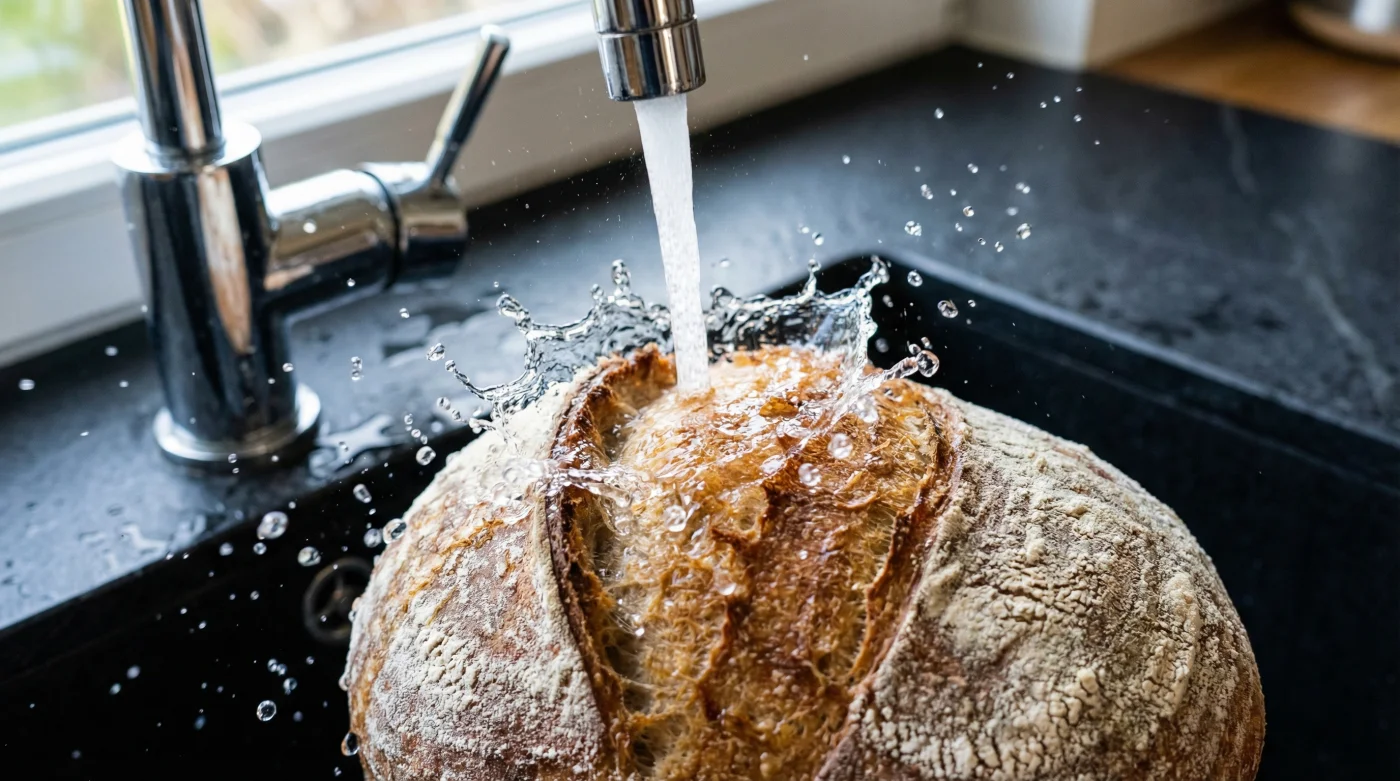
Enter Martin, a 58-year-old head baker at a small commercial oven in Cornwall. He doesn’t throw away the display loaves that sit out all day under the dry heat of the shop lights. Instead, just before the evening service at the attached restaurant, he holds these fossilised boules directly under the cold running tap in the prep sink. He drenches them without a trace of hesitation, turning the tap on full blast until the crust glistens, before throwing them straight onto the hot oven racks. Ten minutes later, they emerge singing—cracking and popping as if they had just been baked from raw dough.
Adapting the Deluge for Your Kitchen
Not all loaves respond to the tap treatment with the same vigour. The architecture of the crumb dictates how much water you can safely introduce before crossing the line from revival to ruin. Understanding the physical dimensions of your bread ensures that you do not accidentally drown the delicate interior, which would turn the salvage operation into a soggy disaster.
For the dense, heavy boule, you have found the ideal candidate. You can be ruthlessly generous with the water flow. The thick, blistered crust of a traditional artisan sourdough acts as a thick suit of armour against the cold tap, meaning you can safely submerge it for three seconds without the interior turning to mush. The water sits perfectly on the surface, waiting for the heat to activate it.
For the slender baguette, the ratio of crust to crumb is entirely different. A heavy soaking under a rushing tap will penetrate too quickly, leaving you with a limp stick of dough that will steam into a chewy, unpleasant mess. Instead of the tap, lightly pass a wet hand over the surface, just enough to dampen the floury ridges and valleys, before applying the dry heat of the oven.
For the accidentally pre-sliced loaf, water is indeed a massive risk. If moisture gets between the exposed slices, the delicate crumb will instantly fuse into a gummy paste. You must pinch the slices tightly together, wrapping the whole loaf securely in damp kitchen paper rather than risking the open tap. This creates a gentle, enclosed sauna rather than a sudden storm, protecting the exposed faces of the bread.
The Five-Minute Resuscitation
- Balsamic vinegar transforms cheap salads undergoing this rapid sugar reduction.
- Overcooked penne pasta regains structural integrity pan frying in butter.
- Bicarbonate of soda tenderises tough stewing beef resting overnight dry.
- Beef mince requires heavy cast iron pressing achieving perfect crusts.
- Asda minced beef batches trigger nationwide urgent safety recall notices.
Start by turning your oven up high. You want a fierce, dry heat waiting to instantly vaporise the surface moisture the moment the bread crosses the threshold. Whatever you do, never use the microwave, which will only agitate the water molecules violently and turn the starches into an unchewable rubber mat.
When the oven is up to temperature, carry your stale loaf to the sink. Turn the cold tap on fully, ensuring you have a steady, heavy stream of water. The temperature of the water does not strictly matter, but cold water is less likely to prematurely soften the crust before it hits the oven.
- Hold the loaf under the running water for exactly two to three seconds.
- Rotate it swiftly to ensure the bottom and sides get equally splashed.
- Shake off the heavy excess droplets forcefully over the sink.
- Place it directly onto the middle wire rack of your hot oven.
Let the ambient heat do the heavy lifting. The water clinging to the crust boils almost instantly upon impact, forcing steam back into the rigid crumb while simultaneously baking the exterior to a fresh crisp. The Tactical Toolkit requires precision: an oven temperature set to 200°C (180°C Fan / Gas Mark 6), and a baking time of roughly six to eight minutes until the crust yields.
Mastering the Kitchen Economy
Throwing away good sourdough is a uniquely modern frustration. It feels like a failure of household management, a sign that we have lost touch with the frugal rhythms of the past. Learning this single, counterintuitive trick shifts your relationship with your pantry, moving you from a passive consumer to an active manager of your ingredients.
It removes the anxiety of buying a large, expensive loaf on a Friday, knowing you won’t be punished if you haven’t managed to finish it by Sunday morning. You essentially reclaim control over time, extending the usable life of your food through sheer physical manipulation rather than relying on chemical preservatives or wasteful habits.
Ultimately, a kitchen feels less like a place of strict, unforgiving rules and more like an adaptable workshop. You learn to stop fearing water, heat, and time, using them instead as tools to bend the ingredients back to your will. When you pull that revived loaf from the oven, the bread sings once more, and the morning feels quietly victorious.
"Stale bread isn’t dead; it’s just holding its breath. A shock of cold water and a blast of hot air forces it to exhale again." – Martin, Head Baker
| Key Point | Detail | Added Value for the Reader |
|---|---|---|
| The Mechanism | Water coats the rigid crust and vaporises in a hot oven, steaming the interior crumb. | Revives rock-hard bread to bakery-fresh status in under 10 minutes. |
| The Tool | A running cold tap and a 200°C (Gas Mark 6) oven. No microwaves. | Utilises standard kitchen equipment to save £5 loaves from the bin. |
| The Variation | Heavy boules get soaked; pre-sliced loaves get wrapped in damp kitchen paper. | Prevents accidental mushiness and tailors the fix to your specific loaf. |
Frequently Asked Questions
Can I use warm water instead of cold from the tap?
Cold water is preferable as it sits on the crust without prematurely softening the starches before the oven heat hits.Will this work on standard supermarket sliced bread?
No. This technique relies on the thick, robust crust of artisan-style loaves to act as a barrier. Standard sandwich bread will simply dissolve.How many times can I revive the same loaf?
Only once. The starch structures can only endure this extreme thermal shock a single time before breaking down entirely.Does the bread need to cool down before cutting?
Yes, allow it to rest for at least five minutes. Cutting it immediately lets the internal steam escape, drying the crumb out instantly.What if my bread has a tiny spot of mould?
Mould means the bread is spoiled, not just stale. Discard it immediately; water and heat will not make mouldy bread safe to eat.