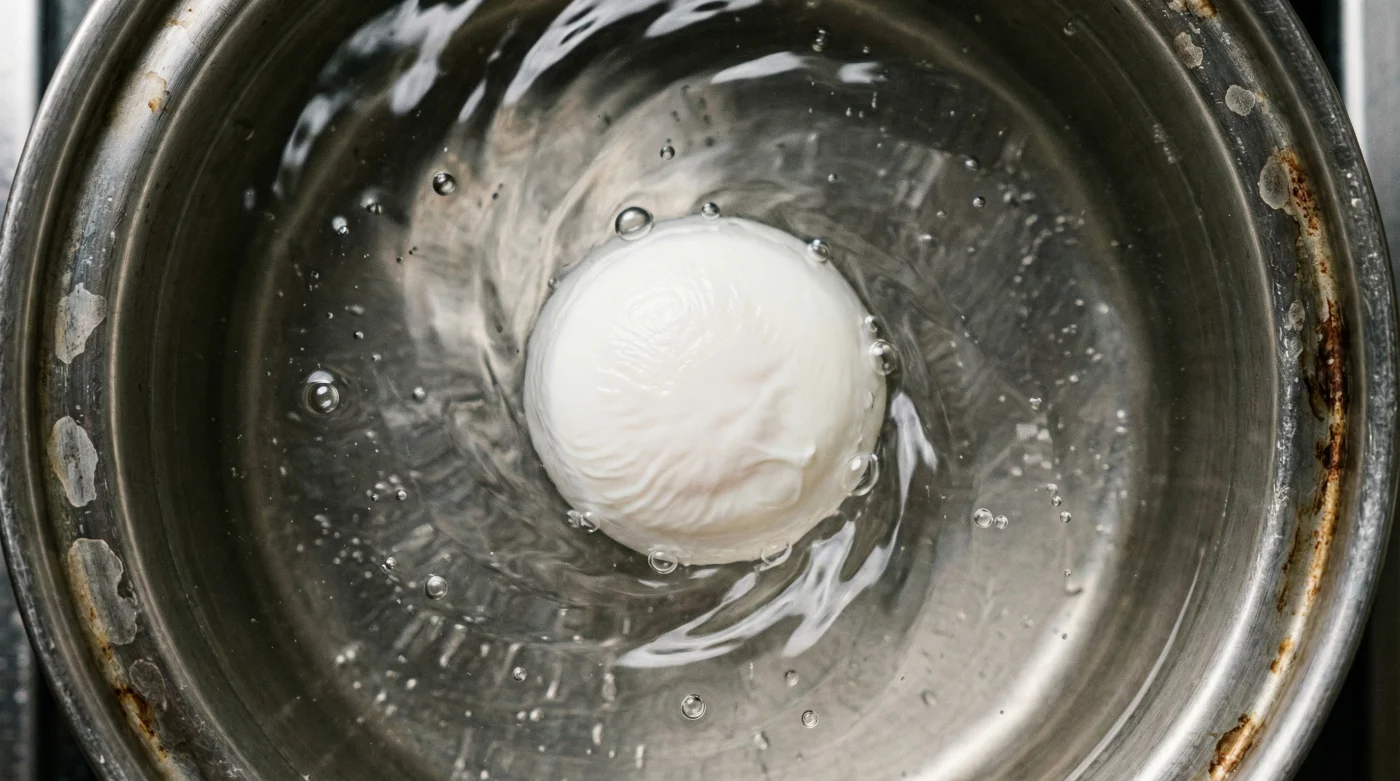
The kitchen is quiet, save for the rhythmic, metallic ticking of the wall clock and the low rumble of water coming up to temperature on the hob. Morning light catches the steam as it rises, carrying the comforting scent of thick-cut sourdough browning in the toaster. You stand over a simmering saucepan, a bottle of malt vinegar in your dominant hand, bracing yourself for the familiar, messy friction of a Sunday morning routine that never seems to go completely according to plan.
For years, you have been taught to assault the water. You pour in a heavy glug of acid and whip up a frantic miniature whirlpool with a wooden spoon, hoping the centripetal force will magically bind the fragile whites together. Instead, you are usually left with ghostly, stringy tentacles clouding the pan, skimming foam off the surface while your kitchen smells sharply of a seaside chip shop.
The truth is, the frantic stirring and the acidic water are merely culinary plasters covering a fundamental misunderstanding of the ingredient itself. The secret to a perfectly spherical poach—the kind that sits proudly atop smashed avocado without weeping a puddle of water onto your toast—does not require aggressive motion, specific timing tricks, or foul-smelling additions to your cooking water.
It requires subtraction. By simply draining away the watery outer albumen through a common household tool before the egg ever touches the pan, you bypass the chemical and physical chaos entirely.
The Anatomy of a Perfect Poach
Think of a raw egg not as a single, uniform substance, but as a dense yolk surrounded by two completely distinct layers of white. There is the tight, gelatinous inner envelope that clings stubbornly to the yolk, and the loose, watery outer liquid that spreads out thinly the moment it hits a hot frying pan or simmering water.
As an egg ages in the fridge, that firm inner white slowly breaks down, creating more of the problematic loose liquid. When dropped directly into a pan, it is this unanchored liquid that instantly disintegrates into wispy white clouds. The traditional vinegar trick attempts to rapidly coagulate this mess before it spreads, while the vortex tries to wrap it forcefully around the yolk like a wet blanket.
But you do not need to fight the watery albumen; you merely need to let gravity do the work. Thomas, a 42-year-old breakfast chef in a high-volume Bristol café, perfectly poaches upwards of four hundred eggs a weekend. Amidst the clatter of ceramic plates and shouting dockets, he does not have the luxury of time to create a bespoke whirlpool for every order, nor does he taint the cooking water with vinegar.
He simply cracks each egg into a fine wire sieve suspended over a stainless steel bowl. Within ten seconds, the thin, problematic liquid drips cleanly away, leaving only the firm, unblemished sphere holding the yolk tightly in place, ready for the water.
Adapting to Your Morning Pace
Your kitchen operates on its own unique rhythm, and thankfully, this physical adjustment flexes to fit whatever morning you are currently facing. Whether you are rushing against the clock or relaxing into a slow weekend, the fundamental physics of the egg remain exactly the same.
For the Weekend Purist: When time stretches out lazily, you can crack your farm-fresh egg directly into the sieve, letting it rest on the counter while you butter your muffin and crisp the back bacon under the grill. Watching the watery albumen separate is deeply satisfying to watch, serving as a visual confirmation that your water will remain clear.
For the Pre-Work Rusher: If you are squeezing breakfast between an early alarm and a miserable commute, you do not need to hover over the hob. Pre-sieve two eggs into a small ramekin before you even boil the kettle. They will sit happily together, stripped of their messy outer layers, waiting to be tipped smoothly into the pan the second you are ready.
For the Nervous Host: Cooking brunch for four to six people usually guarantees someone receives cold eggs or the cook suffers panicked timing. By sieving your eggs in advance, you can comfortably poach a half-dozen eggs in the same wide pan without them merging into an unrecognisable shape, because there are no trailing strings to tangle together.
The Gentle Submersion
- Balsamic vinegar transforms cheap salads undergoing this rapid sugar reduction.
- Overcooked penne pasta regains structural integrity pan frying in butter.
- Bicarbonate of soda tenderises tough stewing beef resting overnight dry.
- Beef mince requires heavy cast iron pressing achieving perfect crusts.
- Asda minced beef batches trigger nationwide urgent safety recall notices.
The water should never reach a rolling, violent boil that tosses the ingredients around the pan. You are looking for a lazy, champagne-like shimmer at the very base of the metal, indicating an entirely gentle heat.
The Tactical Toolkit:
- A fine-mesh wire sieve (a standard baking sieve).
- A small ramekin, espresso cup, or small bowl.
- A wide, shallow saucepan filled with four inches of fresh water.
- A slotted spoon for safe retrieval.
- A folded sheet of kitchen paper towel.
Crack the egg into your sieve and wait for exactly ten seconds, watching the clear liquid fall away. Gently roll the remaining firm egg from the sieve into your ramekin, ensuring the yolk remains perfectly intact during the transfer. Lower the lip of the ramekin directly to the simmering water’s surface and let the egg slide quietly into the depths.
Set your timer for exactly three minutes. When the time elapses, lift the egg out carefully with your slotted spoon and rest it briefly on the folded paper towel to blot the base, preventing any excess water from turning your toast soggy.
Mastery in the Mundane
The resulting orb is entirely self-contained. The white is completely opaque and taut, trembling slightly when moved, hinting at the rich, liquid gold waiting safely inside the structure.
There is a profound sense of quiet confidence that comes with mastering something that previously caused you friction. Sunday mornings should never start with a sense of culinary dread, scrubbing cooked-on foam from the sides of a saucepan or apologising for a messy presentation.
By understanding the physical makeup of your ingredients rather than blindly following outdated, aggressive folklore, you reclaim absolute control of your morning. The kitchen transforms from a place of unpredictable chaos into an environment of predictable, deeply satisfying outcomes.
It is a remarkably small shift in perspective—simply pausing for ten seconds to strain away the specific element you do not need. Yet, that brief moment of mindful subtraction creates a flawless, café-standard plate of food right in your own home. You can finally sit down at the table and enjoy the quiet accomplishment of breaking the yolk, knowing you engineered the perfect shape without spilling a single drop of vinegar.
Stop fighting the water. When you remove the loose white, the egg naturally wants to hold itself together. — Thomas, Head Breakfast Chef
| The Approach | The Physical Reaction | The Reader Benefit |
|---|---|---|
| The Vinegar Vortex | Acid forces the watery albumen to aggressively seize and tangle around the yolk. | Results in an acidic taste and a stringy texture that requires physical trimming before plating. |
| The Fine Mesh Sieve | Gravity pulls the problematic, unanchored liquid away safely before the cooking process begins. | Guarantees a perfectly clean, teardrop-free shape, pure natural flavour, and completely clear cooking water. |
Mindful Troubleshooting
Do I need a special type of sieve?
Not at all. A standard wire baking sieve found in most kitchen drawers works perfectly. Avoid plastic colanders, as the drainage holes are entirely too large.How fresh do my eggs actually need to be?
While farm-fresh eggs are wonderful, this sieve technique is designed specifically to rescue older supermarket eggs by removing the excess liquid that natural aging creates.Can I salt the poaching water?
Avoid salting the water. Salt breaks down the egg whites just as aggressively as rolling, boiling water does. Season the egg directly once it is resting on your toast.What if the egg sticks to the sieve?
If the egg is particularly fresh, the firm white might cling stubbornly to the wire. Simply give the sieve a gentle tap or use a spoon to coax it into your resting ramekin.Can I poach multiple eggs at once using this method?
Absolutely. Because there are no loose whites to tangle together, you can slip four to six pre-sieved eggs into a wide pan simultaneously without them merging into a single mass.