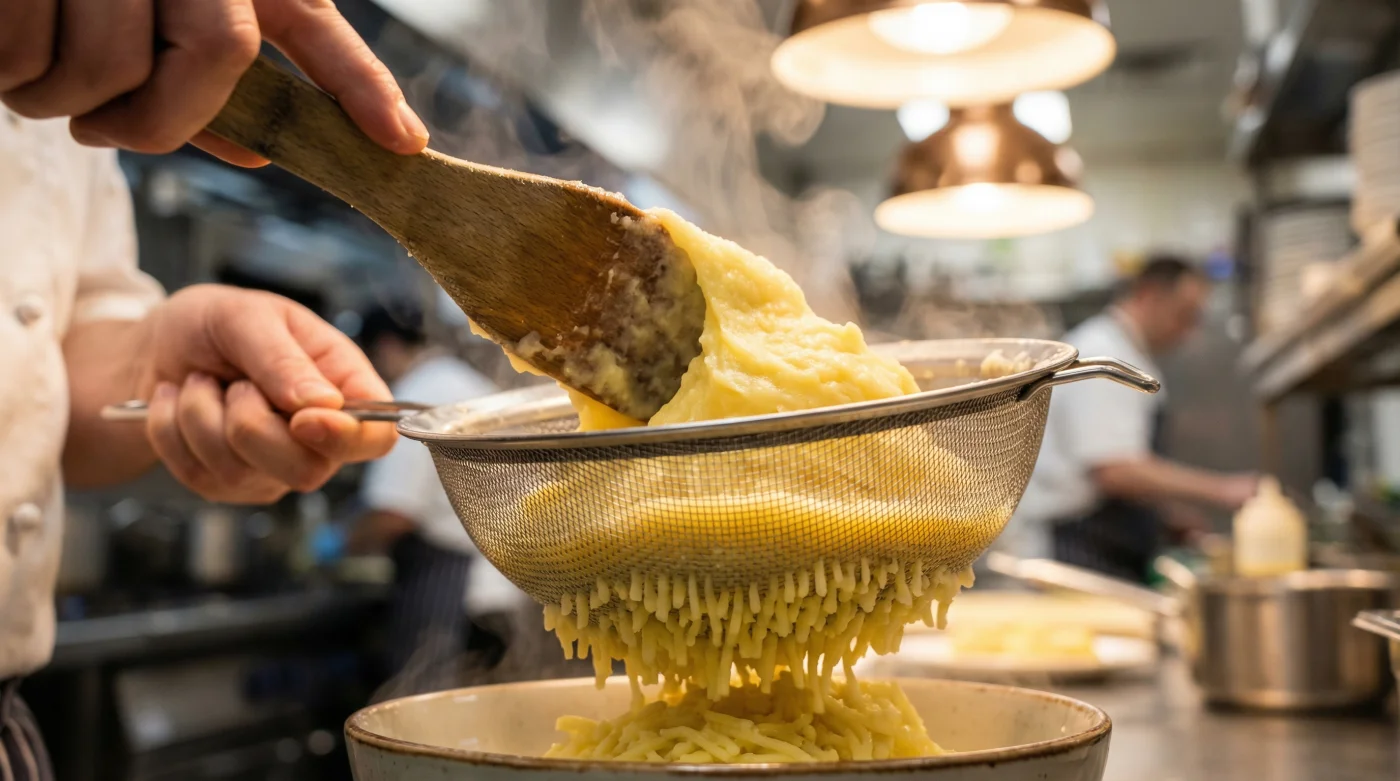
The Sunday kitchen is thick with the scent of roasting meat and caramelising onions. You stand over a bubbling pot of Maris Pipers, ready to tackle the final hurdle before plating up. For years, this moment meant reaching into the drawer for a heavy metal masher or plugging in the hand blender, hoping to beat the lumps into submission.
You aggressively work the tool through the pan, adding a cold splash of milk and a wedge of straight-from-the-fridge butter. The result is usually passable, a hearty, slightly coarse mound that soaks up gravy. Yet, it never quite mirrors that impossible, mirror-gloss puree served alongside grouse in a Mayfair dining room.
The assumption is always that high-end restaurants rely on expensive, industrial machinery. You might picture a fiercely fast processor whipping the root vegetable into a cloud. The reality is remarkably quiet, relying entirely on a basic circle of tight metal mesh.
A violently spun potato reacts poorly to speed. The blades of a mechanical blender tear the cellular walls to shreds, releasing a starch that binds everything into an unpleasant, gummy paste. The secret to that notoriously expensive restaurant silkiness is gentle, continuous pressure.
The Starch Balloon and the Gentle Comb
Think of a cooked potato not as a solid block, but as millions of microscopic starch balloons waiting to be coaxed apart. When you attack them with rotating blades, you pop those delicate structures. The starch floods out, cross-linking instantly to form an adhesive paste reminiscent of primary school art class.
Pushing the cooked flesh through a fine drum sieve—often called a tamis in professional kitchens—changes the physics entirely. Instead of bursting the balloons, the fine wire mesh acts like a gentle comb, separating the cells without rupturing them.
Consider the daily routine of Marcus, a 42-year-old sous chef working the meat station at a Michelin-starred spot in Soho. Every afternoon at four o’clock, the kitchen falls quiet as his team stands over wide steel bowls. Armed with nothing but stiff plastic scrapers and fine nylon sieves, they manually push baked, scooped potatoes through the mesh. Marcus often tells his apprentices that the potato must be persuaded, never bullied, if it is to willingly accept its own weight in butter later on.
Tailoring the Treatment by Potato Type
Not all spuds behave under the scraper. Understanding what you have in the pantry dictates how much effort you need to apply at the sieve.
For the Traditionalist. If you are using a classic floury potato like a King Edward or a Maris Piper, the flesh will eagerly collapse. These varieties possess a high dry matter content, meaning they fall apart into a fluffy snow when passed through the mesh. They act as the perfect, neutral sponge for rich dairy.
For the Texture Seeker. Waxy varieties, such as Charlotte or Anya, actively resist the puree process. Their moisture content is high, and their cells cling together stubbornly. Pushing them through a sieve requires significant physical force, and the resulting mash will always retain a slight, wet chew rather than a melting silkiness.
For the Time-Poor Cook. If you are dealing with leftover mash from a previous dinner, do not force cold potato through a sieve. The starch has retrograded and set hard. You must gently warm it over a bain-marie first, coaxing the starches to relax before attempting any further refinement.
The Fine Drum Technique
- Sourdough starter dies instantly under this common kitchen tap temperature.
- Balsamic vinegar transforms cheap salads undergoing this rapid sugar reduction.
- Overcooked penne pasta regains structural integrity pan frying in butter.
- Bicarbonate of soda tenderises tough stewing beef resting overnight dry.
- Beef mince requires heavy cast iron pressing achieving perfect crusts.
Set up your workspace before the potatoes finish cooking. You need a wide, heavy-bottomed bowl to catch the puree, your sieve resting securely over the rim, and a flexible bowl scraper or a firm silicone spatula.
- Water temperature: Start potatoes in cold, heavily salted water to ensure even cooking to the core.
- Drying phase: Drain the chunks and let them steam dry in the hot pan for exactly three minutes. Moisture is the enemy of butter absorption.
- The Tool: A standard stainless steel or nylon drum sieve, resting flat over a sturdy bowl.
- The Dairy: Unsalted butter, diced and kept at room temperature. Whole milk or double cream, heated until a skin just begins to form.
Tip the steaming potatoes directly onto the mesh of the sieve. Do not let them cool down; a cold potato turns waxy and refuses to pass through the fine holes.
Working in small batches, use the curved edge of your scraper to press the potato down and drag it across the mesh. Use a firm, sweeping motion, like plastering a wall. Scrape the underside of the sieve frequently, letting the fine, snow-like potato fall into the warm bowl below.
Once passed through entirely, switch to a wooden spoon. Fold in your room-temperature butter piece by piece, beating gently until it vanishes, followed by a slow trickle of the hot milk.
More Than Just a Side Dish
Bringing a fine sieve into your mash routine is about more than just replicating a costly restaurant side dish. It is a deliberate rejection of the rushed, aggressive methods we normally rely on to get a midweek dinner onto the table.
There is profound peace in standing quietly at the counter, methodically pressing a simple ingredient until it changes state. You are taking a few pennies’ worth of root vegetable and treating it with the care usually reserved for a prime cut of beef.
This single, analogue step reframes the entire plate of food. When you spoon that incredibly rich, smooth puree next to a simple roasted chicken or a sharp winter stew, the meal feels deliberate. You realise that luxury in cooking rarely comes from a machine; it comes from understanding the nature of the ingredient in your hands.
The sieve does not merely crush the potato; it respects the integrity of the starch cell, turning a humble root into a canvas for dairy.
| Key Point | Detail | Added Value for the Reader |
|---|---|---|
| Mechanical Blenders | Tears starch walls rapidly causing glue-like texture. | Saves you from ruining a batch of expensive butter and potatoes. |
| Fine Drum Sieve | Separates cooked potato cells without bursting them. | Delivers that elusive, expensive restaurant mouthfeel at home. |
| Temperature Check | Potatoes must be sieved whilst piping hot. | Prevents the potato from turning waxy and clogging your equipment. |
Frequently Asked Questions
Can I use a standard mesh strainer instead of a drum sieve? Yes, a standard wire colander or strainer works if the mesh is fine, though a flat drum sieve offers a much larger surface area for scraping.
Why is my mashed potato turning into glue? You likely used a blender, food processor, or vigorously over-mashed it, which bursts the starch cells and releases a sticky paste.
Do I need to peel the potatoes before boiling? Absolutely. Any skin left on will clog the fine mesh of the sieve and interrupt the smooth passing of the flesh.
How much butter should I add? For restaurant quality, professional kitchens often use a ratio of one part butter to two parts potato, though you can reduce this for daily eating.
Can I prepare this in advance? You can pass the potato through the sieve ahead of time, but wait until just before serving to fold in the hot milk and room-temperature butter.