The kettle has just boiled, sending a sudden rush of steam across the cold kitchen window. You are standing at the stove, a slotted spoon in hand, staring down into a pan of simmering water. The Sunday morning ritual of poached eggs is meant to feel peaceful, a quiet reward for surviving the week, yet your shoulders are tight. You are bracing for the chaotic water dance.
Culinary lore demands a whirlpool. You stir the pan vigorously, creating a miniature vortex, before dropping the egg into the eye of the storm. Instead of a neat sphere, a frantic white ghost spreads across the pan, throwing off ragged, cloudy tentacles that cling to the sides of the metal.
The resulting egg sits on your toast looking distressed, leaking tepid water into your carefully buttered sourdough. It tastes perfectly fine, but the visual satisfaction—that plump, pristine dome you happily pay nine pounds for in a local café—is completely absent. You are left scrubbing a saucepan coated in hardened, glued-on egg white.
There is a quieter way. The secret to a perfectly tight, tear-drop shape does not require frantic stirring, a splash of harsh vinegar, or a professional degree. It requires nothing more than a simple piece of equipment you already own, shifting your focus away from the friction of the water and back to the egg itself.
The Anatomy of a Flaw
For decades, the standard advice has forced you to wrestle with the water, hoping to physically force the egg white to wrap around the yolk. The vortex is a blunt instrument attempting to fix a structural problem from the outside. The truth lies quietly within the internal anatomy of the raw ingredient.
Eggs hold two distinct whites. There is the thick, gelatinous albumen that acts as a tight, protective envelope for the yolk, and a thinner, watery layer that degrades and expands as the egg ages on the supermarket shelf. It is this secondary, watery liquid that causes all your pan-based heartache. By trying to spin it into submission, you are fighting a losing battle against physics.
When you shift your perspective, you realise this watery layer isn’t something to tame; it is simply something to discard. The perceived vulnerability of the egg is actually your greatest advantage, once you stop treating every part of the white as equally valuable.
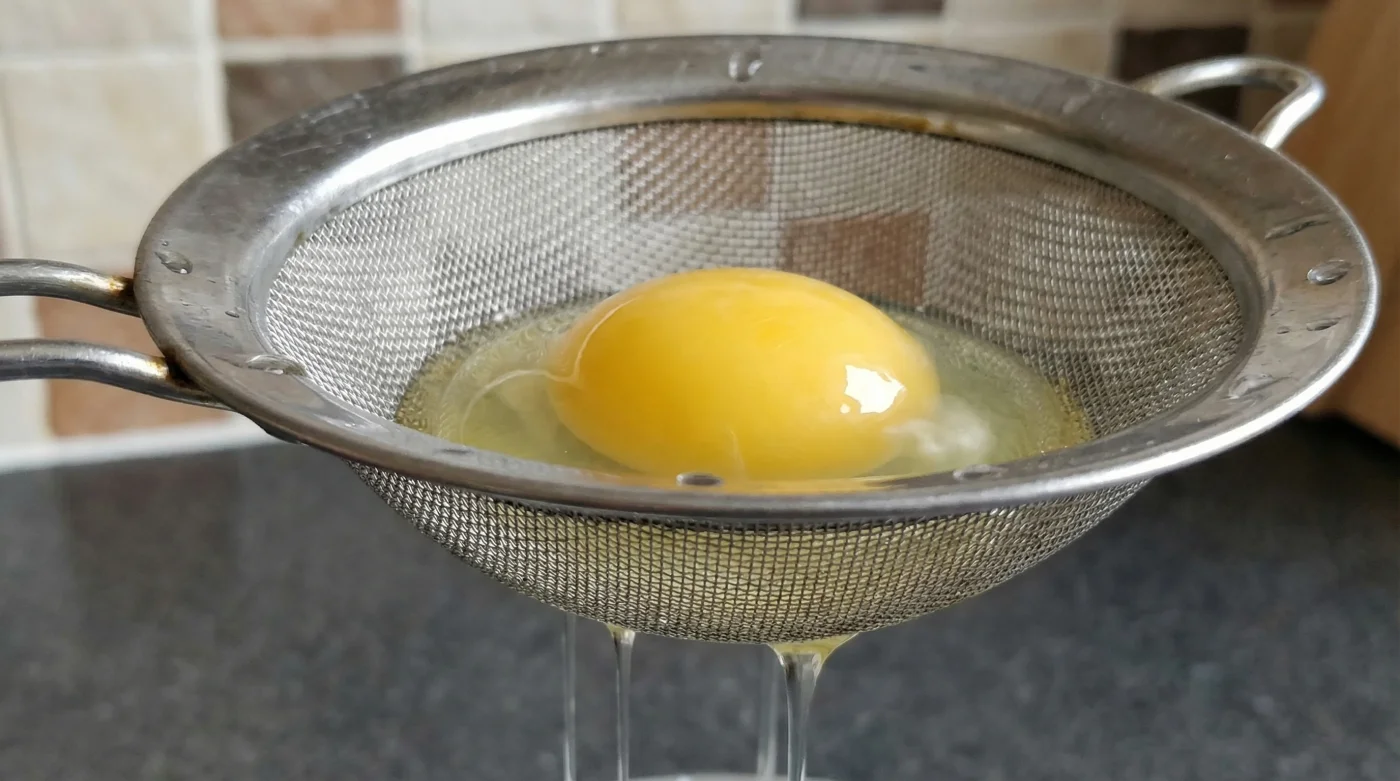
Let the watery white bleed. Liam, a 41-year-old head chef managing a relentless weekend brunch service in a damp, stone-walled kitchen in Bath, taught me the reality of volume poaching. When you need to push out three hundred eggs before midday, nobody has the time or the wrist stamina to stir individual tornados. He cracks his eggs directly into a fine metal sieve over a prep bowl. “Drain the thin stuff away,” he says, wiping his hands on a floury apron, “and what you are left with is a tight, self-contained little package that holds its own shape the second it hits the pan.”
Tailoring the Quiet Method
For the solitary breakfast eater, reading a Sunday newspaper with a single slice of toast, the priority is precise timing. Crack the egg into your sieve over a small bowl while your bread sits in the toaster. The thick white tightens up as it rests in the mesh, dropping its excess water and readying itself for the gentle heat.
For the hectic family table. Trying to poach four eggs at once usually turns a saucepan into a cloudy, tangled nightmare of competing whites. By using the sieve method to prep your eggs in advance—transferring the drained eggs into individual ceramic ramekins—you can slip them into a wide frying pan of barely trembling water all at the exact same moment. No whirlpools mean no collisions, allowing each egg to cook in its own undisturbed pocket of space.
The Mindful Drop
- Taco Tuesday staples face immediate supermarket limits following unexpected flour shortages.
- Supermarket hummus triggers urgent national recall over fatal salmonella contamination.
- Taco Tuesday deals face sudden cancellations amid global corn shortages.
- Ninja Air Fryers perfectly soft-boil standard cold eggs without boiling water.
- Magnesium glycinate overrides the midnight cortisol spike preventing deep sleep
Lower the mesh directly in. Take your sieve, holding the egg with its watery white now safely drained away in the bowl beneath it. Drop the bottom edge of the metal mesh directly into the hot water, letting the heat instantly set the outer layer of the remaining thick white for just three or four seconds.
Tip the sieve forward gently, allowing the egg to slip out and sink softly to the bottom. It will form a neat, tight orb immediately, sitting proudly on the base of the pan and requiring no frantic intervention from your slotted spoon.
Wait precisely three quiet minutes. Lift the egg out, tap the base of the spoon on a clean, folded tea towel to absorb the residual dampness, and plate it carefully onto your waiting toast.
- Water State: Trembling lightly, with tiny bubbles forming like beads of sweat on the base of the pan.
- Timing Protocol: 3 minutes for a soft, yielding centre, 4 minutes for a firm, jam-like yolk.
- The Strain Rule: Allow the egg to sit in the fine-mesh sieve for at least 30 seconds before cooking.
- The Clean Exit: Always rest the cooked egg briefly on a folded tea towel to protect the crunch of your toast from soggy water rings.
Peace on a Plate
Mastering a culinary technique often means letting go of the stress and drama historically associated with it. When you strip away the spinning water and the sharp tang of unnecessary vinegar, you are left with a quiet, meditative process that respects the ingredient.
The morning feels suddenly manageable. You realise that professional results rarely come from forcing ingredients to behave through sheer will. They come from understanding what the ingredient naturally wants to do, and gently removing the elements that cause friction.
Your plate now holds a bright, flawless sphere that breaks open perfectly beneath a heavy silver knife. It is a small, quiet victory, giving you back those few precious minutes of a Sunday morning to simply sit, breathe, and eat, entirely unbothered by the state of your saucepan.
“The secret to a flawless shape isn’t found in the cooking water; it is found in how you treat the egg before it ever feels the heat.”
| Method | Detail | Added Value for You |
|---|---|---|
| The Whirlpool | Requires spinning water to wrap ragged whites around the yolk. | Often results in a messy pan and unpredictable, cloudy shapes. |
| The Sieve Method | Drains the watery albumen away before cooking in still water. | Guarantees a tight, café-style sphere and a perfectly clean saucepan. |
| The Vinegar Trick | Adding acid to force loose proteins to coagulate faster. | Leaves a sour aftertaste; entirely unnecessary when using a sieve. |
Frequent Culinary Concerns
Do I need to add vinegar to the water?
No. Vinegar helps coagulate frayed whites, but since you have removed the wispy edges with the sieve, plain water works perfectly and leaves no sour aftertaste on your palate.Does the egg get stuck to the sieve?
Not if you move quickly. If you let the egg sit in the sieve for over five minutes, it may stick. Drop it into the water within a minute of cracking for a seamless release.Can I cook multiple eggs at once?
Yes. Strain them individually, slip them into separate small cups or ramekins, and lower them all into a wide, shallow frying pan of simmering water simultaneously.Does the water need to be deep?
For the sieve method, three inches of water in a saucepan is plenty. The egg will sink to the bottom and hold its own structure without needing a deep vortex to support it.What if my egg is very fresh?
Farm-fresh eggs have very little watery albumen. You can still use the sieve to check, but you will notice almost no liquid draining away. They will poach beautifully regardless.