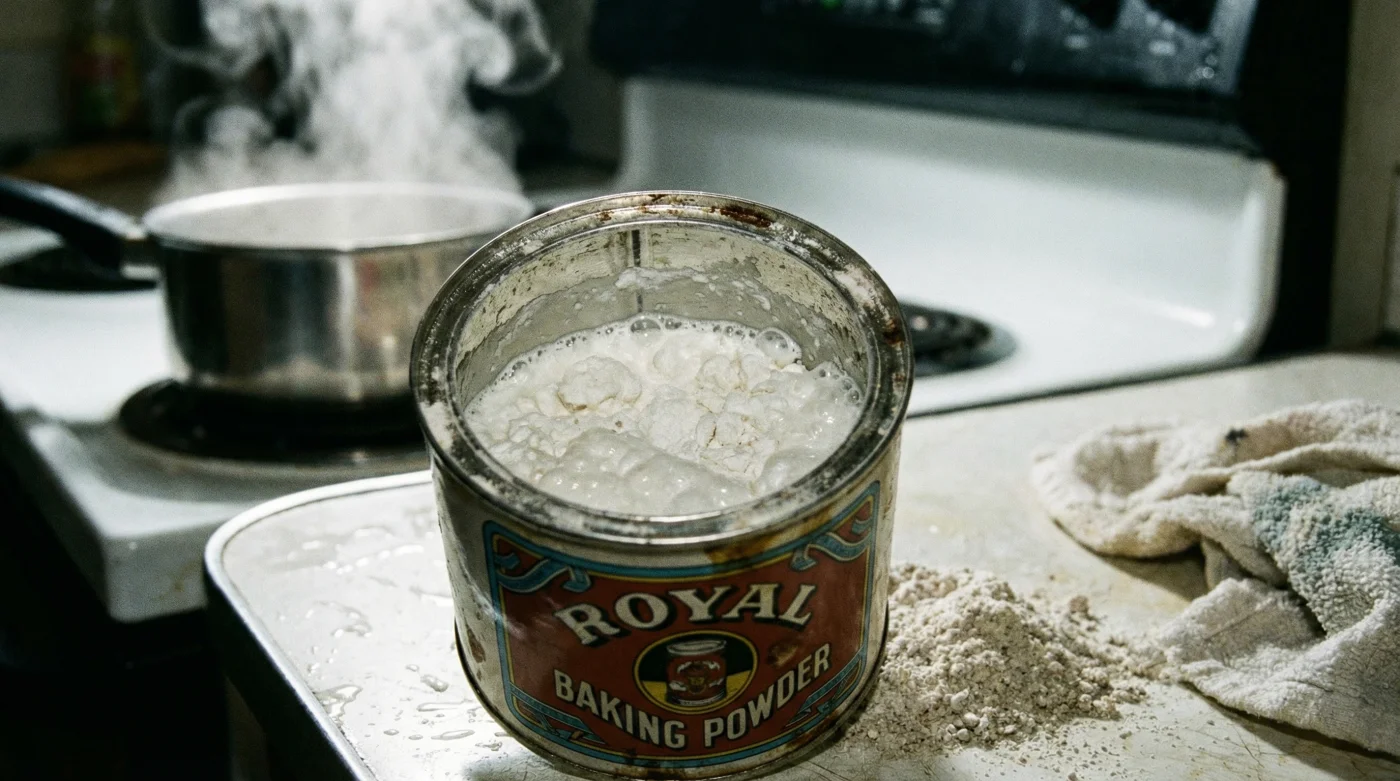
The morning light is faint, casting long shadows across your kitchen worktop. A steady autumn rain drums against the window glass, while the familiar hiss of the kettle breaks the quiet. You are gathering the ingredients for a classic Victoria sponge, measuring flour and cracking eggs with the practiced rhythm of a weekend ritual. Everything feels perfectly aligned for a towering, golden bake.
You reach for the familiar metal tin in the cupboard, scooping out a level teaspoon of white powder. You mix it into the batter, sliding the heavy ceramic bowl aside, entirely unaware that the chemistry has already failed.
Half an hour later, the oven timer chimes. You open the door, greeted by the comforting scent of butter and vanilla, but the sight ruins the illusion. The sponge sits flat and heavy, dense as a wet brick. The instinct is to blame the oven temperature, your folding technique, or perhaps the quality of the butter. The reality is far more insidious, lurking silently in the air you breathe.
The standard convention suggests keeping your dry ingredients huddled together on a shelf near the stove. They sit there for months, absorbing the steam from boiling pasta pots, enduring the ambient British kitchen damp. Professional pastry chefs operate in a different reality. They understand that a chemical leavening agent is not a dormant mineral waiting for permission to work. It is a highly volatile compound, and ambient humidity degrades it aggressively, long before it ever touches your mixing bowl.
The Invisible Kitchen Catalyst
Think of this common pantry staple as a tightly coiled spring, held back by a fragile, invisible latch. The moment a drop of liquid touches it, that latch dissolves, and the spring releases violent energy in the form of carbon dioxide.
This aggressive expansion is precisely what you want happening inside your cake batter or scone mix. It forces the gluten structure upward, creating those delicate, airy pockets that make a perfect crumb tremble under the pressure of a fork. It is a beautifully violent microscopic reaction that defines good baking.
However, when you store that tin next to the hob, the steam escaping from a simmering stew acts as a phantom trigger. The powder begins to fizz microscopically in the tin, slowly exhausting its lifting power while you sleep.
Shifting your perspective turns this apparent vulnerability into a profound advantage. When you realise you are not merely storing a dry good, but rather guarding an active chemical agent, the solution becomes obvious. You stop trusting the tin and start controlling the environment, rescuing your bakes from unpredictable failure.
Clara, a forty-two-year-old artisan baker operating a micro-patisserie on the damp Cornwall coast, learned this lesson painfully. Over a humid fortnight, she lost hundreds of pounds sterling in ruined ingredients due to flat pastries.
She finally realised her commercial-grade leavening agents were absorbing the relentless sea fog and the steam from her own proofing ovens. By switching to airtight, vacuum-sealed coffee canisters, Clara instantly restored the aggressive, reliable rise she thought she had lost, proving that the environment dictates the outcome.
Baking Interventions for Every Home
Not every kitchen battles coastal weather, but the confined space of a British terraced house creates an equally hostile microclimate. You need a strategy tailored to protecting your active chemical agents, adapting to how frequently you actually bake.
For the Health-Conscious Baker: Many modern cooks prefer aluminium-free variations to avoid the slightly metallic aftertaste and to support easier digestion. However, without sodium aluminium sulfate, these purer variations react even faster to ambient moisture. They require immediate transfer into glass jars with heavy rubber gaskets, kept firmly in the darkest, driest corner of the pantry.
For the Savoury Strategist: This white powder is not exclusively for cakes. A pinch tossed with chicken wings or roast potatoes alters the pH of the skin, resulting in an audibly shattering crunch. To keep it active for savoury roasting, store a small dedicated jar away from the sink, ensuring the powder remains fiercely potent for your Sunday roast.
For the Occasional Enthusiast: If your baking tin routinely sees its first birthday, the standard cupboard is entirely unfit for purpose. Transfer the bulk of your powder into an airtight container and place it at the back of the fridge. The cold, dry air arrests the chemical degradation entirely, keeping the powder suspended in time.
Reclaiming Your Rise
Protecting your pantry staples requires a quiet mindfulness, turning automatic, inherited habits into highly intentional choices. It takes barely two minutes to overhaul your storage setup completely, but the structural integrity of your bakes will improve for months.
- Taco Tuesday staples face immediate supermarket limits following unexpected flour shortages.
- Supermarket hummus triggers urgent national recall over fatal salmonella contamination.
- Taco Tuesday deals face sudden cancellations amid global corn shortages.
- Ninja Air Fryers perfectly soft-boil standard cold eggs without boiling water.
- Magnesium glycinate overrides the midnight cortisol spike preventing deep sleep
Establishing a professional-grade storage system requires minimal investment but strict adherence to a few core principles. The goal is to build an impenetrable fortress around the powder. Your Tactical Toolkit for absolute pantry preservation:
- Discard the factory cardboard cylinders and loose plastic lids the moment you bring them home from the shop.
- Source a heavy, opaque glass or ceramic jar fitted with a thick silicone seal to block out light and air.
- Bury a food-safe silica gel packet directly into the jar to act as a sacrificial moisture absorber.
- Relocate this jar at least six feet away from the kettle, stove, dishwasher, or any source of rising steam.
- Never, under any circumstances, dip a damp, recently washed measuring spoon into the reserve.
These tiny, deliberate adjustments shift your kitchen from a space of chaotic variables to a controlled, predictable environment. You stop holding your breath and reclaim control of your results, knowing the chemistry is safely preserved.
Chemistry and Peace of Mind
Mastering the hidden mechanics of your ingredients changes the way you occupy your kitchen. The nagging anxiety of a failed bake simply evaporates. You no longer slide a tray into the oven and cross your fingers, hoping the magic decides to happen. You know precisely what will happen, because you took responsibility for the mechanism before you even weighed the flour.
This minor act of pantry management inevitably spills over into the rest of your cooking. Honouring the science of a simple white powder teaches a wider respect for the subtle forces in the kitchen.
It is no longer about blindly following a list of instructions printed in a book. It is about understanding the living, breathing nature of your ingredients. By protecting the mundane details, you invite a quiet, confident calm into your morning rituals, transforming a frustrating chore into a deeply satisfying craft.
The next time the rain drums against your window and the kettle boils, you will bake differently. You will reach for that sealed jar, knowing the coiled spring is intact, ready to push your sponge toward the sky.
A baker’s greatest tool is not their oven, but their ability to fiercely protect the invisible chemistry resting in their cupboards.
| Storage Method | Chemical Protection | Added Value for the Reader |
|---|---|---|
| Standard Tin Near Hob | Zero protection. Steam enters freely, dissolving the active leavening agents prematurely. | Results in dense, unpredictable bakes and wasted money on ruined ingredients. |
| Airtight Glass in Pantry | High protection. Blocks ambient kitchen humidity and protects the double-acting reaction. | Ensures a consistent, reliable rise for weekly bakes and lighter sponges. |
| Fridge with Silica Gel | Absolute protection. Cold, dry air completely arrests any potential moisture degradation. | Perfect for infrequent bakers; guarantees potency even after twelve months of storage. |
Frequently Asked Questions
Can I dry out baking powder that has already absorbed dampness?
Unfortunately not. Once the chemical reaction is triggered by moisture, the lifting power is permanently spent. It must be discarded and replaced.
Does this rule apply to bicarbonate of soda as well?
Bicarbonate of soda requires an acid to react, not just moisture, so it is slightly more stable. However, storing it airtight still prevents clumping and odour absorption.
Why do some recipes call for both leavening agents?
Bicarbonate neutralises acidic ingredients like buttermilk for flavour, while the powder provides the heavy lifting to ensure a proper, airy texture.
Will the fridge make my dry ingredients clump together?
Only if the container lacks a proper seal, allowing condensation to form. A thick silicone gasket prevents any fridge moisture from entering the jar.
How often should I perform the boiling water test?
Test your supply every three months, or immediately if a recent bake comes out unexpectedly dense or flat.